# change servers for synchronization
#server 0.centos.pool.ntp.org iburst
#server 1.centos.pool.ntp.org iburst
#server 2.centos.pool.ntp.org iburst
#server 3.centos.pool.ntp.org iburst
server 0.asia.pool.ntp.org
server 1.asia.pool.ntp.org
server 2.asia.pool.ntp.org
server 3.asia.pool.ntp.org
# Allow NTP client access from local network.
allow 10.0.2.0/24
In this tutorial, How to install and configure NTP server in Centos. NTP- is a protocol that runs over port 123 UDP at the Transport Layer and allows computers to synchronize time over networks for an accurate time.
What is NTP?
NTP, or Network Time Protocol, is a networking protocol designed to synchronize the clocks of computers to a reference time source. It is used in various networked environments to ensure that all systems maintain accurate time, which is essential for tasks such as logging, security, and scheduled operations.
Why Use NTP on CentOS 7?
Using NTP on CentOS 7 helps you:
Maintain accurate system time across all servers.
Ensure the proper functioning of time-dependent applications.
Avoid issues caused by time discrepancies.
Prerequisites
Before you begin, make sure you have the following:
A CentOS 7 server with root or sudo access.
A stable internet connection to access NTP servers.
Install and configure NTP
[vagrant@DevopsRoles ~]$ sudo yum -y install ntp
Configure NTP server
[vagrant@DevopsRoles ~]$ sudo vi /etc/ntp.conf
The content file “ntp.conf” as below
# line 18: add the network range your network
restrict 10.0.2.0 mask 255.255.255.0 nomodify notrap
# change servers for synchronization
server 0.asia.pool.ntp.org
server 1.asia.pool.ntp.org
server 2.asia.pool.ntp.org
server 3.asia.pool.ntp.org
Installing and configuring NTP on CentOS 7 is essential for maintaining accurate system time, which is critical for various applications and services. By following this guide, you can ensure that your CentOS 7 server is properly synchronized with reliable time sources. Whether you are managing a single server or a complex network, NTP provides the accuracy and reliability needed for effective time management.
By carefully configuring NTP and addressing any potential issues, you can maintain a robust and accurate time synchronization setup, ensuring smooth and efficient operations across your network. I hope will this your helpful. Thank you for reading the DevopsRoles page!
Use the MTR command in Linux to view the traceroute report for a remote machine. As a network administrator, you need to learn the usage of mtr command to Diagnosing Network issues.
MTR command is a powerful tool to diagnose and isolate networking errors and provide reports of the network.
In this tutorial, How to install an RPM package into a different directory on Centos. Installing RPM packages is a common task for Linux users, especially those working with Red Hat-based distributions like Fedora, CentOS, or RHEL. Sometimes, you may need to install an RPM package into a different directory than the default.
What is an RPM Package?
RPM stands for Red Hat Package Manager. It is a package management system used by Red Hat-based distributions to manage software installation, updates, and removals. RPM packages are precompiled binaries that simplify software distribution and installation.
Why Install RPM Packages into a Different Directory?
There are several reasons why you might want to install an RPM package into a different directory:
Space Constraints: Your default installation directory might be running out of space.
Testing: You may want to test a package in a separate environment before moving it to production.
Custom Configurations: Some applications may require custom directory structures.
For example, Install package bind install into another directory /opt/bind.
Use rpm -qi command to check the package has been installed but not yet
$ sudo rpm -qi [name-package]
Not all RPM packages can be installed into another directory.
For example, the bind RPM package is not relocatable. You install it then the error: package bind is not relocatable
[vagrant@DevopsRoles ~]$ rpm -qpi bind-9.8.2-0.68.rc1.el6_10.1.x86_64.rpm | head -1
Name : bind Relocations: (not relocatable)
Install an RPM package into a different directory.
No, not all RPM packages support relocation. You need to check the package metadata using the rpm -qpi command to see if it supports relocation.
What if the RPM package does not support relocation?
If the RPM package does not support relocation, you can use the rpm2cpio and cpio method to manually extract and place the files in your desired directory.
How do I handle dependencies when relocating RPM packages?
Handling dependencies can be tricky when relocating RPM packages. You may need to manually resolve and relocate dependencies as well. Adjusting environment variables and creating symbolic links can help in managing dependencies.
Is it safe to relocate RPM packages?
Relocating RPM packages can be safe if done correctly. However, it can lead to unexpected behavior if not handled properly, especially with packages that have strict directory dependencies.
Can I use package managers like Yum or DNF to relocate packages?
Yum and DNF do not support package relocation directly. You need to use the RPM command with the --relocate option or manually extract the package using rpm2cpio and cpio.
Conclusion
Installing an RPM package into a different directory can be useful for various reasons, including space management, testing, and custom configurations. While not all RPM packages support relocation, the methods outlined in this guide provide a comprehensive approach to handling different scenarios. Whether using the RPM command with relocation options or extracting packages manually with rpm2cpio and cpio, these techniques will help you manage your RPM packages effectively. I hope will this your helpful. Thank you for reading the DevopsRoles page!
In this tutorial, How to generate a random password using the OpenSSL command in Linux. It generates a number of random bytes, which the output HEX or Base64.
In today’s digital landscape, securing sensitive information is more important than ever. Passwords play a critical role in maintaining data privacy, and generating strong, random passwords is a cornerstone of cybersecurity. OpenSSL, a powerful cryptographic toolkit, offers a reliable way to generate random passwords.
This guide delves into how to use the OpenSSL command line tool to generate secure passwords, along with practical examples and tips to enhance your security strategy.
What Is OpenSSL?
OpenSSL is an open-source implementation of the SSL and TLS protocols. It’s widely used for tasks such as encrypting data, generating certificates, and managing cryptographic keys. One lesser-known but highly valuable feature of OpenSSL is its ability to generate random passwords. By leveraging its robust pseudo-random number generator, OpenSSL creates secure passwords that are nearly impossible to predict.
Why Use OpenSSL to Generate Random Passwords?
Enhanced Security: OpenSSL’s random number generation ensures high entropy, reducing the risk of brute-force attacks.
Customizability: You can tailor the password length and character set to meet specific security requirements.
Convenience: With a single command, you can generate passwords for a variety of applications, from securing databases to encrypting files.
Cross-Platform Compatibility: OpenSSL works on Linux, macOS, and Windows, making it a versatile tool.
How to Use OpenSSL to Generate Random Passwords
Generating a Basic Password
The simplest way to generate a random password with OpenSSL is by using the rand command. Here’s an example:
openssl rand -base64 12
rand: Invokes the random number generator.
-base64: Specifies the encoding format.
12: Defines the number of bytes to generate.
Output Example:
3kHnP1T+/rJcWg==
This command generates a 12-byte random password encoded in Base64. Base64 encoding is ideal for generating passwords because it includes a mix of alphanumeric characters and special symbols.
The Base64 the output is a good password.
The syntax OpenSSL generate random password
# For Base64
openssl rand -base64 NUMBER
# For HEX
openssl rand -hex NUMBER
Using OpenSSL to generate random passwords is a quick and effective way to bolster your security measures. Whether you need simple Base64-encoded passwords or complex strings with special characters, OpenSSL provides the flexibility to meet your requirements. By mastering these commands and integrating them into your workflow, you can protect sensitive data and ensure a robust security posture. Start experimenting with OpenSSL today and take the first step toward enhanced password security.
Thought the article, How to use “OpenSSL generate random password” as above. I hope will this your helpful. Thank you for reading the DevopsRoles page!
In this tutorial, How to install KVM ( Kernel-based Virtual Machine ) and QEMU on Ubuntu 14.04 LTS server. This requires a CPU on your system to enable Intel VT or AMD-V.
KVM is an Open Source.
QEMU is a open source machine emulator and virtualizer.
# This file describes the network interfaces available on your system
# and how to activate them. For more information, see interfaces(5).
# The loopback network interface
auto lo
iface lo inet loopback
# The primary network interface
# change like follows
auto eth0
iface eth0 inet manual
#iface eth0 inet static
#address 192.168.3.50
#network 192.168.3.0
#netmask 255.255.255.0
#broadcast 192.168.3.255
#gateway 192.168.3.1
#dns-nameservers 192.168.3.30
# add bridge interface
iface br0 inet static
address 192.168.3.30
network 192.168.3.0
netmask 255.255.255.0
broadcast 192.168.3.255
gateway 192.168.3.1
dns-nameservers 192.168.3.30
bridge_ports eth0
bridge_stp off
auto br0
Conclusion
Through the article, you can use install KVM and QEMU on Ubuntu as above. I hope will this your helpful. Thank you for reading the DevopsRoles page!
In the world of DevOps, log management and data visualization are crucial tasks. The ELK Stack, consisting of Elasticsearch, Logstash, and Kibana, offers a powerful and comprehensive solution to achieve these tasks efficiently. In this tutorial, I guide install ELK stack on Linux. The ELK Stack is a collection of three open-source Elasticsearch, Kibana, and Logstash. Now, let’s install ELK stack on Linux.
For my example install ELK stack
Elasticsearch, Kibana and Logstash -> 192.168.3.4
Filebeat -> 192.168.3.5
Requirements to install elk you need JAVA. If you do not yet install java on your system. The guided install Java on server ELK as below
Installing Java
ELK requires the installation of Java 8 and higher.
$ sudo yum install java-1.8.0-openjdk
Set JAVA_HOME for Elasticsearch
# sudo cp /etc/profile /etc/profile_backup
# echo 'export JAVA_HOME=/usr/lib/jvm/jre-1.8.0-openjdk' | sudo tee -a /etc/profile
# source /etc/profile
Installing and configuring the ELK Stack can significantly enhance your system’s log management and analysis capabilities. With Elasticsearch’s powerful search capabilities, Logstash’s diverse log collection and processing features, and Kibana’s intuitive interface, the entire ELK Stack provides a robust tool for every DevOps professional. We hope that through this article, you have mastered the steps to install the ELK Stack and can effectively apply it to your projects. Don’t hesitate to explore other features of the ELK Stack to further optimize your work. Thank you for reading the DevopsRoles page!
Welcome to this tutorial where I’ll guide you through the basics to advanced uses of the netstat command in Linux, with practical examples to help you master this tool.
What is Netstat?
Netstat is a command-line utility used to display all active network connections, both incoming and outgoing, on Unix, Linux, and Windows NT-based systems. It’s invaluable for network administration and monitoring.
Details can be found on the netstat command manual page:
[root@DevopsRoles ~]# man netstat | more
Detailed Usage of the Netstat Command in Linux
Here’s how you can use the netstat command in Linux to explore various network statistics:
1. List all LISTENING Ports of TCP and UDP connections using netstat -a option
2. Viewing Open TCP Socket Connections
This displays all active TCP connections. Execute this command to see detailed socket information.
[root@DevopsRoles ~]# netstat -s
Ip:
9607 total packets received
0 forwarded
0 incoming packets discarded
9605 incoming packets delivered
4614 requests sent out
7 outgoing packets dropped
Icmp:
16 ICMP messages received
0 input ICMP message failed.
ICMP input histogram:
destination unreachable: 16
16 ICMP messages sent
0 ICMP messages failed
ICMP output histogram:
destination unreachable: 16
IcmpMsg:
InType3: 16
OutType3: 16
Tcp:
267 active connections openings
412 passive connection openings
2 failed connection attempts
3 connection resets received
3 connections established
20699 segments received
19546 segments send out
66 segments retransmited
0 bad segments received.
13 resets sent
Udp:
184 packets received
16 packets to unknown port received.
0 packet receive errors
200 packets sent
0 receive buffer errors
0 send buffer errors
UdpLite:
TcpExt:
255 TCP sockets finished time wait in fast timer
245 delayed acks sent
16 delayed acks further delayed because of locked socket
Quick ack mode was activated 66 times
6400 packet headers predicted
2503 acknowledgments not containing data payload received
8067 predicted acknowledgments
TCPLossProbes: 66
TCPLossProbeRecovery: 65
66 DSACKs sent for old packets
66 DSACKs received
TCPDSACKIgnoredNoUndo: 65
TCPRcvCoalesce: 3322
TCPOrigDataSent: 14558
TCPHystartTrainDetect: 7
TCPHystartTrainCwnd: 124
IpExt:
InNoRoutes: 2
InOctets: 1806054
OutOctets: 7957156
InNoECTPkts: 9899
6. Displaying Service name with PID
[root@DevopsRoles ~]# netstat -tp
Active Internet connections (w/o servers)
Proto Recv-Q Send-Q Local Address Foreign Address State PID/Program name
tcp 0 0 DevopsRoles:ssh gateway:52836 ESTABLISHED 2434/sshd: vagrant
tcp6 0 0 localhost:44918 localhost:d-s-n ESTABLISHED 654/telegraf
tcp6 0 0 localhost:d-s-n localhost:44918 ESTABLISHED 659/influxd
By following the netstat examples provided, you can effectively leverage the netstat command in Linux to gain insights into your system’s network connections. This guide aims to be a practical resource for both new and seasoned users. Thank you for choosing DevopsRoles for your learning needs!
In this tutorial, How to monitor your system using Grafana InfluxDB and Telegraf. This article will guide you through the process of setting up and using these tools, from basic configurations to advanced monitoring techniques.
What is Monitoring with Grafana InfluxDB and Telegraf?
Monitoring with Grafana, InfluxDB, and Telegraf involves collecting, storing, and visualizing time-series data. Telegraf is responsible for gathering data from various sources, InfluxDB stores this data, and Grafana visualizes it through customizable dashboards.
Benefits of Using Grafana, InfluxDB, and Telegraf
Real-time Monitoring: Visualize data in real-time to quickly identify and address issues.
Scalability: Easily scale your monitoring setup to handle increased data volumes.
Customization: Create personalized dashboards to suit your specific monitoring needs.
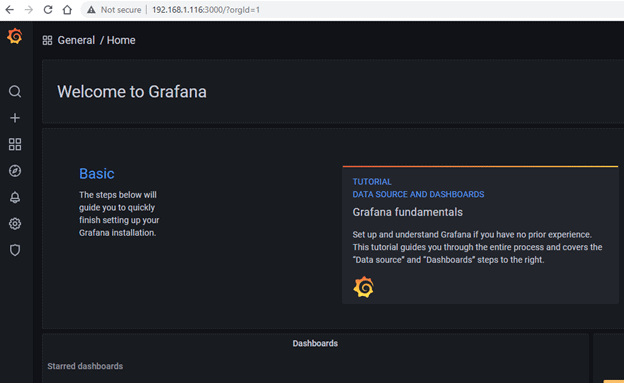
My example is Grafana InfluxDB, Telegraf as in the picture below:
For my example, create 2 Databases with a 14-day retention policy.
[root@DevopsRoles ~]# influx
Connected to http://localhost:8086 version 1.7.6
InfluxDB shell version: 1.7.6
Enter an InfluxQL query
> show databases
name: databases
name
----
telegraf
mydb
_internal
> CREATE DATABASE mydb WITH DURATION 14d
> CREATE DATABASE telegraf WITH DURATION 14d
Open and edit the file /etc/influxdb/influxdb.confas below
In this tutorial, we get started with InfluxDB. we can use commands with InfluxDB. In the latter-mentioned post, I created a “telegraf” database in InfluxDB.
Let’s know if InfluxDB getting started
Now jump into InfluxDB.
[root@devopsroles.localhost ~]# influx
Connected to http://localhost:8086 version 1.7.4
InfluxDB shell version: 1.7.4
Enter an InfluxQL query
>
View a list of all the databases using the “show databases” command.
> show databases
name: databases
name
----
_internal
netdata
monitoring
telegraf
opentsdb
>
“_internal” is an internal InfluxDB database. To use telegraf database the “use telegraf” command:
> use telegraf
Using database telegraf
Now we are inside of the telegraf database. using the “show measurements” command:
> show measurements
name: measurements
name
----
cpu
disk
diskio
kernel
mem
processes
swap
system
> show tag keys
name: cpu
tagKey
------
cpu
host
name: disk
tagKey
------
device
fstype
host
mode
path
name: diskio
tagKey
------
host
name
name: kernel
tagKey
------
host
name: mem
tagKey
------
host
name: processes
tagKey
------
host
name: swap
tagKey
------
host
name: system
tagKey
------
host
InfluxDB Queries
How fields and tags work together. For example as below
> select * from cpu where time > now() - 10s
name: cpu
time cpu host usage_guest usage_guest_nice usage_idle usage_iowait usage_irq usage_nice usage_softirq usage_steal usage_system usage_user
---- --- ---- ----------- ---------------- ---------- ------------ --------- ---------- ------------- ----------- ------------ ----------
1557722520000000000 cpu-total devopsroles.localhost 0 0 92.4924924924855 6.106106106081209 0 0 0 0 0.30030030030030713 1.10110110109885
1557722520000000000 cpu0 devopsroles.localhost 0 0 92.4924924924855 6.106106106081209 0 0 0 0 0.30030030030030713 1.10110110109885
> select * from cpu where cpu='cpu-total' and host='devopsroles.localhost' and time > now() - 10s
name: cpu
time cpu host usage_guest usage_guest_nice usage_idle usage_iowait usage_irq usage_nice usage_softirq usage_steal usage_system usage_user
---- --- ---- ----------- ---------------- ---------- ------------ --------- ---------- ------------- ----------- ------------ ----------
1557727830000000000 cpu-total devopsroles.localhost 0 0 96.7967967967239 2.402402402420665 0 0 0 0 0.20020020020020476 0.6006006006006143
> select usage_user,cpu,host from cpu where cpu='cpu-total' and host='devopsroles.localhost' and time > now() - 20s
name: cpu
time usage_user cpu host
---- ---------- --- ----
1557727930000000000 1.6016016016016381 cpu-total devopsroles.localhost
Link Documentation about Influxdb getting started
Series is a “collection of data in InfluxDB’s data structure that share a measurement, tag set, and retention policy.” Thank you for reading the DevopsRoles page!