Category Archives: Terraform

Learn Terraform with DevOpsRoles.com. Access detailed guides and tutorials to master infrastructure as code and automate your DevOps workflows using Terraform.

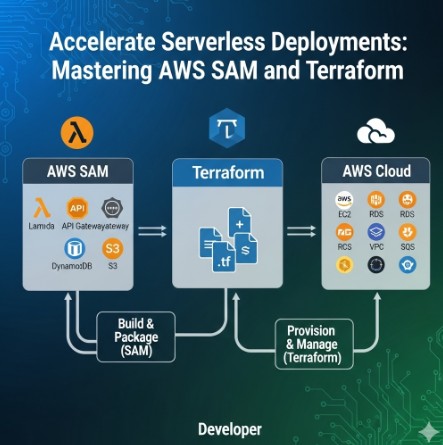
Accelerate Serverless Deployments: Mastering AWS SAM and Terraform

Developing and deploying serverless applications can be complex. Managing infrastructure, dependencies, and deployments across multiple services requires careful orchestration. This article will guide you through leveraging the power of AWS SAM and Terraform to streamline your serverless workflows, significantly reducing deployment time and improving overall efficiency. We’ll explore how these two powerful tools complement each other, enabling you to build robust, scalable, and easily manageable serverless applications.

Understanding AWS SAM

AWS Serverless Application Model (SAM) is a specification for defining serverless applications using a concise, YAML-based format. SAM simplifies the process of defining functions, APIs, databases, and other resources required by your application. It leverages AWS CloudFormation under the hood but provides a more developer-friendly experience, reducing boilerplate code and simplifying the definition of common serverless patterns.

Key Benefits of Using AWS SAM

  • Simplified Syntax: SAM uses a more concise and readable YAML format compared to CloudFormation’s JSON.
  • Built-in Macros: SAM offers built-in macros that automate common serverless tasks, such as creating API Gateway endpoints and configuring function triggers.
  • Improved Developer Experience: The streamlined syntax and features enhance developer productivity and reduce the learning curve.
  • Easy Local Testing: SAM CLI provides tools for local testing and debugging of your serverless functions before deployment.

Example SAM Template

Here’s a basic example of a SAM template defining a simple Lambda function:

AWSTemplateFormatVersion: '2010-09-09'

Transform: AWS::Serverless-2016-10-31

Description: A simple Lambda function defined with SAM.

Resources:

  MyFunction:

    Type: AWS::Serverless::Function

    Properties:

      Handler: index.handler

      Runtime: nodejs16.x

      CodeUri: s3://my-bucket/my-function.zip

      MemorySize: 128

      Timeout: 30

Introducing Terraform for Infrastructure as Code

Terraform is a powerful Infrastructure as Code (IaC) tool that allows you to define and manage your infrastructure in a declarative manner. With Terraform, you describe the desired state of your infrastructure using a configuration file (typically written in HCL), and Terraform manages the process of creating, updating, and destroying the resources.

Terraform’s Role in Serverless Deployments

While SAM excels at defining serverless application components, Terraform shines at managing the underlying infrastructure. This includes creating IAM roles, setting up networks, configuring databases, and provisioning other resources necessary for your serverless application to function correctly. Combining AWS SAM and Terraform allows for a comprehensive approach to serverless deployment.

Example Terraform Configuration

This example shows how to create an S3 bucket using Terraform, which could be used to store the code for your SAM application:


resource "aws_s3_bucket" "my_bucket" {
bucket = "my-unique-bucket-name"
acl = "private"
}

Integrating AWS SAM and Terraform for Optimized Deployments

The true power of AWS SAM and Terraform lies in their combined use. Terraform can manage the infrastructure required by your SAM application, including IAM roles, S3 buckets for code deployment, API Gateway settings, and other resources. This approach provides a more robust and scalable solution.

Workflow for Combined Deployment

  1. Define Infrastructure with Terraform: Use Terraform to define and provision all necessary infrastructure resources, such as the S3 bucket to store your SAM application code, IAM roles with appropriate permissions, and any necessary network configurations.
  2. Create SAM Application: Develop your serverless application using SAM and package it appropriately (e.g., creating a zip file).
  3. Deploy SAM Application with CloudFormation: Use the SAM CLI to package and deploy your application to AWS using CloudFormation, leveraging the infrastructure created by Terraform.
  4. Version Control: Utilize Git or a similar version control system to manage both your Terraform and SAM configurations, ensuring traceability and facilitating rollback.

Advanced Techniques

For more complex deployments, consider using Terraform modules to encapsulate reusable infrastructure components. This improves organization and maintainability. You can also leverage Terraform’s state management capabilities for better tracking of your infrastructure deployments. Explore using output values from your Terraform configuration within your SAM template to dynamically configure aspects of your application.

Best Practices for AWS SAM and Terraform

  • Modular Design: Break down your Terraform and SAM configurations into smaller, manageable modules.
  • Version Control: Use Git to manage your infrastructure code.
  • Testing: Thoroughly test your Terraform configurations and SAM applications before deploying them to production.
  • Security: Implement appropriate security measures, such as IAM roles with least privilege, to protect your infrastructure and applications.
  • Continuous Integration and Continuous Deployment (CI/CD): Integrate AWS SAM and Terraform into a CI/CD pipeline to automate your deployments.

AWS SAM and Terraform: Addressing Common Challenges

While AWS SAM and Terraform offer significant advantages, some challenges may arise. Understanding these challenges beforehand allows for proactive mitigation.

State Management

Properly managing Terraform state is crucial. Ensure you understand how to handle state files securely and efficiently, particularly in collaborative environments.

IAM Permissions

Carefully configure IAM roles and policies to grant the necessary permissions for both Terraform and your SAM applications without compromising security.

Dependency Management

In complex projects, manage dependencies between Terraform modules and your SAM application meticulously to avoid conflicts and deployment issues.

Frequently Asked Questions

Q1: Can I use AWS SAM without Terraform?

Yes, you can deploy serverless applications using AWS SAM alone. SAM directly interacts with AWS CloudFormation. However, using Terraform alongside SAM provides better control and management of the underlying infrastructure.

Q2: What are the benefits of using both AWS SAM and Terraform?

Using both tools provides a comprehensive solution. Terraform manages the infrastructure, while SAM focuses on the application logic, resulting in a cleaner separation of concerns and improved maintainability. This combination also simplifies complex deployments.

Q3: How do I handle errors during deployment with AWS SAM and Terraform?

Both Terraform and SAM provide logging and error reporting mechanisms. Carefully review these logs to identify and address any issues during deployment. Terraform’s state management can help in troubleshooting and rollback.

Q4: Is there a learning curve associated with using AWS SAM and Terraform together?

Yes, there is a learning curve, as both tools require understanding of their respective concepts and syntax. However, the benefits outweigh the initial learning investment, particularly for complex serverless deployments.

Conclusion

Mastering AWS SAM and Terraform is essential for anyone serious about building and deploying scalable serverless applications. By leveraging the strengths of both tools, developers can significantly streamline their workflows, enhance infrastructure management, and accelerate deployments. Remember to prioritize modular design, version control, and thorough testing to maximize the benefits of this powerful combination. Effective use of AWS SAM and Terraform will significantly improve your overall serverless development process.

For more in-depth information, refer to the official documentation for AWS SAM and Terraform.

Additionally, exploring community resources and tutorials can enhance your understanding and proficiency. Hashicorp’s Terraform tutorial can be a valuable resource. Thank you for reading the DevopsRoles page!

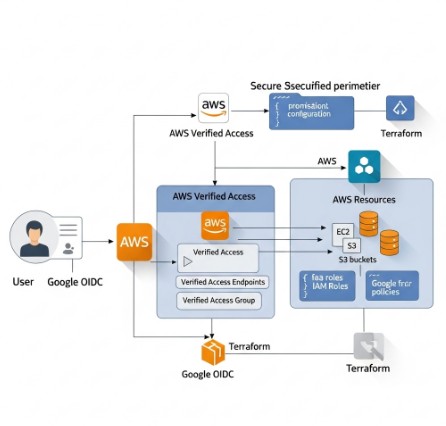
Secure Your AWS Resources with Terraform AWS Verified Access and Google OIDC

Establishing secure access to your AWS resources is paramount. Traditional methods often lack the granularity and automation needed for modern cloud environments. This article delves into leveraging Terraform AWS Verified Access with Google OIDC (OpenID Connect) to create a robust, automated, and highly secure access control solution. We’ll guide you through the process, from initial setup to advanced configurations, ensuring you understand how to implement Terraform AWS Verified Access effectively.

Understanding AWS Verified Access and OIDC

AWS Verified Access is a fully managed service that enables secure, zero-trust access to your AWS resources. It verifies the identity and posture of users and devices before granting access, minimizing the attack surface. Integrating it with Google OIDC enhances security by leveraging Google’s robust identity and access management (IAM) system. This approach eliminates the need to manage and rotate numerous AWS IAM credentials, simplifying administration and improving security.

Key Benefits of Using AWS Verified Access with Google OIDC

  • Enhanced Security: Leverages Google’s secure authentication mechanisms.
  • Simplified Management: Centralized identity management through Google Workspace or Cloud Identity.
  • Automation: Terraform enables Infrastructure as Code (IaC), automating the entire deployment process.
  • Zero Trust Model: Access is granted based on identity and posture, not network location.
  • Improved Auditability: Detailed logs provide comprehensive audit trails.

Setting up Google OIDC

Before configuring Terraform AWS Verified Access, you need to set up your Google OIDC provider. This involves creating a service account in your Google Cloud project and generating its credentials.

Creating a Google Service Account

  1. Navigate to the Google Cloud Console and select your project.
  2. Go to IAM & Admin > Service accounts.
  3. Click “CREATE SERVICE ACCOUNT”.
  4. Provide a name (e.g., “aws-verified-access”).
  5. Assign the “Cloud Identity and Access Management (IAM) Admin” role. Adjust roles based on your specific needs.
  6. Click “Create”.
  7. Download the JSON key file. Keep this file secure; it contains sensitive information.

Configuring the Google OIDC Provider

You’ll need the Client ID from your Google service account JSON key file. This will be used in your Terraform configuration.

Implementing Terraform AWS Verified Access

Now, let’s build the Terraform AWS Verified Access infrastructure using the Google OIDC provider. This example assumes you have already configured your AWS credentials for Terraform.

Terraform Code for AWS Verified Access


resource "aws_verified_access_trust_provider" "google_oidc" {
  name                = "google-oidc-provider"
  provider_type       = "oidc"
  server_url          = "https://accounts.google.com/.well-known/openid-configuration"
  client_id           = "YOUR_GOOGLE_CLIENT_ID" # Replace with your Client ID
  issuer_url          = "https://accounts.google.com"
}

resource "aws_verified_access_instance" "example" {
  name                 = "example-instance"
  trust_providers_ids = [aws_verified_access_trust_provider.google_oidc.id]
  device_policy {
    allowed_device_types = ["MOBILE", "DESKTOP"]
  }
}

Remember to replace YOUR_GOOGLE_CLIENT_ID with your actual Google Client ID. This configuration creates an OIDC trust provider and an AWS Verified Access instance that uses the provider.

Advanced Configurations

This basic configuration can be expanded to include:

  • Resource Policies: Define fine-grained access control to specific AWS resources.
  • Custom Device Policies: Implement stricter device requirements for access.
  • Conditional Access: Combine Verified Access with other security measures like MFA.
  • Integration with other IAM systems: Extend your identity and access management to other providers.

Terraform AWS Verified Access: Best Practices

Implementing secure Terraform AWS Verified Access requires careful planning and execution. Following best practices ensures robust security and maintainability.

Security Best Practices

  • Use the principle of least privilege: Grant only the necessary permissions.
  • Regularly review and update your access policies.
  • Monitor access logs and audit trails for suspicious activity.
  • Store sensitive credentials securely, using secrets management tools.

IaC Best Practices

  • Version control your Terraform code.
  • Use a modular approach to manage your infrastructure.
  • Employ automated testing to verify your configurations.
  • Follow a structured deployment process.

Frequently Asked Questions

Q1: Can I use AWS Verified Access with other identity providers besides Google OIDC?

Yes, AWS Verified Access supports various identity providers, including SAML and other OIDC providers. You will need to adjust the Terraform configuration accordingly, using the relevant provider details.

Q2: How do I manage access to specific AWS resources using AWS Verified Access?

You manage resource access by defining resource policies associated with your Verified Access instance. These policies specify which resources are accessible and under what conditions. These policies are often expressed using IAM policies within the Terraform configuration.

Q3: What happens if a user’s device doesn’t meet the specified device policy requirements?

If a user’s device does not meet the specified requirements (e.g., OS version, security patches), access will be denied. The user will receive an appropriate error message indicating the reason for the denial.

Q4: How can I monitor the activity and logs of AWS Verified Access?

AWS CloudTrail logs all Verified Access activity. You can access these logs through the AWS Management Console or programmatically using the AWS SDKs. This provides a detailed audit trail for compliance and security monitoring.

Conclusion

Implementing Terraform AWS Verified Access with Google OIDC provides a powerful and secure way to manage access to your AWS resources. By leveraging the strengths of both services, you create a robust, automated, and highly secure infrastructure. Remember to carefully plan your implementation, follow best practices, and continuously monitor your environment to maintain optimal security. Effective use of Terraform AWS Verified Access significantly enhances your organization’s cloud security posture.

For further information, consult the official AWS Verified Access documentation: https://aws.amazon.com/verified-access/ and the Google Cloud documentation on OIDC: https://cloud.google.com/docs/authentication/production. Also consider exploring HashiCorp’s Terraform documentation for detailed examples and best practices: https://www.terraform.io/. Thank you for reading the DevopsRoles page!

Deploying Terraform on AWS with Control Tower

This comprehensive guide will walk you through the process of deploying Terraform on AWS, leveraging the capabilities of AWS Control Tower to establish a secure and well-governed infrastructure-as-code (IaC) environment. We’ll cover setting up your environment, configuring Control Tower, writing and deploying Terraform code, and managing your infrastructure effectively. Understanding how to effectively utilize Terraform on AWS is crucial for any organization aiming for efficient and repeatable cloud deployments.

Setting Up Your AWS Environment and Control Tower

Before you can begin deploying Terraform on AWS, you need a properly configured AWS environment and AWS Control Tower. Control Tower provides a centralized governance mechanism, ensuring consistency and compliance across your AWS accounts.

1. Creating an AWS Account

If you don’t already have an AWS account, you’ll need to create one. Ensure you choose a suitable support plan based on your needs. The free tier offers a good starting point for experimentation.

2. Enabling AWS Control Tower

Next, enable AWS Control Tower. This involves deploying a landing zone, which sets up the foundational governance and security controls for your organization. Follow the AWS Control Tower documentation for detailed instructions. This includes defining organizational units (OUs) to manage access and policies.

  • Step 1: Navigate to the AWS Control Tower console.
  • Step 2: Follow the guided setup to create your landing zone.
  • Step 3: Choose the appropriate AWS Regions for your deployment.

3. Configuring IAM Roles

Properly configuring IAM roles is critical for secure access to AWS resources. Terraform on AWS requires specific IAM permissions to interact with AWS services. Create an IAM role with permissions necessary for deploying your infrastructure. This should adhere to the principle of least privilege.

Deploying Terraform on AWS: A Practical Example

This section demonstrates deploying a simple EC2 instance using Terraform on AWS. This example assumes you have Terraform installed and configured with appropriate AWS credentials.

1. Writing the Terraform Configuration File (main.tf)


terraform {
  required_providers {
    aws = {
      source  = "hashicorp/aws"
      version = "~> 4.0"
    }
  }
}

provider "aws" {
  region = "us-west-2" # Replace with your desired region
}

resource "aws_instance" "example" {
  ami           = "ami-0c55b31ad2299a701" # Replace with a suitable AMI ID for your region
  instance_type = "t2.micro"
}

2. Initializing and Deploying Terraform

After creating your main.tf file, navigate to the directory in your terminal and execute the following commands:

  1. terraform init: This downloads the necessary AWS provider plugins.
  2. terraform plan: This shows you a preview of the changes Terraform will make.
  3. terraform apply: This applies the changes and deploys the EC2 instance.

3. Destroying the Infrastructure

When you’re finished, use terraform destroy to remove the deployed resources. Always review the plan before applying any destructive changes.

Advanced Terraform Techniques with AWS Control Tower

Leveraging Control Tower alongside Terraform on AWS allows for more sophisticated deployments and enhanced governance. This section explores some advanced techniques.

1. Using Modules for Reusability

Terraform modules promote code reuse and maintainability. Create modules for common infrastructure components, such as VPCs, subnets, and security groups. This improves consistency and reduces errors.

2. Implementing Security Best Practices

Utilize Control Tower’s security controls alongside Terraform on AWS. This includes managing IAM roles effectively, adhering to least privilege principles, and implementing security groups and network ACLs to control access to your resources. Always use version control for your Terraform code.

3. Integrating with Other AWS Services

Terraform on AWS integrates seamlessly with many AWS services. Consider incorporating services like:

  • AWS S3: For storing configuration files and state.
  • AWS CloudFormation: For orchestrating complex deployments.
  • AWS CloudWatch: For monitoring infrastructure health and performance.

4. Using Workspaces for Different Environments

Employ Terraform workspaces to manage different environments (e.g., development, staging, production) using the same codebase. This helps maintain separation and reduces risk.

Implementing CI/CD with Terraform and AWS Control Tower

Integrating Terraform on AWS within a CI/CD pipeline enhances automation and allows for streamlined deployments. Utilize tools like GitHub Actions or Jenkins to trigger Terraform deployments based on code changes.

Frequently Asked Questions

Q1: What are the benefits of using Terraform with AWS Control Tower?

Using Terraform on AWS in conjunction with Control Tower significantly improves governance and security. Control Tower ensures your infrastructure adheres to defined policies, while Terraform provides repeatable and efficient deployments. This combination minimizes risks and allows for more streamlined operations.

Q2: How do I manage Terraform state securely?

Store your Terraform state securely using AWS services like S3, backed by KMS encryption. This protects your infrastructure configuration and prevents unauthorized modifications.

Q3: What are some common pitfalls to avoid when using Terraform on AWS?

Common pitfalls include insufficient IAM permissions, incorrect region settings, and neglecting to properly manage your Terraform state. Always thoroughly test your deployments in a non-production environment before applying to production.

Conclusion

This guide has detailed the process of deploying Terraform on AWS, emphasizing the benefits of integrating with AWS Control Tower for enhanced governance and security. By mastering these techniques, you can establish a robust, repeatable, and secure infrastructure-as-code workflow. Remember, consistent adherence to security best practices is paramount when deploying Terraform on AWS, especially when leveraging the centralized governance features of Control Tower. Proper planning and testing are key to successful and reliable deployments.

For more detailed information, refer to the official Terraform AWS Provider documentation and the AWS Control Tower documentation. Thank you for reading the DevopsRoles page!

Deploy AWS Lambda with Terraform: A Simple Guide

Deploying serverless functions on AWS Lambda offers significant advantages, including scalability, cost-effectiveness, and reduced operational overhead. However, managing Lambda functions manually can become cumbersome, especially in complex deployments. This is where Infrastructure as Code (IaC) tools like Terraform shine. This guide will provide a comprehensive walkthrough of deploying AWS Lambda with Terraform, covering everything from basic setup to advanced configurations, enabling you to automate and streamline your serverless deployments.

Understanding the Fundamentals: AWS Lambda and Terraform

Before diving into the deployment process, let’s briefly review the core concepts of AWS Lambda and Terraform. AWS Lambda is a compute service that lets you run code without provisioning or managing servers. You upload your code, configure triggers, and Lambda handles the execution environment, scaling, and monitoring. Terraform is an IaC tool that allows you to define and provision infrastructure resources across multiple cloud providers, including AWS, using a declarative configuration language (HCL).

AWS Lambda Components

  • Function Code: The actual code (e.g., Python, Node.js) that performs a specific task.
  • Execution Role: An IAM role that grants the Lambda function the necessary permissions to access other AWS services.
  • Triggers: Events that initiate the execution of the Lambda function (e.g., API Gateway, S3 events).
  • Environment Variables: Configuration parameters passed to the function at runtime.

Terraform Core Concepts

  • Providers: Plugins that interact with specific cloud providers (e.g., the AWS provider).
  • Resources: Definitions of the infrastructure components you want to create (e.g., AWS Lambda function, IAM role).
  • State: A file that tracks the current state of your infrastructure.

Deploying Your First AWS Lambda Function with Terraform

This section demonstrates a straightforward approach to deploying a simple “Hello World” Lambda function using Terraform. We will cover the necessary Terraform configuration, IAM role setup, and deployment steps.

Setting Up Your Environment

  1. Install Terraform: Download and install the appropriate Terraform binary for your operating system from the official website: https://www.terraform.io/downloads.html
  2. Configure AWS Credentials: Configure your AWS credentials using the AWS CLI or environment variables. Ensure you have the necessary permissions to create Lambda functions and IAM roles.
  3. Create a Terraform Project Directory: Create a new directory for your Terraform project.

Writing the Terraform Configuration

Create a file named main.tf in your project directory with the following code:

terraform {
  required_providers {
    aws = {
      source  = "hashicorp/aws"
      version = "~> 4.0"
    }
  }
}

provider "aws" {
  region = "us-east-1" // Replace with your desired region
}

resource "aws_iam_role" "lambda_role" {
  name = "lambda_execution_role"

  assume_role_policy = jsonencode({
    Version = "2012-10-17"
    Statement = [
      {
        Action = "sts:AssumeRole"
        Effect = "Allow"
        Principal = {
          Service = "lambda.amazonaws.com"
        }
      }
    ]
  })
}

resource "aws_iam_role_policy" "lambda_policy" {
  name = "lambda_policy"
  role = aws_iam_role.lambda_role.id
  policy = jsonencode({
    Version = "2012-10-17"
    Statement = [
      {
        Action = [
          "logs:CreateLogGroup",
          "logs:CreateLogStream",
          "logs:PutLogEvents"
        ]
        Effect = "Allow"
        Resource = "*"
      }
    ]
  })
}

resource "aws_lambda_function" "hello_world" {
  filename         = "hello.zip"
  function_name    = "hello_world"
  role             = aws_iam_role.lambda_role.arn
  handler          = "index.handler"
  runtime          = "python3.9"
  source_code_hash = filebase64sha256("hello.zip")
}

Creating the Lambda Function Code

Create a file named hello.py with the following code:

import json

def handler(event, context):
    return {
        'statusCode': 200,
        'body': json.dumps('Hello from AWS Lambda!')
    }

Zip the hello.py file into a file named hello.zip.

Deploying the Lambda Function

  1. Navigate to your project directory in the terminal.
  2. Run terraform init to initialize the Terraform project.
  3. Run terraform plan to preview the changes.
  4. Run terraform apply to deploy the Lambda function.

Deploying AWS Lambda with Terraform: Advanced Configurations

The previous example demonstrated a basic deployment. This section explores more advanced configurations for AWS Lambda with Terraform, enhancing functionality and resilience.

Implementing Environment Variables

You can manage environment variables within your Terraform configuration:

resource "aws_lambda_function" "hello_world" {
  # ... other configurations ...

  environment {
    variables = {
      MY_VARIABLE = "my_value"
    }
  }
}

Using Layers for Dependencies

Lambda Layers allow you to package dependencies separately from your function code, improving organization and reusability:

resource "aws_lambda_layer_version" "my_layer" {
  filename          = "mylayer.zip"
  layer_name        = "my_layer"
  compatible_runtimes = ["python3.9"]
  source_code_hash = filebase64sha256("mylayer.zip")
}

resource "aws_lambda_function" "hello_world" {
  # ... other configurations ...

  layers = [aws_lambda_layer_version.my_layer.arn]
}

Implementing Dead-Letter Queues (DLQs)

DLQs enhance error handling by capturing failed invocations for later analysis and processing:

resource "aws_sqs_queue" "dead_letter_queue" {
  name = "my-lambda-dlq"
}

resource "aws_lambda_function" "hello_world" {
  # ... other configurations ...

  dead_letter_config {
    target_arn = aws_sqs_queue.dead_letter_queue.arn
  }
}

Implementing Versioning and Aliases

Versioning enables rollback to previous versions and aliases simplify referencing specific versions of your Lambda function.

resource "aws_lambda_function" "hello_world" {
  #...other configurations
}

resource "aws_lambda_alias" "prod" {
  function_name    = aws_lambda_function.hello_world.function_name
  name             = "prod"
  function_version = aws_lambda_function.hello_world.version
}

Frequently Asked Questions

Q1: How do I handle sensitive information in my Lambda function?

Avoid hardcoding sensitive information directly into your code. Use AWS Secrets Manager or environment variables managed through Terraform to securely store and access sensitive data.

Q2: What are the best practices for designing efficient Lambda functions?

Design functions to be short-lived and focused on a single task. Minimize external dependencies and optimize code for efficient execution. Leverage Lambda layers to manage common dependencies.

Q3: How can I monitor the performance of my Lambda functions deployed with Terraform?

Use CloudWatch metrics and logs to monitor function invocations, errors, and execution times. Terraform can also be used to create CloudWatch dashboards for centralized monitoring.

Q4: How do I update an existing Lambda function deployed with Terraform?

Modify your Terraform configuration, run terraform plan to review the changes, and then run terraform apply to update the infrastructure. Terraform will efficiently update only the necessary resources.

Conclusion

Deploying AWS Lambda with Terraform provides a robust and efficient way to manage your serverless infrastructure. This guide covered the foundational aspects of deploying simple functions to implementing advanced configurations. By leveraging Terraform’s IaC capabilities, you can automate your deployments, improve consistency, and reduce the risk of manual errors. Remember to always follow best practices for security and monitoring to ensure the reliability and scalability of your serverless applications. Mastering AWS Lambda with Terraform is a crucial skill for any modern DevOps engineer or cloud architect.Thank you for reading the DevopsRoles page!
Automating VMware NSX Firewall Rules with Terraform

Managing network security in a virtualized environment can be a complex and time-consuming task. Manually configuring firewall rules on VMware NSX, especially in large-scale deployments, is inefficient and prone to errors. This article demonstrates how to leverage terraform vmware nsx to automate the creation and management of NSX firewall rules, improving efficiency, reducing errors, and enhancing overall security posture. We’ll explore the process from basic rule creation to advanced techniques, providing practical examples and best practices.

Understanding the Power of Terraform and VMware NSX

VMware NSX is a leading network virtualization platform that provides advanced security features, including distributed firewalls. Managing these firewalls manually can become overwhelming, particularly in dynamic environments with frequent changes to virtual machines and applications. Terraform, a leading Infrastructure-as-Code (IaC) tool, provides a powerful solution for automating this process. Using terraform vmware nsx allows you to define your infrastructure, including firewall rules, as code, enabling version control, repeatability, and automated deployments.

Benefits of Automating NSX Firewall Rules with Terraform

  • Increased Efficiency: Automate the creation, modification, and deletion of firewall rules, eliminating manual effort.
  • Reduced Errors: Minimize human error through automated deployments, ensuring consistent and accurate configurations.
  • Improved Consistency: Maintain consistent firewall rules across multiple environments.
  • Version Control: Track changes to firewall rules over time using Git or other version control systems.
  • Enhanced Security: Implement security best practices more easily and consistently through automation.

Setting up Your Terraform Environment for VMware NSX

Before you begin, ensure you have the following prerequisites:

  • A working VMware vCenter Server instance.
  • A deployed VMware NSX-T Data Center instance.
  • Terraform installed on your system. Download instructions can be found on the official Terraform website.
  • The VMware NSX-T Terraform provider installed and configured. This typically involves configuring the `provider` block in your Terraform configuration file with your vCenter credentials and NSX manager details.

Configuring the VMware NSX Provider

A typical configuration for the VMware NSX-T provider in your `main.tf` file would look like this:

terraform {
  required_providers {
    vmware = {
      source  = "vmware/vsphere"
      version = "~> 2.0"
    }
    nsxt = {
      source  = "vmware/nsxt"
      version = "~> 1.0"
    }
  }
}

provider "vmware" {
  user                 = "your_vcenter_username"
  password             = "your_vcenter_password"
  vcenter_server       = "your_vcenter_ip_address"
  allow_unverified_ssl = false #Consider this security implication carefully!
}

provider "nsxt" {
  vcenter_server     = "your_vcenter_ip_address"
  nsx_manager_ip     = "your_nsx_manager_ip_address"
  user               = "your_nsx_username"
  password           = "your_nsx_password"
}

Creating and Managing Firewall Rules with Terraform VMware NSX

Now, let’s create a simple firewall rule. We’ll define a rule that allows SSH traffic (port 22) from a specific IP address to a given virtual machine.

Defining the Firewall Rule Resource

The following Terraform code defines a basic firewall rule. Replace placeholders with your actual values.

resource "nsxt_firewall_section" "example" {
  display_name = "Example Firewall Section"
  description  = "This section contains basic firewall rules"
}

resource "nsxt_firewall_rule" "allow_ssh" {
  display_name = "Allow SSH"
  description  = "Allow SSH from specific IP"
  section_id   = nsxt_firewall_section.example.id
  action       = "ALLOW"

  source {
    groups       = ["group_id"] #replace with your pre-existing source group
    ip_addresses = ["192.168.1.100"]
  }

  destination {
    groups           = ["group_id"] #replace with your pre-existing destination group
    virtual_machines = ["vm_id"]    #replace with your virtual machine ID
  }

  services {
    ports     = ["22"]
    protocols = ["TCP"]
  }
}

Applying the Terraform Configuration

After defining your firewall rule, apply the configuration using the command terraform apply. Terraform will create the rule in your VMware NSX environment. Always review the plan before applying any changes.

Advanced Techniques with Terraform VMware NSX

Beyond basic rule creation, Terraform offers advanced capabilities:

Managing Multiple Firewall Rules

You can define multiple firewall rules within the same Terraform configuration, allowing for comprehensive management of your NSX firewall policies.

Dynamically Generating Firewall Rules

For large-scale deployments, you can dynamically generate firewall rules using data sources and loops, allowing you to manage hundreds or even thousands of rules efficiently.

Integrating with Other Terraform Resources

Integrate your firewall rule management with other Terraform resources, such as virtual machines, networks, and security groups, for a fully automated infrastructure.

Frequently Asked Questions

What if I need to update an existing firewall rule?

Update the Terraform configuration file to reflect the desired changes. Running terraform apply will update the existing rule in your NSX environment.

How do I delete a firewall rule?

Remove the corresponding resource "nsxt_firewall_rule" block from your Terraform configuration file and run terraform apply. Terraform will delete the rule from NSX.

Can I use Terraform to manage NSX Edge Firewall rules?

While the approach will vary slightly, yes, Terraform can also manage NSX Edge Firewall rules. You would need to adapt the resource blocks to use the appropriate NSX-T Edge resources and API calls.

How do I handle dependencies between firewall rules?

Terraform’s dependency management ensures that rules are applied in the correct order. Define your rules in a way that ensures proper sequencing, and Terraform will manage the dependencies automatically.

How do I troubleshoot issues when applying my Terraform configuration?

Thoroughly review the terraform plan output before applying. Check the VMware NSX logs for any errors. The Terraform error messages usually provide helpful hints for diagnosing the problems. Refer to the official VMware NSX and Terraform documentation for further assistance.

Conclusion

Automating the management of VMware NSX firewall rules with terraform vmware nsx offers significant advantages in terms of efficiency, consistency, and error reduction. By defining your firewall rules as code, you can achieve a more streamlined and robust network security infrastructure. Remember to always prioritize security best practices and regularly test your Terraform configurations before deploying them to production environments. Mastering terraform vmware nsx is a key skill for any DevOps engineer or network administrator working with VMware NSX. Thank you for reading the DevopsRoles page!

Setting Up a PyPI Mirror in AWS with Terraform

Efficiently managing Python package dependencies is crucial for any organization relying on Python for software development. Slow or unreliable access to the Python Package Index (PyPI) can significantly hinder development speed and productivity. This article demonstrates how to establish a highly available and performant PyPI mirror within AWS using Terraform, enabling faster package resolution and improved resilience for your development workflows. We will cover the entire process, from infrastructure provisioning to configuration and maintenance, ensuring you have a robust solution for your Python dependency management.

Planning Your PyPI Mirror Infrastructure

Before diving into the Terraform code, carefully consider these aspects of your PyPI mirror deployment:

  • Region Selection: Choose an AWS region strategically positioned to minimize latency for your developers. Consider regions with robust network connectivity.
  • Instance Size: Select an EC2 instance size appropriate for your anticipated package download volume. Start with a smaller instance type and scale up as needed.
  • Storage: Determine the storage requirements based on the size of the packages you intend to mirror. Amazon EBS volumes are suitable; consider using a RAID configuration for improved redundancy and performance. For very large repositories, consider Amazon S3.
  • High Availability: Implement a strategy for high availability. This usually involves at least two EC2 instances, load balancing, and potentially an auto-scaling group.

Setting up the AWS Infrastructure with Terraform

Terraform allows for infrastructure as code (IaC), enabling reproducible and manageable deployments. The following code snippets illustrate a basic setup. Remember to replace placeholders like and with your actual values.

Creating the EC2 Instance


resource "aws_instance" "pypi_mirror" {
  ami                    = ""
  instance_type          = "t3.medium"
  key_name               = ""
  vpc_security_group_ids = [aws_security_group.pypi_mirror.id]

  tags = {
    Name = "pypi-mirror"
  }
}

Defining the Security Group


resource "aws_security_group" "pypi_mirror" {
  name        = "pypi-mirror-sg"
  description = "Security group for PyPI mirror"

  ingress {
    from_port   = 80
    to_port     = 80
    protocol    = "tcp"
    cidr_blocks = ["0.0.0.0/0"] # Adjust this to your specific needs
  }

  ingress {
    from_port   = 443
    to_port     = 443
    protocol    = "tcp"
    cidr_blocks = ["0.0.0.0/0"] # Adjust this to your specific needs
  }

  egress {
    from_port   = 0
    to_port     = 0
    protocol    = "-1"
    cidr_blocks = ["0.0.0.0/0"]
  }

  tags = {
    Name = "pypi-mirror-sg"
  }
}

Creating an EBS Volume


resource "aws_ebs_volume" "pypi_mirror_volume" {
  availability_zone = aws_instance.pypi_mirror.availability_zone
  size              = 100 # Size in GB
  type              = "gp3" # Choose appropriate volume type
  tags = {
    Name = "pypi-mirror-volume"
  }
}

Attaching the Volume to the Instance


resource "aws_ebs_volume_attachment" "pypi_mirror_attachment" {
  volume_id = aws_ebs_volume.pypi_mirror_volume.id
  device_name = "/dev/xvdf" # Adjust as needed based on your AMI
  instance_id = aws_instance.pypi_mirror.id
}

Configuring the PyPI Mirror Software

Once the EC2 instance is running, you need to install and configure the PyPI mirror software. Bandersnatch is a popular choice. The exact steps will vary depending on your chosen software, but generally involve:

  1. Connect to the instance via SSH.
  2. Update the system packages. This ensures you have the latest versions of required utilities.
  3. Install Bandersnatch. This can typically be done via pip: pip install bandersnatch.
  4. Configure Bandersnatch. This involves creating a configuration file specifying the upstream PyPI URL, the local storage location, and other options. Refer to the Bandersnatch documentation for detailed instructions: https://bandersnatch.readthedocs.io/en/stable/
  5. Run Bandersnatch. Once configured, start the mirroring process. This may take a considerable amount of time, depending on the size of the PyPI index.
  6. Set up a web server (e.g., Nginx) to serve the mirrored packages.

Setting up a Load Balanced PyPI Mirror

For increased availability and resilience, consider using an Elastic Load Balancer (ELB) in front of multiple EC2 instances. This setup distributes traffic across multiple PyPI mirror instances, ensuring high availability even if one instance fails.

You’ll need to extend your Terraform configuration to include:

  • An AWS Application Load Balancer (ALB)
  • Target group(s) to register your EC2 instances
  • Listener(s) configured to handle HTTP and HTTPS traffic

This setup requires more complex Terraform configuration and careful consideration of security and network settings.

Maintaining Your PyPI Mirror

Regular maintenance is vital for a healthy PyPI mirror. This includes:

  • Regular updates: Keep Bandersnatch and other software updated to benefit from bug fixes and performance improvements.
  • Monitoring: Monitor the disk space usage, network traffic, and overall performance of your mirror. Set up alerts for critical issues.
  • Regular synchronization: Regularly sync your mirror with the upstream PyPI to ensure you have the latest packages.
  • Security: Regularly review and update the security group rules to prevent unauthorized access.

Frequently Asked Questions

Here are some frequently asked questions regarding setting up a PyPI mirror in AWS with Terraform:

Q1: What are the benefits of using a PyPI mirror?

A1: A PyPI mirror offers several advantages, including faster package downloads for developers within your organization, reduced load on the upstream PyPI server, and improved resilience against PyPI outages.

Q2: Can I use a different mirroring software instead of Bandersnatch?

A2: Yes, you can. Several other mirroring tools are available, each with its own strengths and weaknesses. Choosing the right tool depends on your specific requirements and preferences.

Q3: How do I scale my PyPI mirror to handle increased traffic?

A3: Scaling can be achieved by adding more EC2 instances to your load-balanced setup. Using an auto-scaling group allows for automated scaling based on predefined metrics.

Q4: How do I handle authentication if my organization uses private packages?

A4: Handling private packages requires additional configuration and might involve using authentication methods like API tokens or private registries which can be integrated with your PyPI mirror.

Conclusion

Setting up a PyPI mirror in AWS using Terraform provides a powerful and efficient solution for managing Python package dependencies. By following the steps outlined in this article, you can create a highly available and performant PyPI mirror, dramatically improving the speed and reliability of your Python development workflows. Remember to regularly monitor and maintain your mirror to ensure it remains efficient and secure. Choosing the right tools and strategies, including load balancing and auto-scaling, is key to building a robust and scalable solution for your organization’s needs. Thank you for reading the DevopsRoles page!
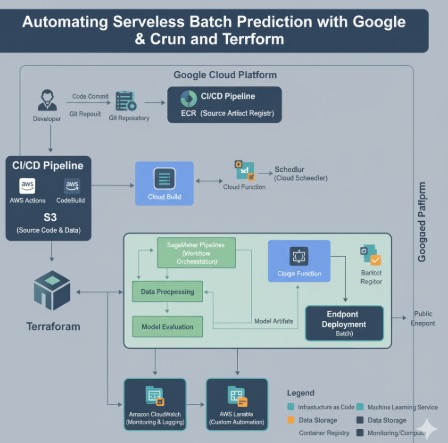
Optimizing Generative AI Deployment with Terraform

The rapid advancement of generative AI has created an unprecedented demand for efficient and reliable deployment strategies. Manually configuring infrastructure for these complex models is not only time-consuming and error-prone but also hinders scalability and maintainability. This article addresses these challenges by demonstrating how Terraform, a leading Infrastructure as Code (IaC) tool, significantly streamlines and optimizes Generative AI Deployment. We’ll explore practical examples and best practices to ensure robust and scalable deployments for your generative AI projects.

Understanding the Challenges of Generative AI Deployment

Deploying generative AI models presents unique hurdles compared to traditional applications. These challenges often include:

  • Resource-Intensive Requirements: Generative AI models, particularly large language models (LLMs), demand substantial computational resources, including powerful GPUs and significant memory.
  • Complex Dependencies: These models often rely on various software components, libraries, and frameworks, demanding intricate dependency management.
  • Scalability Needs: As user demand increases, the ability to quickly scale resources to meet this demand is crucial. Manual scaling is often insufficient.
  • Reproducibility and Consistency: Ensuring consistent environments across different deployments (development, testing, production) is essential for reproducible results.

Leveraging Terraform for Generative AI Deployment

Terraform excels in addressing these challenges by providing a declarative approach to infrastructure management. This means you describe your desired infrastructure state in configuration files, and Terraform automatically provisions and manages the necessary resources.

Defining Infrastructure Requirements with Terraform

For a basic example, consider deploying a generative AI model on Google Cloud Platform (GCP). A simplified Terraform configuration might look like this:

terraform {
  required_providers {
    google = {
      source = "hashicorp/google"
      version = "~> 4.0"
    }
  }
}

provider "google" {
  project = "your-gcp-project-id"
  region  = "us-central1"
}

resource "google_compute_instance" "default" {
  name         = "generative-ai-instance"
  machine_type = "n1-standard-8" # Adjust based on your model's needs
  zone         = "us-central1-a"

  boot_disk {
    initialize_params {
      image = "debian-cloud/debian-9" # Replace with a suitable image
    }
  }
}

This code creates a single virtual machine instance. However, a real-world deployment would likely involve more complex configurations, including:

  • Multiple VM instances: For distributed training or inference.
  • GPU-accelerated instances: To leverage the power of GPUs for faster processing.
  • Storage solutions: Persistent disks for storing model weights and data.
  • Networking configurations: Setting up virtual networks and firewalls.
  • Kubernetes clusters: For managing containerized applications.

Automating the Deployment Process

Once the Terraform configuration is defined, the deployment process is automated:

  1. Initialization: terraform init downloads necessary providers.
  2. Planning: terraform plan shows the changes Terraform will make.
  3. Applying: terraform apply creates and configures the infrastructure.

This automation significantly reduces manual effort and ensures consistent deployments. Terraform also allows for version control of your infrastructure, facilitating collaboration and rollback capabilities.

Optimizing Generative AI Deployment with Advanced Terraform Techniques

Beyond basic provisioning, Terraform enables advanced optimization strategies for Generative AI Deployment:

Modularization and Reusability

Break down your infrastructure into reusable modules. This enhances maintainability and reduces redundancy. For example, a module could be created to manage a specific type of GPU instance, making it easily reusable across different projects.

State Management

Properly managing Terraform state is crucial. Use a remote backend (e.g., AWS S3, Google Cloud Storage) to store the state, allowing multiple users to collaborate and manage infrastructure effectively. This ensures consistency and allows for collaborative management of the infrastructure.

Variable and Input Management

Use variables and input variables to parameterize your configurations, making them flexible and adaptable to different environments. This allows you to easily change parameters such as instance types, region, and other settings without modifying the core code. For instance, the machine type in the example above can be defined as a variable.

Lifecycle Management

Terraform’s lifecycle management features allow for advanced control over resources. For example, you can use the lifecycle block to define how resources should be handled during updates or destruction, ensuring that crucial data is not lost unintentionally.

Generative AI Deployment: Best Practices with Terraform

Implementing best practices ensures smooth and efficient Generative AI Deployment:

  • Adopt a modular approach:

  • This improves reusability and maintainability.
  • Utilize version control:

  • This ensures traceability and enables easy rollbacks.
  • Implement comprehensive testing:

  • Test your Terraform configurations thoroughly before deploying to production.
  • Employ automated testing and CI/CD pipelines:

  • Integrate Terraform into your CI/CD pipelines for automated deployments.
  • Monitor resource usage:

  • Regularly monitor resource utilization to optimize costs and performance.

Frequently Asked Questions

Q1: Can Terraform manage Kubernetes clusters for Generative AI workloads?

Yes, Terraform can manage Kubernetes clusters on various platforms (GKE, AKS, EKS) using appropriate providers. This enables you to deploy and manage containerized generative AI applications.

Q2: How does Terraform handle scaling for Generative AI deployments?

Terraform can automate scaling by integrating with auto-scaling groups provided by cloud platforms. You define the scaling policies in your Terraform configuration, allowing the infrastructure to automatically adjust based on demand.

Q3: What are the security considerations when using Terraform for Generative AI Deployment?

Security is paramount. Secure your Terraform state, use appropriate IAM roles and policies, and ensure your underlying infrastructure is configured securely. Regular security audits are recommended.

Conclusion

Optimizing Generative AI Deployment is crucial for success in this rapidly evolving field. Terraform’s Infrastructure as Code capabilities provide a powerful solution for automating, managing, and scaling the complex infrastructure requirements of generative AI projects. By following best practices and leveraging advanced features, organizations can ensure robust, scalable, and cost-effective deployments. Remember that consistent monitoring and optimization are key to maximizing the efficiency and performance of your Generative AI Deployment.

For further information, refer to the official Terraform documentation: https://www.terraform.io/ and the Google Cloud documentation: https://cloud.google.com/docs. Thank you for reading the DevopsRoles page!

Mastering Azure Virtual Desktop with Terraform: A Comprehensive Guide

Azure Virtual Desktop (AVD) provides a powerful solution for delivering virtual desktops and applications to users, enhancing productivity and security. However, managing AVD’s complex infrastructure manually can be time-consuming and error-prone. This is where Terraform comes in, offering Infrastructure as Code (IaC) capabilities to automate the entire deployment and management process of your Azure Virtual Desktop environment. This comprehensive guide will walk you through leveraging Terraform to efficiently configure and manage your Azure Virtual Desktop, streamlining your workflows and minimizing human error.

Understanding the Azure Virtual Desktop Infrastructure

Before diving into Terraform, it’s crucial to understand the core components of an Azure Virtual Desktop deployment. A typical AVD setup involves several key elements:

  • Host Pools: Collections of virtual machines (VMs) that host the virtual desktops and applications.
  • Virtual Machines (VMs): The individual computing resources where user sessions run.
  • Application Groups: Groupings of applications that users can access.
  • Workspace: The user interface through which users connect to their assigned virtual desktops and applications.
  • Azure Active Directory (Azure AD): Provides authentication and authorization services for user access.

Terraform allows you to define and manage all these components as code, ensuring consistency, reproducibility, and ease of modification.

Setting up Your Terraform Environment for Azure Virtual Desktop

To begin, you’ll need a few prerequisites:

  • Azure Subscription: An active Azure subscription is essential. You’ll need appropriate permissions to create and manage resources.
  • Terraform Installation: Download and install Terraform from the official website: https://www.terraform.io/downloads.html
  • Azure CLI: The Azure CLI is recommended for authentication and interacting with Azure resources. Install it and log in using az login.
  • Azure Provider for Terraform: Install the Azure provider using: terraform init

Building Your Azure Virtual Desktop Infrastructure with Terraform

We will now outline the process of building a basic Azure Virtual Desktop infrastructure using Terraform. This example uses a simplified setup; you’ll likely need to adjust it based on your specific requirements.

Creating the Resource Group

First, create a resource group to hold all your AVD resources:


resource "azurerm_resource_group" "rg" {
name = "avd-resource-group"
location = "WestUS"
}

Creating the Virtual Network and Subnet

Next, define your virtual network and subnet:

resource "azurerm_virtual_network" "vnet" {
  name                = "avd-vnet"
  address_space       = ["10.0.0.0/16"]
  location            = azurerm_resource_group.rg.location
  resource_group_name = azurerm_resource_group.rg.name
}

resource "azurerm_subnet" "subnet" {
  name                 = "avd-subnet"
  resource_group_name  = azurerm_resource_group.rg.name
  virtual_network_name = azurerm_virtual_network.vnet.name
  address_prefixes     = ["10.0.1.0/24"]
}

Deploying the Virtual Machines

This section details the creation of the virtual machines that will host your Azure Virtual Desktop sessions. Note that you would typically use more robust configurations in a production environment. The following example demonstrates a basic deployment.

resource "azurerm_linux_virtual_machine" "vm" {
  name                = "avd-vm"
  resource_group_name = azurerm_resource_group.rg.name
  location            = azurerm_resource_group.rg.location
  size                = "Standard_D2s_v3"
  admin_username      = "adminuser"
  # ... (rest of the VM configuration) ...
  network_interface_ids = [azurerm_network_interface.nic.id]
}

resource "azurerm_network_interface" "nic" {
  name                = "avd-nic"
  location            = azurerm_resource_group.rg.location
  resource_group_name = azurerm_resource_group.rg.name

  ip_configuration {
    name                          = "internal"
    subnet_id                     = azurerm_subnet.subnet.id
    private_ip_address_allocation = "Dynamic"
  }
}

Configuring the Azure Virtual Desktop Host Pool

The creation of the host pool utilizes the Azure Virtual Desktop API. The below code snippet shows how this process can be automated using the AzureRM provider.

resource "azurerm_virtual_desktop_host_pool" "hostpool" {
  name                           = "avd-hostpool"
  resource_group_name            = azurerm_resource_group.rg.name
  location                       = azurerm_resource_group.rg.location
  type                           = "Personal" # Or "Pooled"
  personal_desktop_assignment_type = "Automatic" # Only for Personal Host Pools
  # Optional settings for advanced configurations
}

Adding the Virtual Machines to the Host Pool

This step links the virtual machines you deployed to the created Host Pool, making them available for user sessions:

resource "azurerm_virtual_desktop_host_pool" "hostpool" {
  # ... (Existing Host Pool configuration) ...
  virtual_machine_ids = [azurerm_linux_virtual_machine.vm.id]
}

Deploying the Terraform Configuration

Once you’ve defined your infrastructure in Terraform configuration files (typically named main.tf), you can deploy it using the following commands:

  1. terraform init: Initializes the working directory, downloading necessary providers.
  2. terraform plan: Generates an execution plan, showing you what changes will be made.
  3. terraform apply: Applies the changes to your Azure environment.

Managing Your Azure Virtual Desktop with Terraform

Terraform’s power extends beyond initial deployment. You can use it to manage your Azure Virtual Desktop environment throughout its lifecycle:

  • Scaling: Easily scale your AVD infrastructure up or down by modifying your Terraform configuration and re-applying it.
  • Updates: Update VM images, configurations, or application groups by modifying the Terraform code and re-running the apply command.
  • Rollback: In case of errors, you can easily roll back to previous states using Terraform’s state management features.

Frequently Asked Questions

What are the benefits of using Terraform for Azure Virtual Desktop?

Using Terraform offers several advantages, including automation of deployments, improved consistency, reproducibility, version control, and streamlined management of your Azure Virtual Desktop environment. It significantly reduces manual effort and potential human errors.

Can I manage existing Azure Virtual Desktop deployments with Terraform?

While Terraform excels in creating new deployments, it can also be used to manage existing resources. You can import existing resources into your Terraform state, allowing you to manage them alongside newly created ones. Consult the Azure provider documentation for specifics on importing resources.

How do I handle sensitive information like passwords in my Terraform configuration?

Avoid hardcoding sensitive information directly into your Terraform code. Use environment variables or Azure Key Vault to securely store and manage sensitive data, accessing them during deployment.

What are the best practices for securing my Terraform code and configurations?

Employ version control (like Git) to track changes, review code changes carefully before applying them, and use appropriate access controls to protect your Terraform state and configuration files.

Conclusion

Terraform offers a robust and efficient approach to managing your Azure Virtual Desktop infrastructure. By adopting Infrastructure as Code (IaC), you gain significant advantages in automation, consistency, and manageability. This guide has provided a foundational understanding of using Terraform to deploy and manage AVD, enabling you to streamline your workflows and optimize your virtual desktop environment. Remember to always prioritize security best practices when implementing and managing your AVD infrastructure with Terraform. Continuous learning and keeping up-to-date with the latest Terraform and Azure Virtual Desktop features are crucial for maintaining a secure and efficient environment.Thank you for reading the DevopsRoles page!
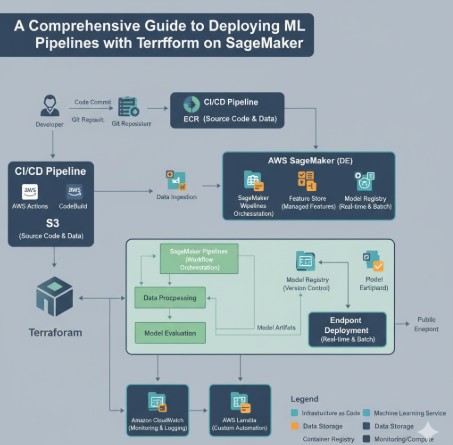
Optimizing AWS Batch with Terraform and the AWS Cloud Control Provider

Managing and scaling AWS Batch jobs can be complex. Manually configuring and maintaining infrastructure for your batch processing needs is time-consuming and error-prone. This article demonstrates how to leverage the power of Terraform and the AWS Cloud Control provider to streamline your AWS Batch deployments, ensuring scalability, reliability, and repeatability. We’ll explore how the AWS Cloud Control provider simplifies the management of complex AWS resources, making your infrastructure-as-code (IaC) more efficient and robust. By the end, you’ll understand how to effectively utilize this powerful tool to optimize your AWS Batch workflows.

Understanding the AWS Cloud Control Provider

The AWS Cloud Control provider for Terraform offers a declarative way to manage AWS resources. Unlike traditional providers that interact with individual AWS APIs, the AWS Cloud Control provider utilizes the Cloud Control API, a unified interface for managing various AWS services. This simplifies resource management by allowing you to define your desired state, and the provider handles the necessary API calls to achieve it. For AWS Batch, this translates to easier management of compute environments, job queues, and job definitions.

Key Benefits of Using the AWS Cloud Control Provider with AWS Batch

  • Simplified Resource Management: Manage complex AWS Batch configurations with a declarative approach, reducing the need for intricate API calls.
  • Improved Consistency: Ensure consistency across environments by defining your infrastructure as code.
  • Enhanced Automation: Automate the entire lifecycle of your AWS Batch resources, from creation to updates and deletion.
  • Version Control and Collaboration: Integrate your infrastructure code into version control systems for easy collaboration and rollback capabilities.

Creating an AWS Batch Compute Environment with Terraform and the AWS Cloud Control Provider

Let’s create a simple AWS Batch compute environment using Terraform and the AWS Cloud Control provider. This example utilizes an on-demand compute environment for ease of demonstration. For production environments, consider using spot instances for cost optimization.

Prerequisites

  • An AWS account with appropriate permissions.
  • Terraform installed on your system.
  • AWS credentials configured for Terraform.

Terraform Configuration


terraform {
  required_providers {
    aws = {
      source  = "hashicorp/aws"
      version = "~> 4.0"
    }
    aws-cloud-control = {
      source  = "aws-cloud-control/aws-cloud-control"
      version = "~> 1.0"
    }
  }
}

provider "aws" {
  region = "us-west-2" # Replace with your desired region
}

provider "aws-cloud-control" {
  region = "us-west-2" # Replace with your desired region
}

resource "aws_cloud_control_resource" "batch_compute_environment" {
  type = "AWS::Batch::ComputeEnvironment"
  properties = {
    compute_environment_name = "my-batch-compute-environment"
    type                    = "MANAGED"
    compute_resources       = {
      type                  = "EC2"
      maxv_cpus             = 10
      minv_cpus             = 0
      desiredv_cpus         = 2
      instance_types        = ["t2.micro"] # Replace with your desired instance type
      subnets               = ["subnet-xxxxxxxxxxxxxxx", "subnet-yyyyyyyyyyyyyyy"] # Replace with your subnet IDs
      security_group_ids    = ["sg-zzzzzzzzzzzzzzz"] # Replace with your security group ID
    }
    service_role = "arn:aws:iam::xxxxxxxxxxxxxxx:role/BatchServiceRole" # Replace with your service role ARN
  }
}

Remember to replace placeholders like region, subnet IDs, security group ID, and service role ARN with your actual values. This configuration uses the AWS Cloud Control provider to define the Batch compute environment. Terraform will then handle the creation of this resource within AWS.

Managing AWS Batch Job Queues with the AWS Cloud Control Provider

After setting up your compute environment, you’ll need a job queue to manage your job submissions. The AWS Cloud Control provider also streamlines this process.

Creating a Job Queue


resource "aws_cloud_control_resource" "batch_job_queue" {
  type = "AWS::Batch::JobQueue"
  properties = {
    job_queue_name = "my-batch-job-queue"
    priority       = 1
    compute_environment_order = [
      {
        compute_environment = aws_cloud_control_resource.batch_compute_environment.id
        order               = 1
      }
    ]
  }
}

This code snippet shows how to define a job queue associated with the compute environment created in the previous section. The `compute_environment_order` property specifies the compute environment and its priority in the queue.

Advanced Configurations and Optimizations

The AWS Cloud Control provider offers flexibility for more sophisticated AWS Batch configurations. Here are some advanced options to consider:

Using Spot Instances for Cost Savings

By utilizing spot instances within your compute environment, you can significantly reduce costs. Modify the `compute_resources` block in the compute environment definition to include spot instance settings.

Implementing Resource Tagging

Implement resource tagging for better organization and cost allocation. Add a `tags` block to both the compute environment and job queue resources in your Terraform configuration.

Automated Scaling

Configure auto-scaling to dynamically adjust the number of EC2 instances based on demand. This ensures optimal resource utilization and cost-efficiency. AWS Batch’s built-in auto-scaling features can be integrated with the AWS Cloud Control provider for a fully automated solution.

Frequently Asked Questions (FAQ)

Q1: What are the advantages of using the AWS Cloud Control provider over the traditional AWS provider for managing AWS Batch?

The AWS Cloud Control provider offers a more streamlined and declarative approach to managing AWS resources, including AWS Batch. It simplifies complex configurations, improves consistency, and enhances automation capabilities compared to managing individual AWS APIs directly.

Q2: Can I use the AWS Cloud Control provider with other AWS services besides AWS Batch?

Yes, the AWS Cloud Control provider supports a wide range of AWS services. This allows for a unified approach to managing your entire AWS infrastructure as code, fostering greater consistency and efficiency.

Q3: How do I handle errors and troubleshooting when using the AWS Cloud Control provider?

The AWS Cloud Control provider provides detailed error messages to help with troubleshooting. Properly structured Terraform configurations and thorough testing are key to mitigating potential issues. Refer to the official AWS Cloud Control provider documentation for detailed error handling and troubleshooting guidance.

Q4: Is there a cost associated with using the AWS Cloud Control Provider?

The cost of using the AWS Cloud Control provider itself is generally negligible; however, the underlying AWS services (such as AWS Batch and EC2) will still incur charges based on usage.

Conclusion

The AWS Cloud Control provider significantly simplifies the management of AWS Batch resources within a Terraform infrastructure-as-code framework. By using a declarative approach, you can create, manage, and scale your AWS Batch infrastructure efficiently and reliably. The examples provided demonstrate basic and advanced configurations, allowing you to adapt this approach to your specific requirements. Remember to consult the official documentation for the latest features and best practices when using the AWS Cloud Control provider to optimize your AWS Batch deployments. Mastering the AWS Cloud Control provider is a significant step towards efficient and robust AWS Batch management.

For further information, refer to the official documentation: AWS Cloud Control Provider Documentation and AWS Batch Documentation. Also, consider exploring best practices for AWS Batch optimization on AWS’s official blog for further advanced strategies. Thank you for reading the DevopsRoles page!

Deploying Your Application on Google Cloud Run with Terraform

This comprehensive guide delves into the process of deploying applications to Google Cloud Run using Terraform, a powerful Infrastructure as Code (IaC) tool. Google Cloud Run is a serverless platform that allows you to run containers without managing servers. This approach significantly reduces operational overhead and simplifies deployment. However, managing deployments manually can be time-consuming and error-prone. Terraform automates this process, ensuring consistency, repeatability, and efficient management of your Cloud Run services. This article will walk you through the steps, from setting up your environment to deploying and managing your applications on Google Cloud Run with Terraform.

Setting Up Your Environment

Before you begin, ensure you have the necessary prerequisites installed and configured. This includes:

  • Google Cloud Platform (GCP) Account: You need a GCP project with billing enabled.
  • gcloud CLI: The Google Cloud SDK command-line interface is essential for interacting with your GCP project. You can download and install it from the official Google Cloud SDK documentation.
  • Terraform: Download and install Terraform from the official Terraform website. Ensure it’s added to your system’s PATH.
  • Google Cloud Provider Plugin for Terraform: Install the Google Cloud provider plugin using the command: terraform init
  • A Container Image: You’ll need a Docker image of your application ready to be deployed. This guide assumes you already have a Dockerfile and a built image, either in Google Container Registry (GCR) or another registry.

Creating a Terraform Configuration

The core of automating your Google Cloud Run deployments lies in your Terraform configuration file (typically named main.tf). This file uses the Google Cloud provider plugin to define your infrastructure resources.

Defining the Google Cloud Run Service

The following code snippet shows a basic Terraform configuration for deploying a simple application to Google Cloud Run. Replace placeholders with your actual values.

resource "google_cloud_run_v2_service" "default" {
  name     = "my-cloud-run-service"
  location = "us-central1"
  template {
    containers {
      image = "gcr.io/my-project/my-image:latest" # Replace with your container image
      resources {
        limits {
          cpu    = "1"
          memory = "256Mi"
        }
      }
    }
  }
  traffic {
    percent = 100
    type    = "ALL"
  }
}

Authentication and Provider Configuration

Before running Terraform, you need to authenticate with your GCP project. The easiest way is to use the gcloud CLI’s application default credentials. This is usually handled automatically when you set up your Google Cloud SDK. This is specified in a separate file (typically providers.tf):

terraform {
  required_providers {
    google = {
      source  = "hashicorp/google"
      version = "~> 4.0"
    }
  }
}

provider "google" {
  project = "your-gcp-project-id" # Replace with your project ID
  region  = "us-central1"        # Replace with your desired region
}

Deploying Your Application to Google Cloud Run

Once your Terraform configuration is complete, you can deploy your application using the following commands:

  1. terraform init: Initializes the Terraform project and downloads the necessary providers.
  2. terraform plan: Creates an execution plan showing the changes Terraform will make. Review this plan carefully before proceeding.
  3. terraform apply: Applies the changes and deploys your application to Google Cloud Run. Type “yes” when prompted to confirm.

After the terraform apply command completes successfully, your application should be running on Google Cloud Run. You can access it via the URL provided by Terraform’s output.

Managing Your Google Cloud Run Service with Terraform

Terraform provides a robust mechanism for managing your Google Cloud Run services. You can easily make changes to your application, such as scaling, updating the container image, or modifying resource limits, by modifying your Terraform configuration and running terraform apply again.

Updating Your Container Image

To update your application with a new container image, simply change the image attribute in your Terraform configuration and re-run terraform apply. Terraform will detect the change and automatically update your Google Cloud Run service. This eliminates the need for manual updates and ensures consistency across deployments.

Scaling Your Application

You can adjust the scaling of your Google Cloud Run service by modifying the min_instance_count and max_instance_count properties within the google_cloud_run_v2_service resource. Terraform will automatically propagate these changes to your Cloud Run service.

Advanced Configurations for Google Cloud Run

The basic examples above demonstrate fundamental usage. Google Cloud Run offers many advanced features that can be integrated into your Terraform configuration, including:

  • Traffic Splitting: Route traffic to multiple revisions of your service, enabling gradual rollouts and canary deployments.
  • Revisions Management: Control the lifecycle of service revisions, allowing for rollbacks if necessary.
  • Environment Variables: Define environment variables for your application within your Terraform configuration.
  • Secrets Management: Integrate with Google Cloud Secret Manager to securely manage sensitive data.
  • Custom Domains: Use Terraform to configure custom domains for your services.

These advanced features significantly enhance deployment efficiency and maintainability. Refer to the official Google Cloud Run documentation for detailed information on these options and how to integrate them into your Terraform configuration.

Frequently Asked Questions

Q1: How do I handle secrets in my Google Cloud Run deployment using Terraform?

A1: It’s recommended to use Google Cloud Secret Manager to store and manage sensitive data such as API keys and database credentials. You can use the google_secret_manager_secret resource in your Terraform configuration to manage secrets and then reference them as environment variables in your Cloud Run service.

Q2: What happens if my deployment fails?

A2: Terraform provides detailed error messages indicating the cause of failure. These messages usually pinpoint issues in your configuration, networking, or the container image itself. Review the error messages carefully and adjust your configuration as needed. In case of issues with your container image, ensure that it builds and runs correctly in isolation before deploying.

Q3: Can I use Terraform to manage multiple Google Cloud Run services?

A3: Yes, you can easily manage multiple Google Cloud Run services in a single Terraform configuration. Simply define multiple google_cloud_run_v2_service resources, each with its unique name, container image, and settings.

Conclusion

Deploying applications to Google Cloud Run using Terraform provides a powerful and efficient way to manage your serverless infrastructure. By leveraging Terraform’s Infrastructure as Code capabilities, you can automate deployments, ensuring consistency, repeatability, and ease of management. This article has shown you how to deploy and manage your Google Cloud Run services with Terraform, from basic setup to advanced configurations. Remember to always review the Terraform plan before applying changes and to use best practices for security and resource management when working with Google Cloud Run and Terraform.Thank you for reading the DevopsRoles page!