Master Vagrant with DevOpsRoles.com. Explore comprehensive guides and tutorials to automate development environments using Vagrant for efficient DevOps practices.
In this tutorial, How do I use Vagrant create multiple VMs loop? Multiple Vagrant Virtual Machine on Vagrantfile. How to create Multiple VMs with multiple IP loop. Vagrant the essential for DevOps Roles.
Vagrant create multiple VMs loops
For example, I creating two servers with Vagrantfile as below
Vagrant.configure("2") do |config|
config.ssh.insert_key = false
config.vm.provider :virtualbox do |vb|
  vb.memory = 256
  vb.cpus = 1
end
# Application server 1.
config.vm.define "app1" do |app1|
  app1.vm.hostname = "app1.dev"
  app1.vm.box = "centos/7"
  app1.vm.network :private_network, ip: "192.168.3.4"
end
# Database server.
config.vm.define "db" do |db|
  db.vm.hostname = "db.dev"
  db.vm.box = "centos/7"
  db.vm.network :private_network, ip: "192.168.3.5"
end
end
Now, How to Vagrant create N Virtual Machine with different IPs in a loop.
Vagrant.configure("2") do |config|
config.ssh.insert_key = false
config.vm.provider :virtualbox do |vb|
vb.memory = 256
vb.cpus = 1
end
#Disabling the default /vagrant share
config.vm.synced_folder ".", "/vagrant", disabled: true
MACHINE = ["app1.dev","db.dev"]N = 1
(0..N).each do |i|
config.vm.define "server#{i}" do |node|
node.vm.hostname = MACHINE[i]
node.vm.box = "centos/7"
node.vm.network :private_network, ip: "192.168.3.#{10+i}"
end
end
Note: Change N and MACHINE variable is right for you
To run the first vagrant up a Virtual Machine, to starts vagrant environment
[huupv@huupv example01]$ vagrant up
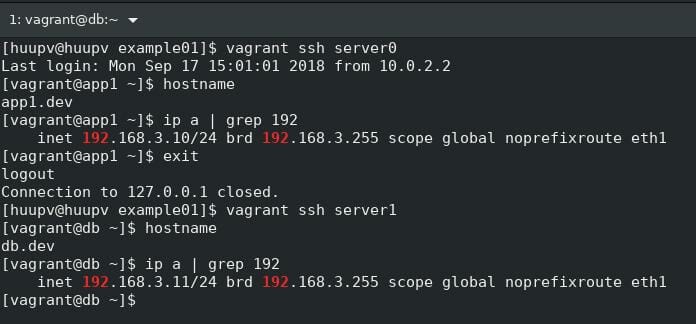
The result, Vagrant create multiple VMs loops
Conclusion
Thought the article, you can use Vagrant create multiple VMs loops as above. I hope will this your helpful. Thank you for reading the DevopsRoles page!
Explore the practical steps to set up a Vagrant CentOS box example in this detailed guide. Whether you’re working with CentOS 6 or 7, this tutorial provides clear instructions and essential tips for using Vagrant to deploy CentOS virtual machines effectively.
In this tutorial, I deployed a centos VM from Vagrantfiles. For example, the Vagrant Centos box example for Centos 6 and Centos 7. To use Vagrant, Virtualbox, and Centos.
The first is to create a Project folder as below:
$ mkdir vagrant_centos
$ cd vagrant_centos
$ vagrant init
To create a vagrant SSH key
[huupv@huupv example01]$ ssh-keygen
The Private key and public key in /home/huupv/project/keys/.ssh
VAGRANTFILE_API_VERSION = "2"
Vagrant.configure(VAGRANTFILE_API_VERSION) do |config|
config.vm.box = "centos/6"
config.vm.hostname = "Server01"
config.ssh.insert_key = false
config.vm.provision :shell, path: "VAGRANT_ENV/bootstrap.sh"
# Create a private network, which allows host-only access to the machine
# using a specific IP.
# config.vm.network :private_network, ip: "192.168.33.10"
config.vm.network "forwarded_port", guest: 80, host: 8888
config.vm.network :public_network, :bridge => "eth1", :auto_config => false
# Share an additional folder to the guest VM
# config.vm.synced_folder ".", "/vagrant", disabled: true
# config.vm.synced_folder ".", "/home/vagrant/provision", type: "rsync"
config.vm.provider :virtualbox do |vb|
# Set VM memory size
vb.customize ["modifyvm", :id, "--memory", "512"]
# these 2 commands massively speed up DNS resolution, which means outbound
# connections don't take forever (eg the WP admin dashboard and update page)
vb.customize ["modifyvm", :id, "--natdnshostresolver1", "on"]
vb.customize ["modifyvm", :id, "--natdnsproxy1", "on"]
end
end
To run vagrant up a Virtual Machine, to start guest VM
[huupv@huupv example01]$ vagrant up
Conclusion
This guide demystifies the process of deploying CentOS using Vagrant, making it accessible for developers and IT professionals alike. With these insights, you’re now equipped to streamline your development and testing environments efficiently.
Thought the article, you can use the Vagrant Centos box example as above. I hope will this your helpful. Thank you for reading the DevopsRoles page!
When you running command Vagrant resume, Vagrant halt and vagrant destroy. Then Vagrant triggers backup databases. For example backup Mysql databases for WordPress. Vagrant the essential for DevOps Roles.
Vagrant triggers backup databases
Installing vagrant triggers
$ vagrant plugin install vagrant-triggers
To configure the vagrant triggers database dump
$ vim Vagrantfile
The content as below:
VAGRANTFILE_API_VERSION = "2"
Vagrant.configure(VAGRANTFILE_API_VERSION) do |config|
#config.vm.box = "digitalquery/wpvagrant"
 config.vm.box = "ubuntu/xenial64"
 config.vm.hostname = "wp"
 config.ssh.insert_key = false
 # Vagrant triggers
 #config.trigger.before :destroy, :stdout => true do
 #config.trigger.before :destroy do
 [:resume, :suspend, :halt, :destroy, :reload].each do |cmd|
 config.trigger.before cmd, stdout: true do
 info "Dumping the database before destroying the VM..."
 run_remote "bash /vagrant/mysql/db_dump.sh"
 #run "vagrant ssh -c 'sh /vagrant/wp-vagrant/mysql/db_dump.sh'"
 end
 end
 end
The databases dump script
$ vim /home/huupv/project/mysql/db_dump.sh
The content db_dump script as below:
#!/bin/bash
 echo "db name is wordpress"
 if [ ! -z "wordpress" ]; then
 now=`date +"%Y_%m_%d-%H-%M-%S"`
 db_dump_file=wordpress"_"$now".sql"
 echo "dumping database before destroy"
 echo "dump file: /vagrant/mysql/db_dumps/$db_dump_file"
 if [ ! -d /vagrant/mysql/db_dumps ]; then
 sudo mkdir /vagrant/mysql/db_dumps
 fi
 mysqldump -u root --password=root wordpress > /vagrant/mysql/db_dumps/$db_dump_file
 if [ ! "$?" -eq 0 ]; then
 echo "DATABASE DUMP FAILED - YOU MAY WISH TO ABORT VAGRANT DESTROY."
 echo "Check /vagrant/VAGRANT_ENV/db_dumps/error.log for more info"
 fi
 fi
Conclusion
How to preserve your MySQL Databases Between Destroy and halt. Vagrant triggers are the plugin. Thank you for reading the DevopsRoles page!
In this tutorial, I will guide you through setting up an Vagrant ssh key pair. We’ll generate the SSH keys, where vagrant_rsa will the private key and vagrant_rsa.pub will serve as the public key. This allows you to log into the Virtual Machine without needing a password. Setting up Vagrant is crucial for those in DevOps roles.
Understanding SSH Key Management in Vagrant
When working with Vagrant, a tool that streamlines the creation and management of virtual development environments, it’s crucial to understand how SSH keys are handled. SSH keys play a vital role in securing access to your Vagrant virtual machines (VMs).
Vagrant SSH Key Location
By default, when you initiate a new Vagrant environment, Vagrant automatically generates an SSH key pair if none exists. This is done to ensure secure, password-less access to the created VM. The location of these SSH keys is typically within the Vagrant project directory .vagrant/machines/<machine-name>/virtualbox/private_key for VirtualBox users. This path might vary slightly depending on the provider you are using, such as VMware or Hyper-V.
Managing Vagrant SSH Keys
It’s important to know that Vagrant configures its VMs to use these automatically generated keys. However, for enhanced security or personal preference, you can configure Vagrant to use a custom SSH key pair. This involves specifying your private key in the Vagrantfile and ensuring the corresponding public key is authorized in the VM. Managing these keys properly ensures that access to your VM is both secure and restricted to authorized users only.
Below is the folder structure for the Vagrant project:
/home/huupv/project
/home/huupv/project/keys/.ssh
Vagrant SSH key pair
The first is to create a vagrant SSH key
Using the ssh-keygen command to create the private key and public key for a vagrant.
ssh-keygen
The output private key and public key files in “/home/huupv/project/keys/.ssh” folder as below:
vagrant_rsa vagrant_rsa.pub
To configure vagrant ssh key in Vagrantfile
To add the lines in the Vagrantfile file as below:
~/.vagrant.d/insecure_private_key: You should append this default key. The use config.ssh.insert_key = false to Vagrant not generate a random key.
config.ssh.private_key_path: Changing Insecure Key To My Own Key On Vagrant box.
Conclusion
Finishing, We are customizing the vagrant SSH key with a Private/Public key. What you need to Private key saves in the host and the Public key copies authorized_keys into a vagrant box for Virtual Machine. Reference to configure vagrant SSH of the vagrant main site. Thank you for reading the DevopsRoles page!
Setting up WordPress with Vagrant has become a go-to solution for developers seeking a reliable, consistent, and portable environment for web development. Vagrant simplifies the process of creating and configuring virtual environments, ensuring that your WordPress projects are not only portable but also identical across various systems. This guide walks you through the step-by-step process of setting up WordPress Vagrant, from basic installation to advanced configurations.
In this tutorial, I’m set up a WordPress Vagrant, using vagrant box ubuntu with Nginx + MariaDB + WordPress. Vagrant the essential for DevOps Roles.
Benefits of Using Vagrant for WordPress Development
1. Consistent Environments
Ensures uniformity between development, staging, and production environments.
Avoids the common “works on my machine” problem.
2. Portable and Reproducible
Easily share development environments across teams.
Rapidly recreate environments in case of errors or new projects.
3. Integration with Popular Tools
Works seamlessly with VirtualBox, Docker, and other virtualization tools.
Supports provisioning tools like Ansible, Chef, and Puppet.
Prerequisites
Before diving into the setup, ensure you have the following:
#!/usr/bin/env bash
if [ ! -z "wordpress" ] ; then
echo "creating database"
 sudo mysql -u root -p'root' -e "CREATE DATABASE IF NOT EXISTS wordpress;"
if [ ! -z "wp_db_user" ]; then
 echo " adding custom user"
 sudo mysql -u root -p'root' -e "GRANT ALL ON wordpress.* TO 'wp_db_user'@'localhost' IDENTIFIED BY '123456789'"
 sudo mysql -u root -p'root' -e "FLUSH PRIVILEGES;"
 sudo mysql -u root -p'root' -e 'show databases;'
 fi
else
 echo "No database name specified - skipping db creation"
fi
To configure file wp-config.php for WordPress vagrant
vim wp/wp-config.php
The content as below:
<?php
define('DB_NAME', 'wordpress');
/** MySQL database username */
 define('DB_USER', 'wp_db_user');
/** MySQL database password */
 define('DB_PASSWORD', '123456789');
/** MySQL hostname */
 define('DB_HOST', 'localhost');
/** Database Charset to use in creating database tables. */
 define('DB_CHARSET', 'utf8');
/** The Database Collate type. Don't change this if in doubt. */
 define('DB_COLLATE', '');
 define('AUTH_KEY', 'put your unique phrase here');
 define('SECURE_AUTH_KEY', 'put your unique phrase here');
 define('LOGGED_IN_KEY', 'put your unique phrase here');
 define('NONCE_KEY', 'put your unique phrase here');
 define('AUTH_SALT', 'put your unique phrase here');
 define('SECURE_AUTH_SALT', 'put your unique phrase here');
 define('LOGGED_IN_SALT', 'put your unique phrase here');
 define('NONCE_SALT', 'put your unique phrase here');
 $table_prefix = 'wp_';
 define('WP_DEBUG', false);
 /** Absolute path to the WordPress directory. */
 if ( !defined('ABSPATH') )
 define('ABSPATH', dirname(__FILE__) . '/');
/** Sets up WordPress vars and included files. */
 require_once(ABSPATH . 'wp-settings.php');
 define('FS_METHOD', 'direct');
[huupv@localhost ~]$ cd /home/huupv/project/
[huupv@localhost project]$ vagrant up
FAQs
Q1: Why use Vagrant over Docker for WordPress?
While Docker is lightweight, Vagrant provides a full virtualized environment, making it suitable for developers needing an environment closer to production.
Q2: Can I use a different Linux distribution?
Yes, replace ubuntu/bionic64 in the Vagrantfile with the desired box name from Vagrant Cloud.
Q3: How do I update the Vagrant environment?
Use the following commands:
To apply updates: vagrant provision
To rebuild the environment: vagrant destroy -f && vagrant up
You have to set up a Vagrant WordPress Nginx + MariaDB. Setting up WordPress with Vagrant is a powerful way to ensure consistency and efficiency in web development. By following this guide, you can create a robust development environment tailored to your needs. Whether you’re a solo developer or part of a team, Vagrant offers the flexibility and reliability to elevate your WordPress projects. I hope will this your helpful. Thank you for reading the DevopsRoles page!
Master the essentials of Useful vagrant commands line. Whether you’re starting, stopping, or managing virtual machines, this article provides the necessary commands to efficiently control your Vagrant environments. Ideal for developers and IT professionals looking to streamline their workflow in virtual machine management.
In this tutorial, I guide using the useful Vagrant commands line for Virtual Machines such as: Starting and Stopping a VM so forth. Vagrant the essential for DevOps Roles.
Useful vagrant commands line
Vagrant commands for Virtual Machine
Initialize Vagrant with a Vagrantfile
# vagrant init
Initialize the vagrant with a specific box. To find a box, https://app.vagrantup.com/boxes/search Vagrant commands for starting a Virtual Machine To run the first vagrant up a Virtual Machine, to start vagrant environment
# vagrant up
To resume a Virtual Machine
# vagrant resume
Restarting a Virtual Machine
# vagrant reload
Vagrant commands for stopping a Virtual Machine To stop a Virtual Machine
# vagrant halt
To suspend a Virtual Machine
# vagrant suspend
Vagrant commands cleaning up a Virtual Machine To stop and delete all traces of the Virtual Machine
# vagrant destroy
Vagrant commands for Boxes To list all installed boxes on your computer
# vagrant box list
To download a box image to your computer
# vagrant box add
Checking for updates vagrant box update
# vagrant box outdated
To delete a box from the machine
# vagrant boxes remove
The packages a running Virtualbox environment in a reusable box
# vagrant package
To snapshot a Virtual Machine The VM-name often defaults. To roll back at a later time.
# vagrant snapshot save [options] [vm-name]
The useful vagrant commands To get the vagrant version
# vagrant -v
The output status of the vagrant machine
# vagrant status
The output status of all vagrant machines
# vagrant global-status
The same as above, but prunes invalid entries
# vagrant global-status --prune
To use the debug flag to increase the verbosity of the output
# vagrant provision --debug
Vagrant can be configured to deploy code!
# vagrant push
To Runs vagrant up, forces provisioning and logs all output to a file
# vagrant up --provision | tee provision_2017.log
Conclusion
This compilation of useful Vagrant commands will empower you to manage your virtual machines more effectively. By familiarizing yourself with these commands, you can optimize your development environment and enhance your productivity. For a detailed exploration of each command, refer to the full guide. I hope will this your helpful. Thank you for reading the DevopsRoles page!
Vagrant is an open-source tool that simplifies the management of virtualized development environments. Whether you are a developer, system administrator, or DevOps engineer, Vagrant helps you create and manage virtual machines with ease, ensuring that your environments are consistent and repeatable. This guide will walk you through the process of install Vagrant on Ubuntu, covering everything from setting up prerequisites to completing the installation.
Vagrant is a crucial tool for anyone involved in development or DevOps roles, enabling you to streamline your workflows and focus on coding rather than environment setup. Let’s dive into the installation process and get Vagrant running on your Ubuntu system.
Requirements install vagrant on ubuntu
Before starting the installation, make sure you meet the following requirements:
VirtualBox: Vagrant uses VirtualBox to create and manage virtual machines.
sudo access: You’ll need administrative privileges to install software on your system.
Ubuntu System: This guide is tailored for Ubuntu, but the steps are similar for other Linux distributions.
Step 1: Update Your System
Before installing any new software, it’s essential to update your system’s package list. This ensures that you have access to the latest versions of all packages.
sudo apt-get update
This command updates the package list, fetching the latest information on available software from the repositories.
Step 2: Install VirtualBox
Installing VirtualBox on Ubuntu 14.04
For Ubuntu 14.04 users, VirtualBox needs to be installed by adding the appropriate repository to your system. Open the /etc/apt/sources.list file:
sudo vim /etc/apt/sources.list
Add the following lines to the file:
deb http://download.virtualbox.org/virtualbox/debian saucy contrib
deb http://download.virtualbox.org/virtualbox/debian raring contrib
deb http://download.virtualbox.org/virtualbox/debian quantal contrib
deb http://download.virtualbox.org/virtualbox/debian precise contrib
deb http://download.virtualbox.org/virtualbox/debian lucid contrib non-free
deb http://download.virtualbox.org/virtualbox/debian wheezy contrib
deb http://download.virtualbox.org/virtualbox/debian squeeze contrib non-free
Once the repository is added, install VirtualBox 4.3 using the following commands:
Finally, add your user to the vboxusers group to ensure you have the necessary permissions:
sudo usermod -a -G vboxusers <your-username>
Step 3: Install Vagrant
With VirtualBox installed, you’re ready to install Vagrant. The process is straightforward and can be completed with a single command:
sudo apt-get install vagrant
This command installs the latest version of Vagrant, which is available in the Ubuntu repositories.
Frequently Asked Questions (FAQs)
What is Vagrant used for?
Vagrant is used to create and manage virtualized development environments. It allows developers to work on projects in a consistent environment across multiple machines, ensuring that the code behaves the same in development, testing, and production.
Can I use Vagrant with other virtualization platforms besides VirtualBox?
Yes, Vagrant supports several other virtualization platforms, including VMware, Hyper-V, and Docker. However, VirtualBox is the most commonly used and fully supported platform with Vagrant.
Do I need an internet connection to use Vagrant?
An internet connection is required to download Vagrant boxes (pre-configured virtual machines). However, once the boxes are downloaded, you can use Vagrant offline.
How do I update Vagrant to the latest version?
You can update Vagrant by running sudo apt-get update followed by sudo apt-get install vagrant. This will install the latest version available in the Ubuntu repositories.
Conclusion
Installing Vagrant on Ubuntu is a straightforward process that can significantly improve your development workflow. By following the steps outlined in this guide, you can set up a consistent and reproducible development environment in no time. Whether you’re new to Vagrant or a seasoned user, having it installed on your Ubuntu system will undoubtedly streamline your work.
Thank you for reading this guide on how to install Vagrant on Ubuntu. We hope you found it helpful and informative. If you have any questions or need further assistance, feel free to reach out. Thank you for reading the DevopsRoles page!
Vagrant is Configuration Management (CM). Development environment made easy use vagrant. To knowledge, vagrant to help for building and deployment. It’s open-source. let’s go! “How to install vagrant on centos 6”. Vagrant the essential for DevOps Roles.
Through the article, you can use How to install vagrant on centos 6 as above. I hope will this your helpful. Thank you for reading the DevopsRoles page!