The modern cloud-native landscape demands that networking components are not only scalable but also highly adaptable. As microservice architectures proliferate, the complexity of the Ingress Controller becomes a critical operational bottleneck. For organizations managing dozens, even hundreds, of services, the manual process of updating routing rules, TLS certificates, and security policies is not only tedious but dangerously error-prone.
If your infrastructure currently relies on NGINX Ingress, but you are evaluating a specialized, feature-rich alternative like Higress, the migration challenge is significant. We are talking about moving 60+ resources-each with unique routing rules, authentication requirements, and traffic policies—with zero downtime.
This deep dive is designed for Senior DevOps, MLOps, and SecOps engineers. We will move beyond simple YAML comparisons. We will architect a robust, automated pipeline that treats the migration not as a manual lift-and-shift, but as a sophisticated, stateful service transition.
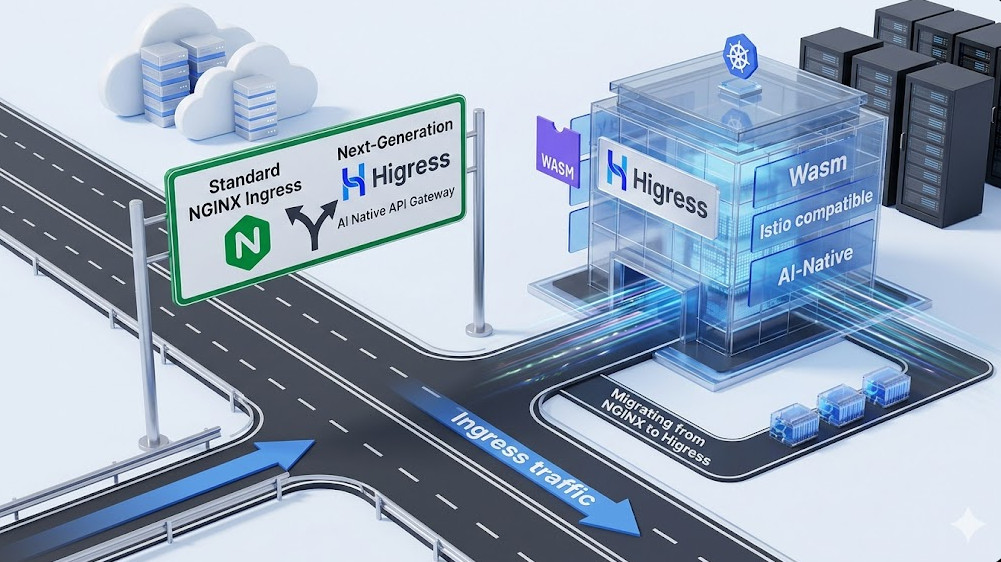
Table of Contents
Phase 1: Architectural Deep Dive – Understanding the State Shift
Before writing a single line of automation code, we must understand the fundamental architectural differences between the two controllers. Both NGINX Ingress and Higress aim to provide Layer 7 routing, but their underlying mechanisms, feature sets, and how they interact with the Kubernetes Gateway API differ significantly.
The NGINX Ingress Model: Robust and Standard
The standard NGINX Ingress Controller is the industry workhorse. It excels at basic routing, TLS termination, and providing a stable, well-understood API surface. It primarily operates using Ingress resources (though modern versions support Gateway resources).
Its strength lies in its adherence to the core Kubernetes specification. However, when dealing with advanced features—such as complex rate limiting, sophisticated traffic splitting, or deep integration with external authentication providers—administrators often find themselves reaching the limits of the native Ingress resource definition.
The Higress Model: Feature-Rich and Specialized
Higress, on the other hand, is built to handle enterprise-grade complexity. It often provides richer, more granular control over networking policies, particularly in areas like advanced WAF (Web Application Firewall) integration and sophisticated traffic management.
Architecturally, the shift often involves moving from the generic Ingress resource to a more powerful, customizable resource model, frequently leveraging the full capabilities of the Gateway API. This allows for policies that go far beyond simple hostname-to-service mapping.
The Core Migration Challenge: CRD Mapping
The biggest hurdle in the Ingress NGINX Higress migration is the mapping of Custom Resource Definitions (CRDs). A single NGINX Ingress object might encapsulate rules that require three separate Gateway or HTTPRoute definitions in the Higress ecosystem.
We must account for:
- Header Rewriting: NGINX might handle specific header manipulations that need explicit recreation in Higress.
- Rate Limiting: The syntax and scope of rate limiting policies differ, requiring a policy translation layer.
- Authentication: Moving from basic NGINX auth to potentially more advanced, context-aware authentication methods.
💡 Pro Tip: When planning the migration, do not treat the resources as a bulk transfer. Instead, group them by function (e.g., all public APIs, all internal services, all payment gateways). This allows you to test the migration in isolated, manageable batches, significantly reducing the blast radius of any failure.
Phase 2: Practical Implementation – Building the Automation Pipeline
To migrate 60+ resources in minutes, we cannot rely on kubectl apply -f. We need a dedicated, state-aware automation pipeline. This pipeline should ideally be built using a tool like Argo Workflows or Tekton Pipelines.
Our goal is to create a three-stage process: Extract $\rightarrow$ Transform $\rightarrow$ Apply.
Step 1: Extraction (The Discovery Phase)
We use kubectl to pull all existing Ingress resources and store them in a structured format (e.g., JSON or YAML).
# Extract all NGINX Ingress resources into a structured directory
kubectl get ingress --all-namespaces -o yaml > ingress_source_manifests.yaml
Step 2: Transformation (The AI/Scripting Layer)
This is the most critical, high-intelligence step. A simple sed command will fail. We need a programmatic layer—ideally a Python script utilizing a Kubernetes client library—to parse the source YAML and generate the target Higress YAML.
The script must perform the following logic:
- Iterate through every
Ingressobject. - Identify the
hostandservice.name. - Analyze
nginx.ingress.kubernetes.io/annotations for advanced features (e.g.,rewrite-target,proxy-body-size). - Map these annotations to the corresponding Higress
HTTPRouteorGatewayparameters.
Example Transformation Logic (Conceptual Python Snippet):
# Pseudocode for the transformation engine
def transform_ingress_to_higress(ingress_yaml):
    routes = []
    for rule in ingress_yaml.spec.rules:
        host = rule.host
        service = rule.http.paths[0].backend.service

        # Check for specific NGINX annotations
        if "rewrite-target" in ingress_yaml.metadata.annotations:
            rewrite_target = ingress_yaml.metadata.annotations["rewrite-target"]
            # Generate Higress-specific rewrite rule
            routes.append(f"rewrite_target: {rewrite_target}")

        # Build the final Higress CRD structure
        higress_route = {
            "host": host,
            "path": rule.http.paths[0].path,
            "service": service,
            "policies": [p for p in routes]
        }
        routes.append(higress_route)
    return "--- Higress CRD YAML ---"
Step 3: Application (The Validation and Deployment Phase)
Once the target YAML manifests are generated, they must be applied in a controlled manner. We recommend a phased rollout using Canary Deployments.
- Dry Run: Always validate the generated manifests first.
- Pilot Group: Apply the manifests only to a small, non-critical subset of services (e.g., 5% of traffic).
- Monitoring: Use Prometheus and Grafana to monitor key metrics (latency, error rates, request volume) for both the old NGINX endpoint and the new Higress endpoint simultaneously.
# 1. Apply the generated Higress manifests
kubectl apply -f higress_target_manifests.yaml

# 2. Verify the deployment status
kubectl get higressroute -A | grep <service-name>

# 3. Monitor the transition using a dedicated dashboard
# (Dashboard configured to compare metrics from NGINX and Higress endpoints)
This structured approach ensures that the migration of 60+ resources is not a single, high-risk event, but a series of validated, low-risk transitions. For deeper dives into the tooling and methodologies, we recommend reading the full migration guide.
Phase 3: Senior-Level Best Practices and Troubleshooting
A successful migration is not just about getting the YAML to apply; it’s about maintaining operational excellence and resilience.
1. Advanced Traffic Management: Weighted Routing
One of the most powerful features in advanced ingress controllers is weighted routing. This is crucial for zero-downtime deployments. Instead of flipping a switch, you gradually shift traffic.
If you are migrating a critical API, you should configure the Higress route to receive 95% of traffic, while the old NGINX endpoint remains active for 5%. This allows real-time comparison of performance metrics.
2. SecOps Focus: Policy Parity and Drift Detection
When migrating, the biggest security risk is policy drift. NGINX might have been configured with a specific set of rate limits or header checks that were never documented.
- Action: Treat the source NGINX configuration as the single source of truth for security policies.
- Tooling: Implement a Policy-as-Code layer (e.g., using Open Policy Agent – OPA) that validates the generated Higress manifests against the original security requirements before deployment.
3. Observability and Metrics Correlation
The migration process must be observable. Ensure that both the NGINX and Higress ingress controllers are configured to emit standardized metrics (e.g., using the Prometheus client library).
Key metrics to monitor during the transition include:
http_requests_total: Total requests handled.http_request_duration_seconds: Latency distribution.nginx_ingress_error_countvs.higress_error_count: Error rate comparison.
💡 Pro Tip: When dealing with high-volume traffic, always implement a circuit breaker pattern at the ingress layer. If the error rate for a newly migrated service exceeds a defined threshold (e.g., 5xx errors > 1%), the ingress controller should automatically revert traffic to the stable, old endpoint until the issue is resolved.
4. Troubleshooting Common Ingress NGINX Higress Pitfalls
| Issue | Cause | Solution |
| Missing Headers | NGINX often passes specific headers (e.g., X-Forwarded-For) that Higress might drop by default to maintain a “secure by default” posture. | Explicitly define the required headers in the Higress CRD using proxy-headers or similar policy blocks. |
| Path Trailing Slashes | NGINX might treat /api/v1/ and /api/v1 differently, leading to 404 errors if the target service is sensitive to slashes. | Standardize all paths in the source manifest extraction phase. Use regex matching in the transformation script to normalize path definitions. |
| TLS Handshake Failures | Mismatch in expected certificate formats, SNI handling, or differences in supported cipher suites between the two controllers. | Verify that the Gateway API resource is correctly configured to handle the tls block and that the associated Secret is correctly mounted and referenced. |
Conclusion: Achieving Operational Maturity
Migrating 60+ resources from NGINX Ingress to Higress is a massive undertaking that cannot be solved with simple scripting. It requires a deep understanding of Kubernetes networking primitives, a commitment to Policy-as-Code, and the implementation of a robust, automated CI/CD pipeline.
By adopting a structured, phased approach—Extract, Transform, Apply—and focusing heavily on observability and security parity, you can achieve a migration that is not only fast but also demonstrably safer and more resilient than the original setup.
For further resources on advanced DevOps tooling and roles, check out our guide on DevOps Roles.