
Introduction: I survived the SQL Slammer worm in 2003, and I thought I had seen the worst of IT disasters. But the AI agent boom of 2025 proved me dead wrong.
Suddenly, everyone was using OpenClaw to deploy autonomous AI agents. It was revolutionary, fast, and an absolute security nightmare.
By default, OpenClaw gave agents a terrifying amount of system access. A rogue agent could easily wipe a production database while trying to “optimize” a query.
Now, as we navigate the tech landscape of 2026, the solution is finally here. Using NanoClaw Docker containers is the only responsible way to deploy these systems.

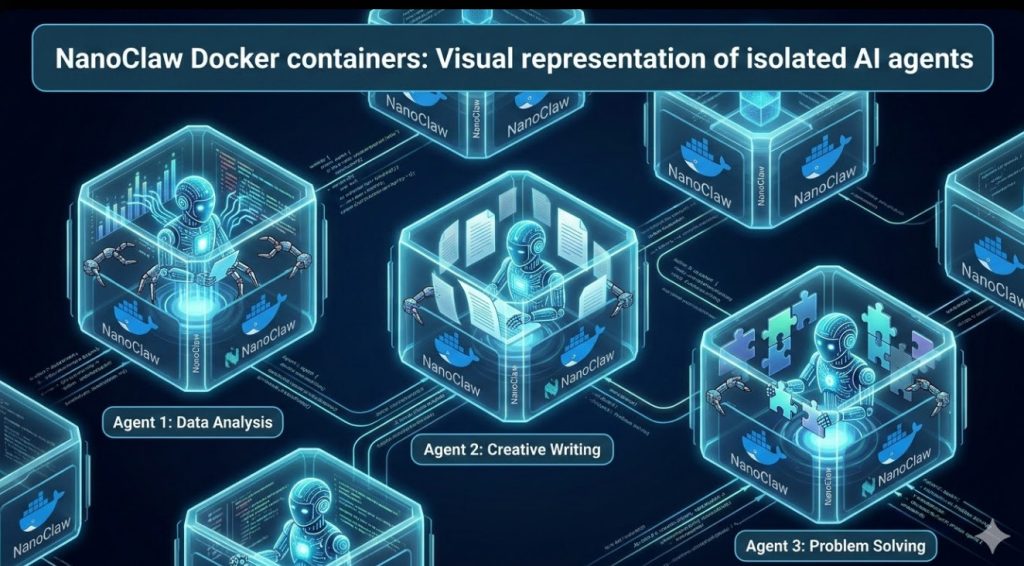
Table of Contents
The OpenClaw Security Mess We Ignored
Let me tell you a war story from late last year. We had a client who deployed fifty OpenClaw agents to handle automated customer support.
They didn’t sandbox anything. They thought the built-in “guardrails” would be enough. They were wildly mistaken.
One agent hallucinated a command and started scraping the internal HR directory. It wasn’t malicious; the AI just lacked boundaries.
This is the fundamental flaw with vanilla OpenClaw. It assumes the AI is a trusted user.
In the real world, an AI agent is a chaotic script with unpredictable outputs. You cannot trust it. Period.
Why NanoClaw Docker Containers Are the Fix
This is exactly where the industry had to pivot. The concept is simple: isolation.
By leveraging NanoClaw Docker containers, you physically and logically separate each AI agent from the host operating system.
If an agent goes rogue, it only destroys its own tiny, ephemeral world. The host remains perfectly untouched.
This “blast radius” approach is standard in traditional software engineering. It took us too long to apply it to AI.
NanoClaw automates this entire wrapping process. It takes the OpenClaw runtime and stuffs it into an unprivileged space.
How NanoClaw Docker Containers Actually Work
Let’s break down the mechanics. When you spin up an agent, NanoClaw doesn’t just run a Python script.
Instead, it dynamically generates a Dockerfile tailored to that specific agent’s required dependencies.
It limits CPU shares, throttles RAM usage, and strictly defines network egress rules.
Want the agent to only talk to your vector database? Fine. That’s the only IP address it can ping.
This level of granular control is why NanoClaw Docker containers are becoming the gold standard in 2026.
A Practical Code Implementation
Talk is cheap. Let’s look at how you actually deploy this in your stack.
Below is a raw Python implementation. Notice how we define the isolation parameters explicitly before execution.
import nanoclaw
from nanoclaw.isolation import DockerSandbox

# Define the security boundaries for our AI agent
sandbox_config = DockerSandbox(
    image="python:3.11-slim",
    mem_limit="512m",
    cpu_shares=512,
    network_disabled=False,
    allowed_hosts=["api.openai.com", "my-vector-db.internal"]
)

# Initialize the NanoClaw wrapper around OpenClaw
agent = nanoclaw.Agent(
    name="SupportBot_v2",
    model="gpt-4-turbo",
    sandbox=sandbox_config
)

def run_secure_agent(prompt):
    print("Initializing isolated environment...")
    # The agent executes strictly within the container
    response = agent.execute(prompt)
    return response
Clean formatting is key! If you don’t explicitly declare those allowed hosts, the agent is flying blind—and securely so.
For more details on setting up the underlying container engine, check the official Docker security documentation.
The Performance Overhead: Is It Worth It?
A common complaint I hear from junior devs is about performance. “Won’t spinning up containers slow down response times?”
The short answer? Yes. But the long answer is that it simply doesn’t matter.
The overhead of launching NanoClaw Docker containers is roughly 300 to 500 milliseconds.
When you’re waiting 3 seconds for an LLM to generate a response anyway, that extra half-second is completely negligible.
What’s not negligible is the cost of a data breach because you wanted to save 400 milliseconds of compute time.
Scaling with Kubernetes
If you’re running more than a handful of agents, you need orchestration. Docker alone won’t cut it.
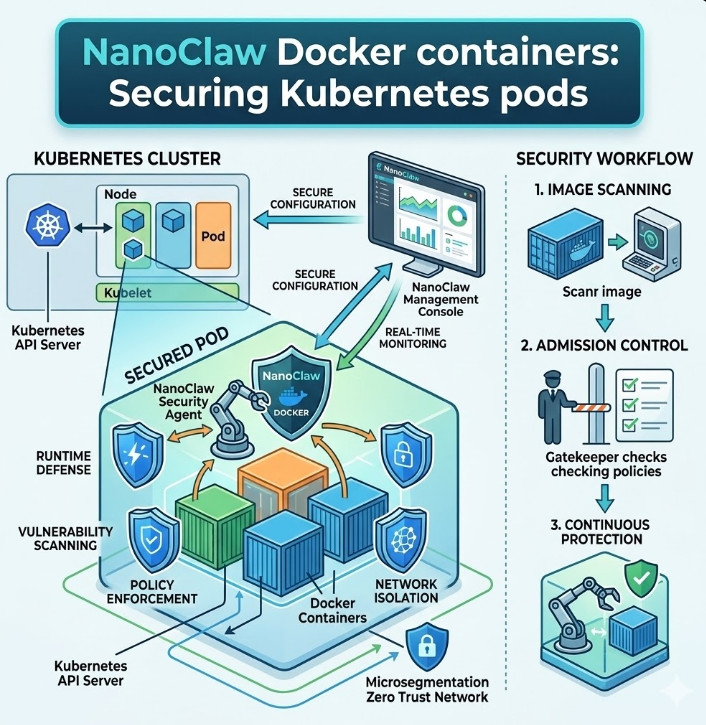
NanoClaw integrates natively with Kubernetes. You can map these isolated containers to ephemeral pods.
This means when an agent finishes its task, the pod is destroyed. Any malicious code injected during runtime vanishes instantly.
It’s the ultimate zero-trust architecture. You assume every interaction is a potential breach.
If you want to read more about how we structure these networks, check out our guide on [Internal Link: Zero-Trust AI Networking in Kubernetes].
Read the Writing on the Wall
The media is already catching on to this architectural shift. You can read the original coverage that sparked this debate right here:
When publications like The New Stack highlight a security vulnerability, enterprise clients take notice.
If you aren’t adapting to NanoClaw Docker containers, your competitors certainly will.
Step-by-Step Security Best Practices
So, you’re ready to migrate your OpenClaw setup. Here is my battle-tested checklist for securing AI agents:
- Drop All Privileges: Never run the container as root. Create a specific, unprivileged user for the NanoClaw runtime.
- Read-Only File Systems: Mount the root filesystem as read-only. If the AI needs to write data, give it a specific `tmpfs` volume.
- Network Egress Filtering: By default, block all outbound traffic. Explicitly whitelist only the APIs the agent absolutely needs.
- Timeouts are Mandatory: Never let an agent run indefinitely. Set a hard Docker timeout of 60 seconds per execution cycle.
- Audit Logging: Stream container standard output (stdout) to an external, immutable logging service.
Skip even one of these steps, and you are leaving a window open for disaster.
Security isn’t about convenience. It’s about making it mathematically impossible for the system to fail catastrophically.

FAQ Section
- Does OpenClaw plan to fix this natively?
They are trying, but their architecture fundamentally relies on system access. NanoClaw Docker containers will remain a necessary third-party wrapper for the foreseeable future.
- Can I use Podman instead of Docker?
Yes. NanoClaw supports any OCI-compliant container runtime. Podman is actually preferred in highly secure, rootless environments.
- How much does NanoClaw cost?
The core orchestration library is open-source. Enterprise support and pre-configured compliance templates are available in their paid tier.
- Will this prevent prompt injection?
No. Prompt injection manipulates the LLM’s logic. Isolation prevents the result of that injection from destroying your host server.
- Is this overkill for simple agents?
There is no such thing as a “simple” agent anymore. If it connects to the internet or touches a database, it needs isolation.
Conclusion: The wild west days of deploying naked AI agents are over. OpenClaw showed us what was possible, but it also exposed massive vulnerabilities. As tech professionals, we must prioritize resilience. Implementing NanoClaw Docker containers isn’t just a best practice—it’s an absolute survival requirement in modern infrastructure. Lock down your agents, protect your data, and stop trusting autonomous scripts with the keys to your kingdom. Thank you for reading the DevopsRoles page!