The paradigm shift from predictive models to autonomous agents represents the most significant leap in applied AI since the advent of deep learning. Traditional machine learning models were black boxes that required explicit input and produced a single, deterministic output. They were predictable, and their failure modes were generally confined to data drift or model decay.
However, Agentic AI is fundamentally different. An agent is not merely a predictor; it is an autonomous system capable of planning, executing multi-step tasks, interacting with external tools, and self-correcting based on real-time feedback. This capability introduces immense power, but it also radically changes the definition of reliability and, critically, Agentic AI trust.
For Senior DevOps, MLOps, and SecOps engineers, this shift is not just an architectural challenge—it is a governance crisis. We must move beyond simply trusting the model’s accuracy and start trusting the entire operational loop.
This guide provides a deep technical dive into the seven critical architectural and governance changes required to operationalize autonomous agents safely, ensuring robust Agentic AI trust in production environments.
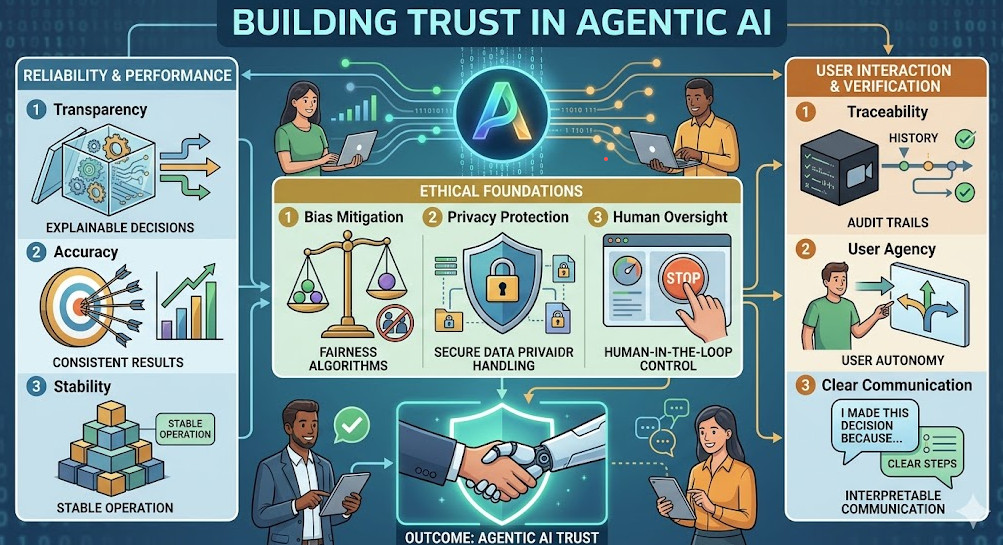
Table of Contents
Phase 1: High-Level Concepts & Core Architecture
To understand how to build trust, we must first dissect the architecture of an autonomous agent. An agent is typically composed of several interacting components:
- The Core LLM: The reasoning engine (e.g., GPT-4, Claude 3). This is the brain, responsible for high-level planning and natural language understanding.
- Memory: The agent’s persistent and short-term memory. This includes vector databases (for RAG) and structured state management.
- Tools/APIs: The agent’s hands. These are external, deterministic functions (e.g.,
query_database(sql),call_jira_api(ticket_id)). - The Planning Loop: The core operational mechanism. This loop takes an objective, breaks it down into steps, executes the steps, observes the outcome, and iterates until the goal is met or failure is declared.
The vulnerability in this system is not the LLM itself, but the Planning Loop. If the agent hallucinates a tool call, or if the tool call interacts with a sensitive system without proper guardrails, the consequences are severe.
The Trust Gap: From Accuracy to Verifiability
In traditional MLOps, trust was often measured by F1 scores or AUC. In agentic systems, trust must be measured by Verifiability and Auditability.
We must architect for the fact that the agent will fail, and that failure must be contained, logged, and explainable. This requires treating the agent’s execution path as a critical, auditable transaction.
💡 Pro Tip: Do not treat the LLM as a single monolithic function. Instead, architect it as a chain of verifiable micro-decisions. Each step (Plan -> Tool Selection -> Execution -> Observation) must be logged and validated against defined schemas.
Phase 2: Practical Implementation: Implementing Guardrails and Observability
Operationalizing agents requires moving beyond simple prompt engineering and implementing formal, structural guardrails. This is where the DevOps mindset intersects with AI governance.
2.1 Tool Schema Enforcement
The most common point of failure is the agent attempting to use a tool with incorrect parameters or an unauthorized scope. We must enforce strict Pydantic or JSON Schema validation on all tool inputs.
When defining tools, the agent should not just receive a description; it must receive a schema that dictates exactly what parameters are required, their data types, and their acceptable ranges.
Consider a simple inventory management agent. If the agent is supposed to query stock levels, the tool must enforce that the product_sku is a string of exactly 8 alphanumeric characters.
Code Example: Defining a Structured Tool Schema (Python/Pydantic)
from pydantic import BaseModel, Field

class InventoryQuery(BaseModel):
    """Schema for querying current stock levels."""
    product_sku: str = Field(description="The 8-character alphanumeric SKU of the product.")
    warehouse_id: str = Field(description="The unique ID of the warehouse location.")
    min_stock_threshold: int = Field(description="Minimum required stock level.")

def query_inventory(sku: str, warehouse_id: str, min_stock_threshold: int) -> dict:
    """Checks stock levels and returns a JSON object."""
    # Actual API call logic goes here
    return {"sku": sku, "warehouse": warehouse_id, "available": 45, "threshold": min_stock_threshold}
By forcing the agent to validate its intended action against this strict schema, we drastically reduce the attack surface and improve Agentic AI trust.
2.2 Observability and Tracing the Agentic Path
Observability for agents requires a specialized approach that goes beyond standard metrics. We need Traceability.
Every single step—the initial prompt, the thought process, the tool selection, the input parameters, the tool output, and the final synthesis—must be logged and associated with a unique Trace ID.
We recommend integrating this tracing into your existing observability stack (e.g., using OpenTelemetry). The agent’s execution path becomes a distributed transaction that can be visualized and debugged.
Code Example: Pseudo-code for Agent Execution Tracing
# Pseudocode for a robust agent execution wrapper
def execute_agent_task(goal: str, context: dict):
    trace_id = generate_uuid()
    log_span(trace_id, "START", "Agent Initialization", goal)

    # 1. Planning Step
    plan = llm_call(prompt, context)
    log_span(trace_id, "PLANNING", plan.steps)

    for step in plan.steps:
        # 2. Tool Selection & Execution
        tool_name, tool_args = select_tool(step)
        log_span(trace_id, "EXECUTION", f"Calling {tool_name} with {tool_args}")

        try:
            observation = execute_tool(tool_name, **tool_args)
            log_span(trace_id, "OBSERVATION", observation)
        except Exception as e:
            log_span(trace_id, "ERROR", str(e))
            return Failure(e)

    log_span(trace_id, "SUCCESS", "Task Completed")
    return Success()
This level of granular logging is paramount for debugging and establishing Agentic AI trust when things go wrong.
Phase 3: Senior-level Best Practices & Governance
For teams operating at scale, the focus shifts from “Does it work?” to “How do we prove it won’t fail, even under adversarial conditions?”
3.1 Formal Verification and Policy Enforcement
The ultimate level of Agentic AI trust requires moving toward formal verification. This means mathematically proving that the agent’s behavior adheres to a set of predefined, non-negotiable policies.
We should leverage Policy-as-Code engines, such as Open Policy Agent (OPA), to sit between the LLM’s decision-making layer and the actual API calls. OPA acts as a final, deterministic gatekeeper.
Before the agent executes query_database(sql), the request must pass through OPA, which checks:
- Does the user role have permission to run this query?
- Does the query violate any data masking policies (e.g., preventing
SELECT *on PII tables)? - Is the query structure valid against the schema?
This decouples the high-level, probabilistic reasoning of the LLM from the low-level, deterministic security enforcement of the infrastructure.
3.2 Implementing Sandboxing and Least Privilege
Never allow an agent to operate with blanket permissions. Every agent must operate within a strictly defined sandbox.
This sandbox must enforce Least Privilege Access (LPA). If an agent only needs to read from the Jira API, it should not have write access to the production database.
Architecturally, this means:
- Network Segmentation: Agents should reside in a dedicated, restricted network segment.
- API Keys/Tokens: Use temporary, scoped credentials (e.g., using Vault or AWS STS) that expire rapidly and only grant access to the specific resources required for the current task.
- Input/Output Filtering: Implement mandatory sanitization layers to prevent prompt injection or SQL injection attempts from reaching the backend tools.
3.3 The Human-in-the-Loop (HITL) Fallback
For high-stakes operations (e.g., financial transactions, infrastructure changes), the agent must never operate fully autonomously. The system must incorporate a mandatory Human-in-the-Loop (HITL) checkpoint.
The agent should be trained to recognize when its confidence score drops below a certain threshold, or when the planned action involves high-impact resources. At this point, the execution path must pause, generate a detailed summary of its proposed action, and require explicit human approval via a dedicated workflow (e.g., an internal ticketing system).
This layered approach—from schema validation to OPA enforcement and HITL—is the modern definition of robust Agentic AI trust.
💡 Pro Tip: When designing agentic workflows, always model the “failure path” before modeling the “success path.” What happens if the external API times out? What if the LLM hallucinates a non-existent tool? Build explicit retry logic, circuit breakers, and fallback plans for every possible failure mode.
Conclusion: The Future of Trust
The move to agentic systems is inevitable, and the power they unlock is revolutionary. However, this power comes with an unprecedented responsibility regarding governance and security.
Building Agentic AI trust is not a feature you add; it is a foundational architectural principle that must permeate every layer of the stack—from the prompt engineering to the policy enforcement engine. By adopting structured validation, deep observability, and formal verification methods, organizations can harness the immense potential of autonomous agents while maintaining the rigorous security and reliability demanded by senior DevOps and SecOps engineering teams.
If your team is navigating the complexities of integrating autonomous systems, understanding the full lifecycle of agentic governance is crucial. For more resources on mastering modern DevOps roles, check out our guide on DevOps roles.