Securing a Kubernetes cluster at scale is no longer optional; it is a fundamental requirement for production-grade environments. As clusters grow, manual configuration audits become impossible, leading to the rise of Policy-as-Code (PaC). In the cloud-native ecosystem, the debate usually centers around two heavyweights: Kyverno OPA Gatekeeper. While both aim to enforce guardrails, their architectural philosophies and day-two operational impacts differ significantly.
Table of Contents
Understanding Policy-as-Code in K8s
In a typical Admission Control workflow, a request to the API server is intercepted after authentication and authorization. Policy engines act as Validating or Mutating admission webhooks. They ensure that incoming manifests (like Pods or Deployments) comply with organizational standards—such as disallowing root containers or requiring specific labels.
Pro-Tip: High-maturity SRE teams don’t just use policy engines for security; they use them for governance. For example, automatically injecting sidecars or default resource quotas to prevent “noisy neighbor” scenarios.
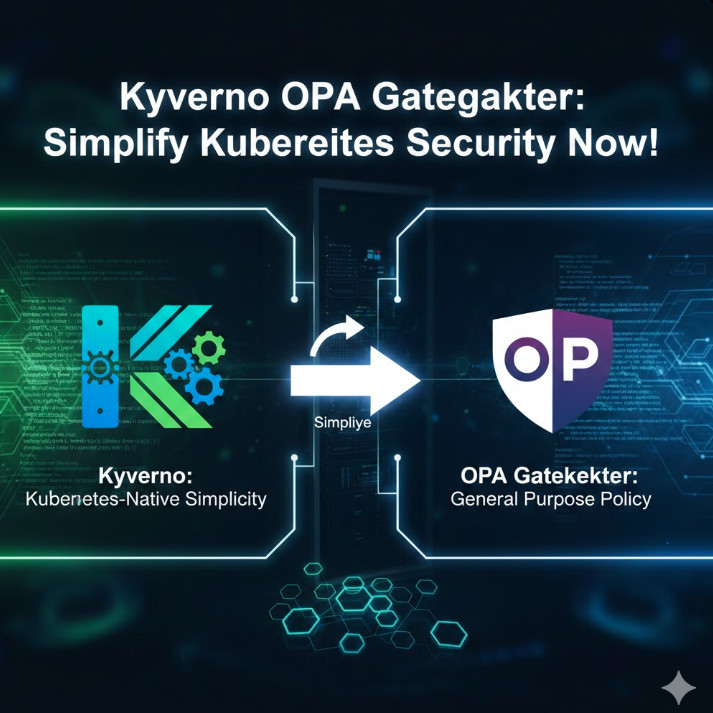
OPA Gatekeeper: The General Purpose Powerhouse
The Open Policy Agent (OPA) is a CNCF graduated project. Gatekeeper is the Kubernetes-specific implementation of OPA. It uses a declarative language called Rego.
The Rego Learning Curve
Rego is a query language inspired by Datalog. It is incredibly powerful but has a steep learning curve for engineers used to standard YAML manifests. To enforce a policy in OPA Gatekeeper, you must define a ConstraintTemplate (the logic) and a Constraint (the application of that logic).
# Example: OPA Gatekeeper ConstraintTemplate logic (Rego)
package k8srequiredlabels

violation[{"msg": msg, "details": {"missing_labels": missing}}] {
  provided := {label | input.review.object.metadata.labels[label]}
  required := {label | label := input.parameters.labels[_]}
  missing := required - provided
  count(missing) > 0
  msg := sprintf("you must provide labels: %v", [missing])
}
Kyverno: Kubernetes-Native Simplicity
Kyverno (Greek for “govern”) was designed specifically for Kubernetes. Unlike OPA, it does not require a new programming language. If you can write a Kubernetes manifest, you can write a Kyverno policy. This makes Kyverno OPA Gatekeeper comparisons often lean toward Kyverno for teams wanting faster adoption.
Key Kyverno Capabilities
- Mutation: Modify resources (e.g., adding
imagePullSecrets). - Generation: Create new resources (e.g., creating a default NetworkPolicy when a Namespace is created).
- Validation: Deny non-compliant resources.
- Cleanup: Remove stale resources based on time-to-live (TTL) policies.
# Example: Kyverno Policy to require 'team' label
apiVersion: kyverno.io/v1
kind: ClusterPolicy
metadata:
  name: require-team-label
spec:
  validationFailureAction: Enforce
  rules:
  - name: check-team-label
    match:
      any:
      - resources:
          kinds:
          - Pod
    validate:
      message: "The label 'team' is required."
      pattern:
        metadata:
          labels:
            team: "?*"
Kyverno vs. OPA Gatekeeper: Head-to-Head
| Feature | Kyverno | OPA Gatekeeper |
|---|---|---|
| Language | Kubernetes YAML | Rego (DSL) |
| Mutation Support | Excellent (Native) | Supported (via Mutation CRDs) |
| Resource Generation | Native (Generate rule) | Not natively supported |
| External Data | Supported (API calls/ConfigMaps) | Highly Advanced (Context-aware) |
| Ecosystem | K8s focused | Cross-stack (Terraform, HTTP, etc.) |
Production Best Practices & Troubleshooting
1. Audit Before Enforcing
Never deploy a policy in Enforce mode initially. Both tools support an Audit or Warn mode. Check your logs or PolicyReports to see how many existing resources would be “broken” by the new rule.
2. Latency Considerations
Every admission request adds latency. Complex Rego queries or Kyverno policies involving external API calls can slow down kubectl apply commands. Monitor the admission_webhook_admission_duration_seconds metric in Prometheus.
3. High Availability
If your policy engine goes down and the webhook is set to FailurePolicy: Fail, you cannot update your cluster. Always run at least 3 replicas of your policy controller and use pod anti-affinity to spread them across nodes.
Advanced Concept: Use Conftest (for OPA) or
kyverno jp(for Kyverno) in your CI/CD pipeline to catch policy violations at the Pull Request stage, long before they hit the cluster.
Frequently Asked Questions
Is Kyverno better than OPA?
“Better” depends on use case. Kyverno is easier for Kubernetes-only teams. OPA is better if you need a unified policy language for your entire infrastructure (Cloud, Terraform, App-level auth).
Can I run Kyverno and OPA Gatekeeper together?
Yes, you can run both simultaneously. However, it increases complexity and makes troubleshooting “Why was my pod denied?” significantly harder for developers.
How does Kyverno handle existing resources?
Kyverno periodically scans the cluster and generates PolicyReports. It can also be configured to retroactively mutate or validate existing resources when policies are updated.
Conclusion
Choosing between Kyverno OPA Gatekeeper comes down to the trade-off between power and simplicity. If your team is deeply embedded in the Kubernetes ecosystem and values YAML-native workflows, Kyverno is the clear winner for simplifying security. If you require complex, context-aware logic that extends beyond Kubernetes into your broader platform, OPA Gatekeeper remains the industry standard.
Regardless of your choice, the goal is the same: shifting security left and automating the boring parts of compliance. Start small, audit your policies, and gradually harden your cluster security posture.
Next Step: Review the Kyverno Policy Library to find pre-built templates for the CIS Kubernetes Benchmark. Thank you for reading the DevopsRoles page!