In the modern DevOps landscape, Infrastructure as Code (IaC) has moved from a best practice to an absolute necessity. Tools like Terraform, CloudFormation, and Pulumi allow us to treat our infrastructure configuration with the same rigor we apply to application code. This shift promises speed and repeatability.
However, writing code that deploys infrastructure is not the same as guaranteeing that infrastructure is secure, reliable, or compliant. A single missed security group rule, an unencrypted storage bucket, or a resource dependency failure can lead to catastrophic production outages.
This is where robust Infrastructure Testing becomes non-negotiable.
This comprehensive guide dives deep into the architecture and implementation of advanced Infrastructure Testing. We will move beyond simple linting, exploring how to combine static security analysis (using Checkov) with dynamic, end-to-end validation (using Terratest) to create a truly resilient CI/CD pipeline.
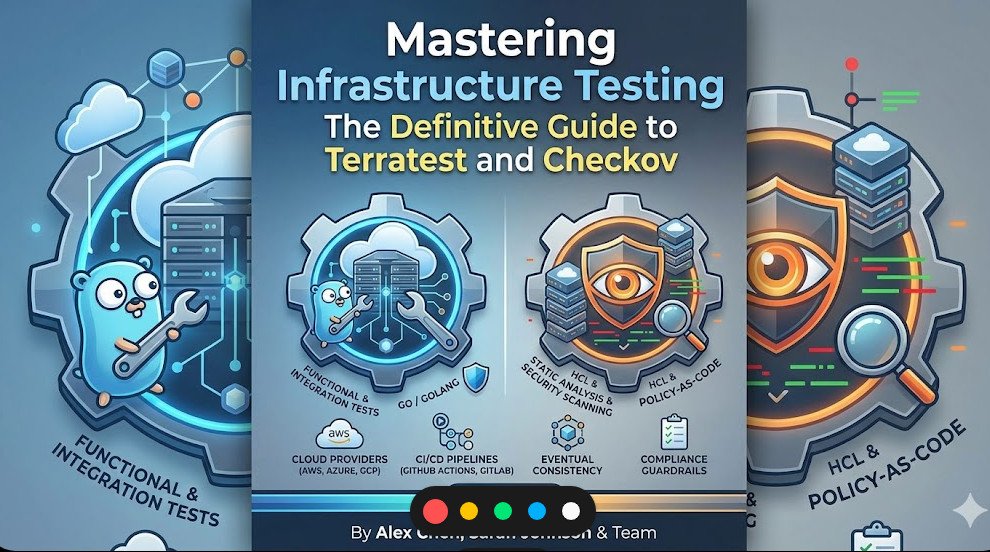
Table of Contents
Phase 1: Understanding the Pillars of IaC Validation
Before diving into code, we must understand the spectrum of testing required for IaC. Infrastructure Testing is not a single tool; it is a methodology that combines several layers of validation.
1. Static Analysis (Security and Compliance)
Static analysis tools examine your IaC files (YAML, HCL, JSON) without deploying anything. They check for policy violations, security misconfigurations, and adherence to organizational standards.
Checkov is the industry standard here. It scans code against thousands of predefined security and compliance benchmarks (CIS, PCI-DSS, etc.). It acts as a guardrail, catching misconfigurations before they ever reach the cloud provider.
2. Dynamic/Integration Testing (Functionality and State)
Dynamic testing requires the actual deployment of resources into a controlled environment. This validates that the deployed infrastructure works as intended and that the state management is correct.
Terratest, written in Go, is the powerhouse for this. It allows you to write standard unit and integration tests that interact with the cloud provider’s API. You can assert that a resource exists, that it has the correct attributes, or that a service endpoint is reachable.
3. The Synergy: Combining Tools for Full Coverage
The true power lies in the combination. You use Checkov to ensure the plan is secure, and Terratest to ensure the result is functional and reliable. This multi-layered approach is the hallmark of mature DevOps practices.
💡 Pro Tip: Never rely solely on the cloud provider’s native validation. While services like AWS CloudFormation Guard are excellent, they often focus on specific service constraints. Using open-source tools like Checkov and Terratest provides a broader, customizable, and often more immediate feedback loop into your development workflow.
Phase 2: Practical Implementation Workflow
We will simulate a common scenario: deploying a critical, publicly accessible resource (like an S3 bucket) and ensuring it meets both security and functional requirements.
Step 1: Defining the Infrastructure (Terraform)
Assume we have a main.tf file defining an S3 bucket.
# main.tf
resource "aws_s3_bucket" "data_store" {
  bucket = "my-secure-data-store-prod"
  acl    = "private"
  tags = {
    Environment = "Production"
  }
}
Step 2: Static Security Validation with Checkov
Before running terraform plan, we must run Checkov. This ensures that the bucket, for instance, is not accidentally configured to be public or lack encryption.
We execute Checkov against the directory containing our IaC files:
# Checkov scans the current directory for IaC files
checkov --directory . --framework terraform --skip-check CKV_AWS_133
If Checkov detects a violation (e.g., if we had removed acl = "private"), it will fail the build, providing immediate feedback on the security flaw.
Step 3: Dynamic Functional Validation with Terratest
After Checkov passes, we proceed to Terratest. We write a test that assumes the infrastructure has been provisioned and then verifies its properties.
Terratest tests are typically written in Go. The goal is to write a test function that:
- Applies the Terraform configuration.
- Waits for the resource to be fully provisioned.
- Uses the AWS SDK (via Terratest) to query the resource.
- Asserts that the queried properties match the expected state (e.g.,
IsPublicReadAccess = false).
Here is a conceptual snippet of the Go test file (test_s3.go):
package test

import (
    "testing"
    "github.com/gruntwork-io/terratest/modules/aws"
    "github.com/gruntwork-io/terratest/modules/terraform"
)

func TestS3BucketSecurity(t *testing.T) {
    // 1. Setup Terraform backend and apply
    terraformManager := terraform.WithWorkingDirectory("./terraform")
    terraformManager.Apply(t)

    // 2. Get the resource ID
    bucketName := terraform.Output(t, "bucket_name")

    // 3. Assert the security state using AWS SDK calls
    publicAccessBlock := aws.GetPublicAccessBlock(t, bucketName, "us-east-1")

    // Assert that the block is fully enabled
    if !publicAccessBlock.BlockPublicAcls {
        t.Errorf("FAIL: Public ACLs are not blocked for bucket %s", bucketName)
    }
}
This process guarantees that the infrastructure not only looks correct in the code but behaves correctly in the deployed cloud environment.
Phase 3: Advanced Best Practices and Troubleshooting
Achieving mature Infrastructure Testing requires integrating these tools into the core CI/CD pipeline and adopting advanced architectural patterns.
State Management and Testing Isolation
A critical failure point is state management. If your tests run concurrently or modify the state outside of the test scope, results will be unreliable.
Best Practice: Always use dedicated, ephemeral testing environments (e.g., a dev-test-run-uuid) for your tests. This ensures that the test run is isolated and does not interfere with staging or production state.
Policy-as-Code (PaC) Integration
For large enterprises, security policies must be centralized. Tools like Open Policy Agent (OPA), combined with Rego language, allow you to enforce policies that span multiple IaC frameworks (Terraform, Kubernetes, etc.).
Integrating OPA into your pipeline means that before Checkov runs, a policy check can run, providing an additional layer of governance. This moves governance from a reactive audit process to a proactive, preventative gate.
Handling Drift Detection
Infrastructure Testing must account for drift. Drift occurs when a resource is manually modified outside of the IaC pipeline (e.g., a sysadmin logs into the console and changes a tag).
Terratest can be adapted to run periodic drift checks. By comparing the desired state (from the IaC) against the actual state (from the API), you can flag discrepancies and enforce remediation via automated GitOps workflows.
💡 Pro Tip: When scaling your team, understanding the different roles required to maintain this complex pipeline is crucial. If you are looking to deepen your expertise in these specialized areas, explore the various career paths available at https://www.devopsroles.com/.
Troubleshooting Common Failures
| Failure Type | Symptom | Root Cause | Solution |
| Checkov Failure | Build fails during the plan or validate phase with a policy violation. | Security misconfiguration or non-compliance with organizational guardrails. | Identify the CKV ID, update the HCL/YAML, or use an inline skip comment if the risk is accepted: #checkov:skip=CKV_AWS_111:Reason. |
| Terratest Failure | Test times out or returns 404 Not Found for a resource just created. | Eventual Consistency: The cloud provider’s API hasn’t propagated the resource globally yet. | Use retry.DoWithRetry or resource.Test features in Go rather than hard time.Sleep to minimize test duration while ensuring reliability. |
| General / CI Failure | “Works on my machine” but fails in GitHub Actions/GitLab CI. | Discrepancies in Provider Versions, missing Secrets, or IAM Role limitations. | Pin versions in versions.tf. Audit the CI Runner’s IAM policy. Ensure TF_VAR_ environment variables are mapped in the pipeline YAML. |
The Future of IaC Testing: AI and Observability
As AI/MLOps matures, Infrastructure Testing will increasingly incorporate predictive modeling. Instead of just checking if a resource is secure, advanced systems will predict if a resource will become insecure under certain load or usage patterns.
This requires integrating your testing results with advanced observability platforms. By feeding the output of Checkov and Terratest into a centralized data lake, you build a comprehensive risk profile for your entire infrastructure stack.
Mastering this combination of static security scanning, dynamic functional testing, and policy enforcement is what separates commodity DevOps teams from elite, resilient engineering organizations. By embedding these checks early and often, you achieve true “shift-left” security and reliability.