
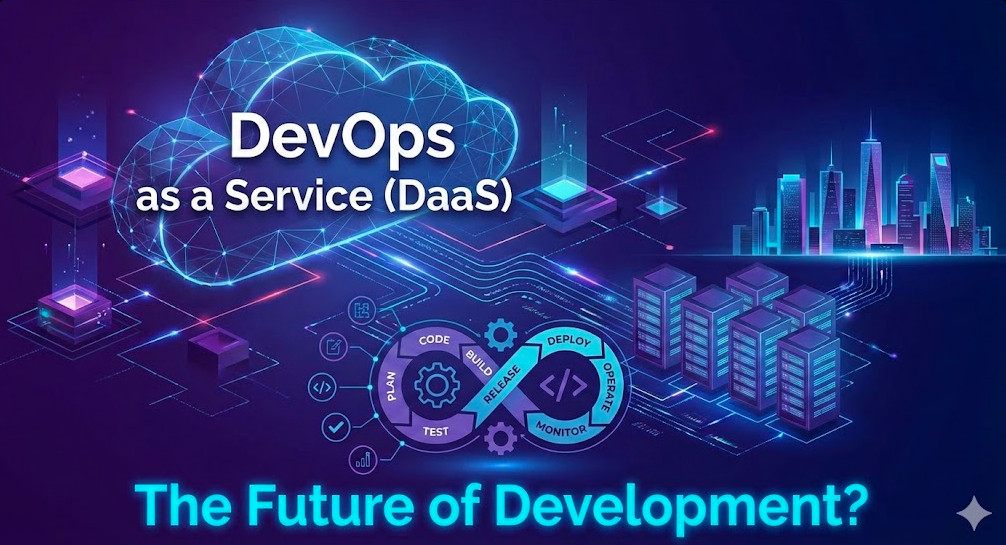
For years, the industry mantra has been “You build it, you run it.” While this philosophy dismantled silos, it also burdened expert engineering teams with cognitive overload. The sheer complexity of the modern cloud-native landscape—Kubernetes orchestration, Service Mesh implementation, compliance automation, and observability stacks—has birthed a new operational model: DevOps as a Service (DaaS).
This isn’t just about outsourcing CI/CD pipelines. For the expert SRE or Senior DevOps Architect, DaaS represents a fundamental shift from building bespoke infrastructure to consuming standardized, managed platforms. Whether you are building an Internal Developer Platform (IDP) or leveraging a third-party managed service, adopting a DevOps as a Service model aims to decouple developer velocity from infrastructure complexity.
Table of Contents
The Architectural Shift: Defining DaaS for the Enterprise
At an expert level, DevOps as a Service is the commoditization of the DevOps toolchain. It transforms the role of the DevOps engineer from a “ticket resolver” and “script maintainer” to a “Platform Engineer.”
The core value proposition addresses the scalability of human capital. If every microservice requires bespoke Helm charts, unique Terraform state files, and custom pipeline logic, the operational overhead scales linearly with the number of services. DaaS abstracts this into a “Vending Machine” model.
Architectural Note: In a mature DaaS implementation, the distinction between “Infrastructure” and “Application” blurs. The platform provides “Golden Paths”—pre-approved, secure, and compliant templates that developers consume via self-service APIs.
Anatomy of a Production-Grade DaaS Platform
A robust DevOps as a Service strategy rests on three technical pillars. It is insufficient to simply subscribe to a SaaS CI tool; the integration layer is where the complexity lies.
1. The Abstracted CI/CD Pipeline
In a DaaS model, pipelines are treated as products. Rather than copy-pasting .gitlab-ci.yml or Jenkinsfiles, teams inherit centralized pipeline libraries. This allows the Platform team to roll out security scanners (SAST/DAST) or policy checks globally by updating a single library version.
2. Infrastructure as Code (IaC) Abstraction
The DaaS approach moves away from raw resource definitions. Instead of defining an AWS S3 bucket directly, a developer defines a “Storage Capability” which the platform resolves to an encrypted, compliant, and tagged S3 bucket.
Here is an example of how a DaaS module might abstract complexity using Terraform:
# The Developer Interface (Simple, Intent-based)
module "microservice_stack" {
  source      = "git::https://internal-daas/modules/app-stack.git?ref=v2.4.0"
  app_name    = "payment-service"
  environment = "production"
  # DaaS handles VPC peering, IAM roles, and SG rules internally
  expose_publicly = false
}

# The Platform Engineering Implementation (Complex, Opinionated)
# Inside the module, we enforce organization-wide standards
resource "aws_s3_bucket" "logs" {
  bucket = "${var.app_name}-${var.environment}-logs"

  # Enforced Compliance
  server_side_encryption_configuration {
    rule {
      apply_server_side_encryption_by_default {
        sse_algorithm = "AES256"
      }
    }
  }
}
This abstraction ensures that Infrastructure as Code remains consistent across hundreds of repositories, mitigating “configuration drift.”
Build vs. Buy: The Technical Trade-offs
For the Senior Staff Engineer, the decision to implement DevOps as a Service often comes down to a “Build vs. Buy” analysis. Are you building an internal DaaS (Platform Engineering) or hiring an external DaaS provider?
| Factor | Internal DaaS (Platform Eng.) | External Managed DaaS |
|---|---|---|
| Control | High. Full customizability of the toolchain. | Medium/Low. constrained by vendor opinion. |
| Day 2 Operations | High burden. You own the uptime of the CI/CD stack. | Low. SLAs guaranteed by the vendor. |
| Cost Model | CAPEX heavy (Engineering hours). | OPEX heavy (Subscription fees). |
| Compliance | Must build custom controls for SOC2/HIPAA. | Often inherits vendor compliance certifications. |
Pro-Tip: Avoid the “Not Invented Here” syndrome. If your core business isn’t infrastructure, an external DaaS partner or a highly opinionated managed platform (like Heroku or Vercel for enterprise) is often the superior strategic choice to reduce Time-to-Market.
Adopting DevOps as a Service introduces a specific set of security challenges. When you centralize DevOps logic, you create a high-value target for attackers. A compromise of the DaaS pipeline can lead to a supply chain attack, injecting malicious code into every artifact built by the system.
Hardening the DaaS Interface
- Least Privilege: The DaaS agent (e.g., GitHub Actions Runner, Jenkins Agent) must have ephemeral permissions. Use OIDC (OpenID Connect) to assume roles rather than storing long-lived AWS_ACCESS_KEY_ID secrets.
- Policy as Code: Implement Open Policy Agent (OPA) to gate deployments. The DaaS platform should reject any infrastructure request that violates compliance rules (e.g., creating a public Load Balancer in a PCI-DSS environment).
- Artifact Signing: Ensure the DaaS pipeline signs container images (using tools like Cosign) so that the Kubernetes admission controller only allows trusted images to run.
Frequently Asked Questions (FAQ)
How does DaaS differ from PaaS (Platform as a Service)?
PaaS (like Google App Engine) provides the runtime environment for applications. DevOps as a Service focuses on the delivery pipeline—the tooling, automation, and processes that get code from commit to the PaaS or IaaS. DaaS manages the “How,” while PaaS provides the “Where.”
Is DevOps as a Service cost-effective for large enterprises?
It depends on your “Undifferentiated Heavy Lifting.” If your expensive DevOps engineers are spending 40% of their time patching Jenkins or upgrading K8s clusters, moving to a DaaS model (managed or internal platform) yields a massive ROI by freeing them to focus on application reliability and performance tuning.
What are the risks of vendor lock-in with DaaS?
High. If you build your entire delivery flow around a proprietary DaaS provider’s specific YAML syntax or plugins, migrating away becomes a refactoring nightmare. To mitigate this, rely on open standards like Docker, Kubernetes, and Terraform, using the DaaS provider merely as the orchestrator rather than the logic holder.

Conclusion
DevOps as a Service is not merely a trend; it is the industrialization of software delivery. For expert practitioners, it signals a move away from “crafting” servers to “engineering” platforms.
Whether you choose to build an internal platform or leverage a managed service, the goal remains the same: reduce cognitive load for developers and increase deployment velocity without sacrificing stability. As we move toward 2026, the organizations that succeed will be those that treat their DevOps capabilities not as a series of tickets, but as a reliable, scalable product.
Ready to architect your platform strategy? Start by auditing your current “Day 2” operational costs to determine if a DaaS migration is your next logical step. Thank you for reading the DevopsRoles page!