The rapid proliferation of AI agents has fundamentally changed the application landscape. These agents, capable of autonomous decision-making and interacting with dozens of external services, are incredibly powerful. However, this power comes with a monumental security burden: managing credentials.
Traditional methods of storing API keys—environment variables, configuration files, or simple key-value stores—are catastrophically inadequate for modern, distributed AI architectures. A single leaked key can grant an attacker access to mission-critical data, financial services, or proprietary models.
This deep dive is designed for Senior DevOps, MLOps, SecOps, and AI Engineers. We will move beyond basic secrets management. We will architect a robust, self-hosted credential solution that enforces Zero Trust principles, ensuring that API Key Security is not an afterthought, but a core architectural pillar.
We are building a system where AI agents never directly hold long-lived secrets. Instead, they dynamically request ephemeral credentials from a hardened, self-hosted vault.
Table of Contents
Phase 1: The Architectural Shift – From Static Secrets to Dynamic Identity
Before writing a single line of code, we must understand the threat model. In a typical microservices environment, a service might use a static key stored in a Kubernetes Secret. If that pod is compromised, the attacker gains the key indefinitely.
The goal of advanced API Key Security is to eliminate static secrets entirely. We must transition to dynamic secrets and identity-based access.
The Core Components of a Secure AI Agent Architecture
Our proposed architecture revolves around three core components:
- The AI Agent Workload: The service that needs to perform actions (e.g., calling OpenAI, interacting with a payment gateway). It only possesses an identity (e.g., a Kubernetes Service Account or an AWS IAM Role).
- The Self-Hosted Vault: The central, hardened authority (e.g., HashiCorp Vault). This vault does not store the actual keys; it stores the rules for generating temporary keys.
- The Sidecar/Agent Injector: A dedicated process running alongside the AI Agent. This component is responsible for mediating all secret requests, ensuring the agent never communicates directly with the external service using a raw key.
This pattern enforces the principle of least privilege by design. The agent only receives the exact credential it needs, for the exact duration it needs it.
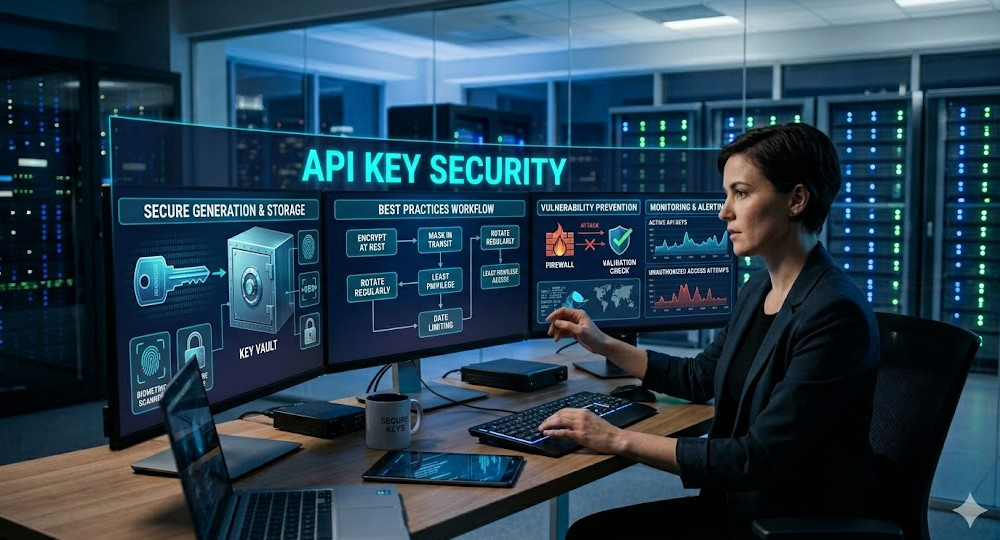
This architectural shift is the cornerstone of modern API Key Security. It means that even if the AI Agent workload is compromised, the attacker only gains access to a temporary, scoped token that will expire within minutes.
💡 Pro Tip: When designing the vault, always implement a dedicated Audit Backend. Every single request—successful or failed—must be logged with the identity that requested it, the resource it accessed, and the time of expiration. This provides an undeniable chain of custody for forensic analysis.
Phase 2: Practical Implementation – Vault Integration with Kubernetes
To make this architecture functional, we will use a common, robust pattern: integrating the vault via a Kubernetes Sidecar Container. This pattern keeps the secret fetching logic separate from the application logic.
We will assume the use of HashiCorp Vault, configured with the Kubernetes Auth Method. This allows the vault to trust the identity provided by the Kubernetes API server.
Step 1: Defining the Vault Policy
The first step is defining a strict policy that dictates what the AI Agent can access. This policy is the core of our API Key Security strategy. It must be scoped down to the absolute minimum required permissions.
Here is an example of a policy (agent-policy.hcl) that grants read-only access to a specific database secret, but nothing else:
# agent-policy.hcl
# This policy ensures the agent can only read the 'database/creds/read-only' path.
# It explicitly denies all other actions.
path "database/creds/read-only" {
  capabilities = ["read"]
}

# We must also ensure the agent cannot list or modify policies.
# This is critical for maintaining the integrity of the vault.
# Deny all other paths by default.
# (Note: Vault policies are additive, but explicit denial is best practice)
Step 2: Configuring the Sidecar Injection
The AI Agent workload definition (Deployment YAML) is modified to include the Sidecar. This sidecar container handles the authentication handshake with the Vault.
apiVersion: apps/v1
kind: Deployment
metadata:
  name: ai-agent-service
spec:
  template:
    spec:
      containers:
      # 1. The main AI Agent container
      - name: agent-app
        image: my-ai-agent:v2.1
        env:
        - name: VAULT_ADDR
          value: "http://vault.vault.svc.cluster.local:8200"
        # The agent only needs to know *where* the vault is.
      # 2. The Sidecar container responsible for secrets fetching
      - name: vault-sidecar
        image: hashicorp/vault-agent:latest
        args:
        - write
        - auth
        - -method=kubernetes
        - -role=ai-agent-role
        - -jwt-path=/var/run/secrets/kubernetes.io/serviceaccount/token
        - -k8s-ca-cert-data=/var/run/secrets/kubernetes.io/serviceaccount/ca.crt
        - -k8s-token-data=/var/run/secrets/kubernetes.io/serviceaccount/token
        - -write-secret-path=secret/data/ai-agent/api-key
        - -secret-key-field=api_key
When this deployment runs, the vault-sidecar authenticates using the Service Account token. It then uses the defined policy to request a temporary secret. The secret is written to a shared volume, which the agent-app container reads from.
This process ensures that the raw API Key Security credentials are never visible in the deployment YAML, environment variables, or container logs.
Phase 3: Senior-Level Best Practices, Auditing, and Resilience
Achieving basic dynamic secrets is only the starting point. For a production-grade, highly resilient system, we must implement advanced controls that address failure modes and operational drift.
1. Mandatory Secret Rotation and TTL Management
Never rely on secrets that live longer than necessary. The vault must be configured with aggressive Time-To-Live (TTL) parameters.
When an AI Agent requests a credential, the vault should issue a token with a very short lifespan (e.g., 15 minutes). The sidecar must be programmed to automatically detect the token expiration and initiate a renewal request before the token dies. This is known as Lease Renewal.
If the renewal fails (e.g., the network connection drops), the agent must fail fast, preventing it from attempting to use an expired credential.
2. Implementing Identity Federation and RBAC
Do not rely solely on Kubernetes Service Accounts for identity. For maximum API Key Security, integrate identity federation with your organization’s Identity Provider (IdP) (e.g., Okta, Azure AD).
The vault should authenticate the human or machine identity against the IdP, which then issues a short-lived, verifiable token that the vault accepts. This ties the secret access not just to a service, but to a specific, audited user or CI/CD pipeline run.
3. The Principle of Just-in-Time (JIT) Access
JIT access is the gold standard. Instead of granting the AI Agent a permanent role, the agent must request elevated access only when a specific, audited event occurs (e.g., “The nightly billing report generation job needs access to the payment API”).
This requires an orchestration layer (like an internal workflow engine) that acts as a gatekeeper, validating the request against business logic before allowing the sidecar to talk to the vault.
💡 Pro Tip: For extremely sensitive operations (like modifying production database credentials), consider implementing a Multi-Party Approval Workflow. The vault policy should require two separate, time-limited tokens—one from the MLOps team and one from the SecOps team—before the secret is even generated.
4. Advanced Troubleshooting: Handling Policy Drift
One of the most common failures in complex secret architectures is Policy Drift. This occurs when a developer manually changes a resource or service without updating the corresponding vault policy.
To mitigate this, implement Policy-as-Code (PaC). Treat your vault policies like application code. Store them in Git, subject them to peer review (Pull Requests), and enforce deployment via CI/CD pipelines. This ensures that the security posture is version-controlled and auditable.
5. Auditing and Monitoring the Vault Plane
The vault itself must be treated as the most critical asset. Monitor the following metrics obsessively:
- Authentication Failures: A spike in failed authentication attempts suggests a potential brute-force attack or misconfiguration.
- Rate Limiting: Track how often a specific service hits its rate limit. This can indicate an infinite loop or a runaway process.
- Policy Changes: Any modification to a policy must trigger an immediate, high-priority alert to the SecOps team.
For deeper insights into the roles and responsibilities involved in maintaining these complex systems, check out the various career paths available at https://www.devopsroles.com/.
By adopting dynamic, identity-based credential management, you move from a reactive security posture to a proactive, zero-trust architecture. This robust approach is essential for scaling AI agents securely.