
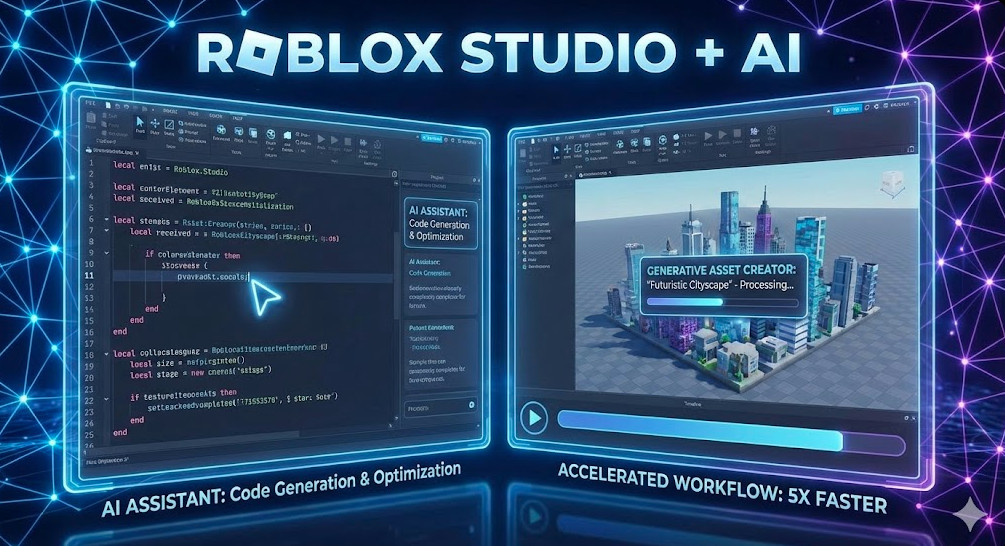
The paradigm of game development is shifting from purely imperative coding to intent-based generation. For technical directors and senior developers, Roblox AI game creation represents more than just a novelty; it is a fundamental workflow accelerator. By integrating Large Language Models (LLMs) and generative texture synthesis directly into the engine, Roblox Studio is reducing the friction between architectural concept and playable prototype. This article dissects the technical implementation of these features, analyzing how they optimize Luau scripting and asset generation for high-velocity development cycles.
Table of Contents
The Architecture of Roblox’s Generative AI Stack
Roblox’s approach to AI is distinct because it operates within a highly constrained, physics-simulated environment. Unlike generic chatbots, the models powering Roblox AI game creation are fine-tuned specifically on the Luau language corpus and the Roblox API surface area.
The stack generally operates on two primary modalities:
- Code Generation: Leveraging transformer-based models trained on years of open-source Roblox scripts to predict logic and syntax.
- Material Synthesis: Utilizing diffusion-like models to generate tileable PBR (Physically Based Rendering) textures (albedo, normal, roughness, metalness maps) from semantic text prompts.
Pro-Tip for AI Engineers: The efficacy of the Code Assist tool relies heavily on the “Context Window.” When prompting for script generation, keeping relevant Service definitions and variable declarations in the active file helps the model infer the correct API references (e.g., distinguishing between
ServerStorageandReplicatedStorageusage).
Accelerating Scripting with AI-Powered Code Assist
For the expert developer, the value of AI is not in writing print("Hello World"), but in boilerplate reduction and algorithmic suggestions. The Roblox AI game creation suite integrates directly into the Script Editor, offering autocomplete and full-function generation.
Context-Aware Logic Generation
The AI analyzes the comment preceding the cursor to determine intent. It attempts to construct valid Luau code that respects Roblox’s event-driven architecture.
Example: Generating a Proximity Prompt Handler
Input Comment:
-- Create a function that tween's the part's color to red when a player interacts with the ProximityPrompt, then resets it after 5 seconds.AI Output:
local TweenService = game:GetService("TweenService")
local part = script.Parent
local prompt = part:WaitForChild("ProximityPrompt")

local goalOpen = {Color = Color3.fromRGB(255, 0, 0)}
local goalClose = {Color = Color3.fromRGB(255, 255, 255)} -- Assuming white is default
local tweenInfo = TweenInfo.new(1)

local tweenOpen = TweenService:Create(part, tweenInfo, goalOpen)
local tweenClose = TweenService:Create(part, tweenInfo, goalClose)

prompt.Triggered:Connect(function(player)
    tweenOpen:Play()
    task.wait(5)
    tweenClose:Play()
end)
Note the use of task.wait() over the deprecated wait(). The model has been tuned to prefer modern Roblox best practices, reducing the technical debt typically associated with auto-generated code.
Refactoring and Optimization
Beyond generation, the Assistant can be used to refactor inefficient loops or deprecated methods. By highlighting a block of code and invoking the AI assistant, you can request optimizations such as “Convert this generic for-loop to utilize table.foreach or parallel Luau where applicable.”
Generative Materials: PBR at Scale
The visual component of Roblox AI game creation addresses the asset bottleneck. Creating custom materials usually involves external tools like Substance Designer or searching through expansive libraries.
The Material Generator allows developers to prompt for specific physical properties. For example, prompting “Wet cobblestone with moss in crevices” does not just paste an image; it generates the necessary maps to interact with Roblox’s lighting engine.
Technical Considerations for Material AI
- Tiling: The generator optimizes for seamless tiling, crucial for large terrain or architectural surfaces.
- Resolution: While currently optimized for performance (memory budget), the consistency of the normal maps generated ensures that depth perception remains high even at lower texture resolutions.
- Style Consistency: You can enforce a “Low Poly” or “Realistic” style token in your prompts to maintain visual coherence across different assets.
DevOps Integration: AI in the CI/CD Pipeline
For teams using Rojo to sync Roblox projects with Git, the AI tools inside Studio act as the “local development environment” accelerator. While the AI generation happens in Studio, the output is standard text (Lua) or binary assets (rbxmx) that can be committed to version control.
Workflow Note: Currently, Roblox’s AI features are Studio-bound. You cannot yet invoke the generation API programmatically via CLI for automated build pipelines, but the generated code is fully compatible with standard linting tools like Selene or StyLua.
Frequently Asked Questions (FAQ)
How does Roblox AI handle security and malicious code?
Roblox utilizes a multi-layered filter. The training data excludes known malicious patterns (backdoors, obfuscated viruses). Additionally, the output is subject to standard Roblox text filtering policies. However, developers must always review AI-generated code, as the AI acts as a “copilot,” not a security guarantor.
Can the AI write complex ModuleScripts for frameworks like Knit?
Yes, but it requires context. If your current script requires a module, the AI can infer usage if the require() statement is present and the variable naming is semantic. It struggles with architectural decisions but excels at implementation details within a defined structure.
Is the generated code optimized for Parallel Luau?
Not by default. You must explicitly prompt the Assistant to “Use Parallel Luau Actors” or “Write this using task.desynchronize” to leverage multi-threading capabilities.

Conclusion
Roblox AI game creation is not about replacing the engineer; it is about elevating the abstraction level. By offloading the syntax of boilerplates and the tedium of texture hunting to generative models, Senior Developers and Technical Artists can focus on gameplay loops, system architecture, and user experience. As these models evolve, we expect deeper integration into the Entity Component System (ECS) and potentially runtime AI generation features.
To stay competitive, teams should begin incorporating these prompts into their daily workflows, treating the AI as a junior pair programmer that is always available and intimately familiar with the Roblox API. Thank you for reading the DevopsRoles page!