
The era of manual prompt engineering is over. For modern firms, deploying AI for agencies is no longer about giving employees access to ChatGPT; it is about architecting intelligent, autonomous ecosystems that function as force multipliers. As we move from experimental pilot programs to production-grade implementation, the challenge shifts from “What can AI do?” to “How do we scale AI across 50+ unique client environments without breaking compliance or blowing up token costs?”
This guide is written for technical leaders and solutions architects who need to build robust, multi-tenant AI infrastructures. We will bypass the basics and dissect the architectural patterns, security protocols, and workflow orchestration strategies required to serve more clients efficiently using high-performance AI pipelines.
Table of Contents
The Architectural Shift: From Chatbots to Agentic Workflows
To truly leverage AI for agencies, we must move beyond simple Request/Response patterns. The future lies in Agentic Workflows—systems where LLMs act as reasoning engines that can plan, execute tools, and iterate on results before presenting them to a human.
Pro-Tip: Do not treat LLMs as databases. Treat them as reasoning kernels. Offload memory to Vector Stores (e.g., Pinecone, Weaviate) and deterministic logic to traditional code. This hybrid approach reduces hallucinations and ensures client-specific data integrity.
The Multi-Agent Pattern
For complex agency deliverables—like generating a full SEO audit or a monthly performance report—a single prompt is insufficient. You need a Multi-Agent System (MAS) where specialized agents collaborate:
- The Router: Classifies the incoming client request (e.g., “SEO”, “PPC”, “Content”) and directs it to the appropriate sub-system.
- The Researcher: Uses RAG (Retrieval-Augmented Generation) to pull client brand guidelines and past performance data.
- The Executor: Generates the draft content or performs the analysis.
- The Critic: Reviews the output against specific quality heuristics before final delivery.
Engineering Multi-Tenancy for Client Isolation
The most critical risk in deploying AI for agencies is data leakage. You cannot allow Client A’s strategy documents to influence Client B’s generated content. Deep multi-tenancy must be baked into the retrieval layer.
Logical Partitioning in Vector Databases
When implementing RAG, you must enforce strict metadata filtering. Every chunk of embedded text must be tagged with a `client_id` or `namespace`.
import pinecone
from langchain.embeddings import OpenAIEmbeddings

# Initialize connection
pinecone.init(api_key="YOUR_API_KEY", environment="us-west1-gcp")
index = pinecone.Index("agency-knowledge-base")

def query_client_knowledge(query, client_id, top_k=5):
    """
    Retrieves context strictly isolated to a specific client.
    """
    embeddings = OpenAIEmbeddings()
    vector = embeddings.embed_query(query)

    # CRITICAL: The filter ensures strict data isolation
    results = index.query(
        vector=vector,
        top_k=top_k,
        include_metadata=True,
        filter={
            "client_id": {"$eq": client_id}
        }
    )
    return results
This approach allows you to maintain a single, cost-effective vector index while mathematically guaranteeing that Client A’s context is invisible to Client B’s queries.
Productionizing Workflows with LangGraph & Queues
Scaling AI for agencies requires handling concurrency. If you have 100 clients triggering reports simultaneously at 9:00 AM on Monday, direct API calls to OpenAI or Anthropic will hit rate limits immediately.
The Asynchronous Queue Pattern
Implement a message broker (like Redis or RabbitMQ) between your application layer and your AI workers.
- Ingestion: Client request is pushed to a `high-priority` or `standard` queue based on their retainer tier.
- Worker Pool: Background workers pick up tasks.
- Rate Limiting: Workers respect global API limits (e.g., Token Bucket algorithm) to prevent 429 errors.
- Persistence: Intermediate states are saved. If a workflow fails (e.g., an API timeout), it can retry from the last checkpoint rather than restarting.
Architecture Note: Consider using LangGraph for stateful orchestration. Unlike simple chains, graphs allow for cycles—enabling the AI to “loop” and self-correct if an output doesn’t meet quality standards.
Cost Optimization & Token Economics
Margins matter. Running GPT-4 for every trivial task will erode profitability. A smart AI for agencies strategy involves “Model Routing.”
| Task Complexity | Recommended Model | Cost Efficiency |
|---|---|---|
| High Reasoning (Strategy, complex coding, creative conceptualization) | GPT-4o, Claude 3.5 Sonnet | Low (High Cost) |
| Moderate (Summarization, simple drafting, RAG synthesis) | GPT-4o-mini, Claude 3 Haiku | High |
| Low/Deterministic (Classification, entity extraction) | Fine-tuned Llama 3 (Self-hosted) or Mistral | Very High |
Semantic Caching: Implement a semantic cache (e.g., GPTCache). If a user asks a question that is semantically similar to a previously answered question (for the same client), serve the cached response instantly. This reduces latency by 90% and costs by 100% for repetitive queries.
Frequently Asked Questions (FAQ)
How do we handle hallucination risks in client deliverables?
Never send raw LLM output directly to a client. Implement a “Human-in-the-Loop” (HITL) workflow where the AI generates a draft, and a notification is sent to a human account manager for approval. Additionally, use “Grounding” techniques where the LLM is forced to cite sources from the retrieved documents.
Should we fine-tune our own models?
Generally, no. For 95% of agency use cases, RAG (Retrieval-Augmented Generation) is superior to fine-tuning. Fine-tuning is for teaching a model a new form or style (e.g., writing code in a proprietary internal language), whereas RAG is for providing the model with new facts (e.g., a client’s specific Q3 performance data). RAG is cheaper, faster to update, and less prone to catastrophic forgetting.
How do we ensure compliance (SOC2/GDPR) when using AI?
Ensure you are using “Enterprise” or “API” tiers of model providers, which typically guarantee that your data is not used to train their base models (unlike the free ChatGPT interface). For strict data residency requirements, consider hosting open-source models (like Llama 3 or Mixtral) on your own VPC using tools like vLLM or TGI.

Conclusion
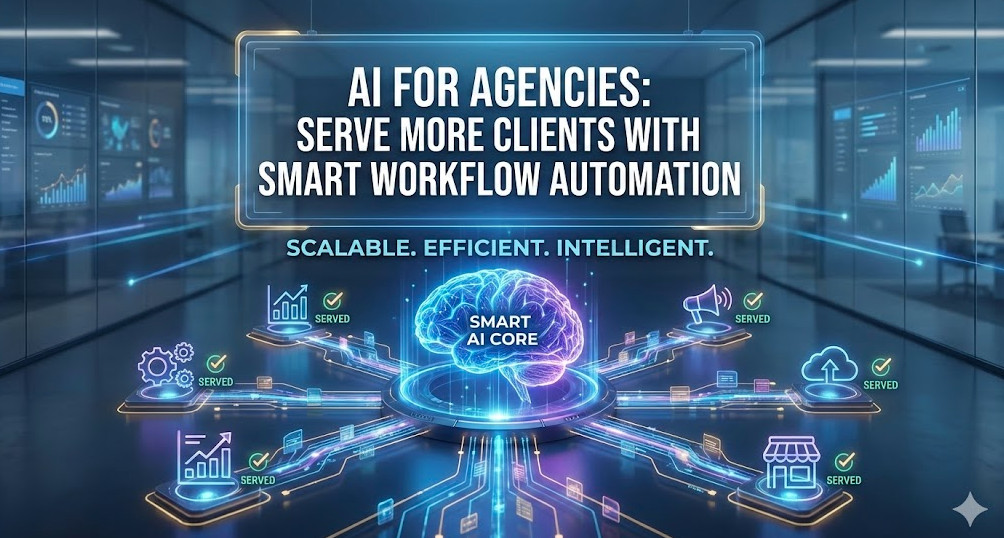
Mastering AI for agencies is an engineering challenge, not just a creative one. By implementing robust multi-tenant architectures, leveraging agentic workflows with stateful orchestration, and managing token economics strictly, your agency can scale operations non-linearly.
The agencies that win in the next decade won’t just use AI; they will be built on top of AI primitives. Start by auditing your current workflows, identify the bottlenecks that require high-reasoning capabilities, and build your first multi-agent router today. Thank you for reading the DevopsRoles page!