The transition from static chatbots to autonomous agents represents a paradigm shift in software engineering. We are no longer writing rigid procedural code; we are orchestrating probabilistic reasoning loops. For expert developers, the challenge isn’t just getting an LLM to respond—it’s controlling the side effects, managing state, and deploying a reliable Python AI Agent that can interact with the real world.
This guide bypasses the beginner fluff. We won’t be explaining what a variable is. Instead, we will architect a production-grade agent using LangGraph for state management, OpenAI for reasoning, and FastAPI for serving, wrapping it all in a multi-stage Docker build ready for Kubernetes or Cloud Run.
Table of Contents
- 1 1. The Architecture: ReAct & Event Loops
- 2 2. Prerequisites & Tooling
- 3 3. Step 1: The Reasoning Engine (LangGraph)
- 4 4. Step 2: Implementing Deterministic Tools
- 5 5. Step 3: Asynchronous Serving with FastAPI
- 6 6. Step 4: Production Containerization
- 7 7. Advanced Patterns: Memory & Observability
- 8 8. Frequently Asked Questions (FAQ)
- 9 9. Conclusion
1. The Architecture: ReAct & Event Loops
Before writing code, we must define the control flow. A robust Python AI Agent typically follows the ReAct (Reasoning + Acting) pattern. Unlike a standard RAG pipeline which retrieves and answers, an agent maintains a loop: Think $\rightarrow$ Act $\rightarrow$ Observe $\rightarrow$ Repeat.
In a production environment, we model this as a state machine (a directed cyclic graph). This provides:
- Cyclic Capability: The ability for the agent to retry failed tool calls.
- Persistence: Storing the state of the conversation graph (checkpoints) in Redis or Postgres.
- Human-in-the-loop: Pausing execution for approval before sensitive actions (e.g., writing to a database).
Pro-Tip: Avoid massive “God Chains.” Decompose your agent into specialized sub-graphs (e.g., a “Research Node” and a “Coding Node”) passed via a supervisor architecture for better determinism.
2. Prerequisites & Tooling
We assume a Linux/macOS environment with Python 3.11+. We will use uv (an extremely fast Python package manager written in Rust) for dependency management, though pip works fine.
pip install langchain-openai langgraph fastapi uvicorn pydantic python-dotenvEnsure your OPENAI_API_KEY is set in your environment.
3. Step 1: The Reasoning Engine (LangGraph)
We will use LangGraph rather than standard LangChain `AgentExecutor` because it offers fine-grained control over the transition logic.
Defining the State
First, we define the AgentState using TypedDict. This effectively acts as the context object passed between nodes in our graph.
from typing import TypedDict, Annotated, Sequence
import operator
from langchain_core.messages import BaseMessage

class AgentState(TypedDict):
    messages: Annotated[Sequence[BaseMessage], operator.add]
    # You can add custom keys here like 'user_id' or 'trace_id'
The Graph Construction
Here we bind the LLM to tools and define the execution nodes.
from langchain_openai import ChatOpenAI
from langgraph.graph import StateGraph, END
from langchain_core.tools import tool

# Initialize Model
model = ChatOpenAI(model="gpt-4-turbo-preview", temperature=0)

# Define the nodes
def call_model(state):
    messages = state['messages']
    response = model.invoke(messages)
    return {"messages": [response]}

# Define the graph
workflow = StateGraph(AgentState)
workflow.add_node("agent", call_model)
# Note: "action" node logic for tool execution will be added in Step 2

workflow.set_entry_point("agent")
4. Step 2: Implementing Deterministic Tools
A Python AI Agent is only as good as its tools. We use Pydantic for strict schema validation of tool inputs. This ensures the LLM hallucinates arguments less frequently.
from langchain_core.tools import tool
from langchain_community.tools.tavily_search import TavilySearchResults

@tool
def get_weather(location: str) -> str:
    """Returns the weather for a specific location."""
    # In production, this would hit a real API like OpenWeatherMap
    return f"The weather in {location} is 22 degrees Celsius and sunny."

# Bind tools to the model
tools = [get_weather]
model = model.bind_tools(tools)

# Update the graph with a ToolNode
from langgraph.prebuilt import ToolNode

tool_node = ToolNode(tools)
workflow.add_node("tools", tool_node)

# Add Conditional Edge (The Logic)
def should_continue(state):
    last_message = state['messages'][-1]
    if last_message.tool_calls:
        return "tools"
    return END

workflow.add_conditional_edges("agent", should_continue)
workflow.add_edge("tools", "agent")

app = workflow.compile()
5. Step 3: Asynchronous Serving with FastAPI
Running an agent in a script is useful for debugging, but deployment requires an HTTP interface. FastAPI provides the asynchronous capabilities needed to handle long-running LLM requests without blocking the event loop.
from fastapi import FastAPI, HTTPException
from pydantic import BaseModel
from langchain_core.messages import HumanMessage

class QueryRequest(BaseModel):
    query: str
    thread_id: str = "default_thread"

api = FastAPI(title="Python AI Agent API")

@api.post("/chat")
async def chat_endpoint(request: QueryRequest):
    try:
        inputs = {"messages": [HumanMessage(content=request.query)]}
        config = {"configurable": {"thread_id": request.thread_id}}

        # Stream or invoke
        response = await app.ainvoke(inputs, config=config)

        return {
            "response": response["messages"][-1].content,
            "tool_usage": len(response["messages"]) > 2 # varied based on flow
        }
    except Exception as e:
        raise HTTPException(status_code=500, detail=str(e))

# Run with: uvicorn main:api --host 0.0.0.0 --port 8000
6. Step 4: Production Containerization
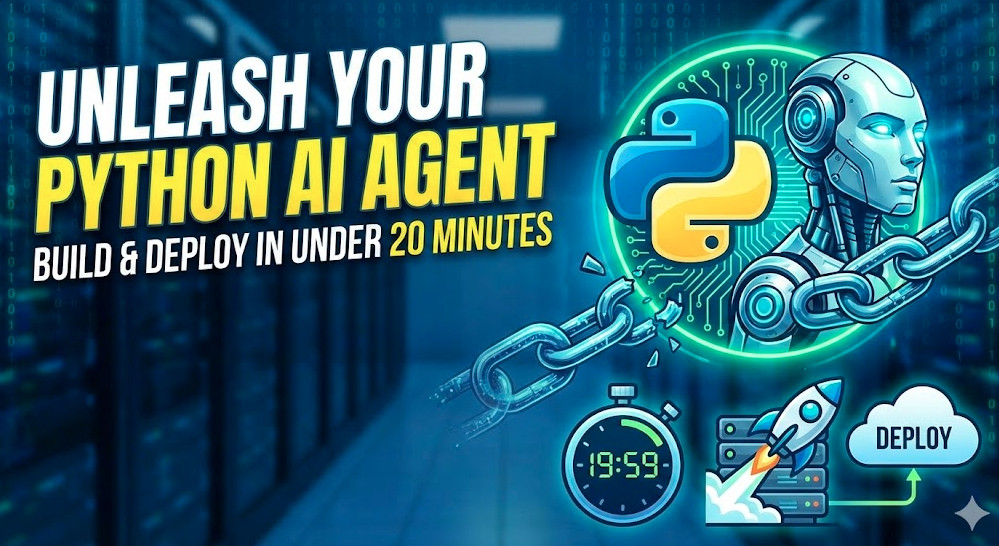
To deploy this “under 20 minutes,” we need a Dockerfile that leverages caching and multi-stage builds to keep the image size low and secure.
# Use a slim python image for smaller attack surface
FROM python:3.11-slim as builder

WORKDIR /app

# Install dependencies
COPY requirements.txt .
RUN pip install --no-cache-dir -r requirements.txt

# Copy source code
COPY . .

# Runtime configuration
ENV PORT=8080
EXPOSE 8080

# Use array syntax for CMD to handle signals correctly
CMD ["uvicorn", "main:api", "--host", "0.0.0.0", "--port", "8080"]
Security Note: Never bake your
OPENAI_API_KEYinto the Docker image. Inject it as an environment variable or a Kubernetes Secret at runtime.
7. Advanced Patterns: Memory & Observability
Once your Python AI Agent is live, two problems emerge immediately: context window limits and “black box” behavior.
Vector Memory
For long-term memory, simply passing the full history becomes expensive. Implementing a RAG (Retrieval-Augmented Generation) memory store allows the agent to recall specific details from past conversations without reloading the entire context.
The relevance of a memory is often calculated using Cosine Similarity:
$$ \text{similarity} = \cos(\theta) = \frac{\mathbf{A} \cdot \mathbf{B}}{\|\mathbf{A}\| \|\mathbf{B}\|} $$
Where $\mathbf{A}$ is the query vector and $\mathbf{B}$ is the stored memory vector.
Observability
You cannot improve what you cannot measure. Integrate tools like LangSmith or Arize Phoenix to trace the execution steps inside your graph. This allows you to pinpoint exactly which tool call failed or where the latency bottleneck exists.
8. Frequently Asked Questions (FAQ)
How do I reduce the latency of my Python AI Agent?
Latency usually comes from the LLM generation tokens. To reduce it: 1) Use faster models (GPT-4o or Haiku) for routing and heavy models only for complex reasoning. 2) Implement semantic caching (Redis) for identical queries. 3) Stream the response to the client using FastAPI’s StreamingResponse so the user sees the first token immediately.
Can I run this agent locally without an API key?
Yes. You can swap ChatOpenAI for ChatOllama using Ollama. This allows you to run models like Llama 3 or Mistral locally on your machine, though you will need significant RAM/VRAM.
How do I handle authentication for the tools?
If your tools (e.g., a Jira or GitHub integration) require OAuth, do not let the LLM generate the token. Handle authentication at the middleware level or pass the user’s token securely in the configurable config of the graph, injecting it into the tool execution context safely.
9. Conclusion
Building a Python AI Agent has evolved from a scientific experiment to a predictable engineering discipline. By combining the cyclic graph capabilities of LangGraph with the type safety of Pydantic and the scalability of Docker/FastAPI, you can deploy agents that are not just cool demos, but reliable enterprise assets.
The next step is to add “human-in-the-loop” breakpoints to your graph, ensuring that your agent asks for permission before executing high-stakes tools. The code provided above is your foundation—now build the skyscraper. Thank you for reading the DevopsRoles page!