
The Generative AI revolution has fundamentally altered the landscape of enterprise computing. Large Language Models (LLMs) promise unprecedented productivity gains, enabling everything from advanced code generation to complex data synthesis. As organizations rush to integrate these powerful tools, the deployment architecture has become a critical concern.
Many teams, understandably, default to the most robust container orchestration platform available: Kubernetes (K8s). K8s provides unparalleled control over networking, resource isolation, and deployment lifecycle management. It is, without question, the backbone of modern cloud-native infrastructure.
However, relying on K8s alone to define the LLM security boundary is a dangerous architectural fallacy.
K8s secures the container, the network, and the runtime environment. It does not, and cannot, inherently secure the data flow, the model logic, or the semantic integrity of the input prompts and outputs. The attack surface shifts dramatically when the primary asset is not a database or a microservice, but the highly malleable, context-aware nature of the LLM itself.
This comprehensive guide will guide senior DevOps, MLOps, and SecOps engineers through the critical architectural layers required to establish a true, multi-faceted LLM security boundary. We will move beyond simple network policies and dive deep into model-aware security controls, data governance, and advanced runtime validation.

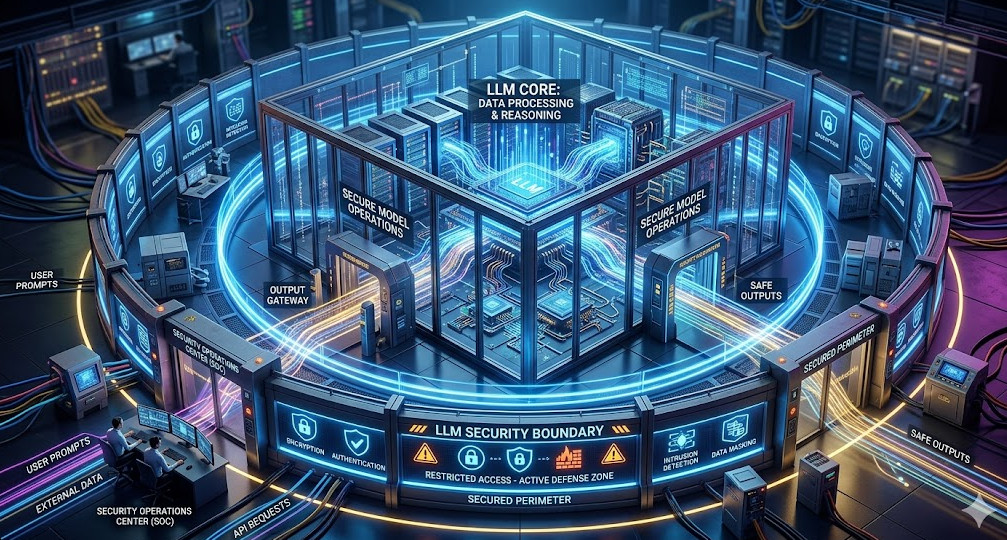
Table of Contents
Phase 1: Understanding the Architectural Gap (Why K8s Fails)
To properly secure an LLM application, we must first understand where K8s’s security guarantees end. K8s operates on the principle of network segmentation and process isolation. It assumes that the workload running inside the pod is behaving according to its defined parameters.
LLMs, however, introduce entirely new classes of vulnerabilities that are semantic, not purely infrastructural.
The Nature of LLM Vulnerabilities
The core risk is that the input prompt itself becomes a vector for attack. This leads to vulnerabilities like:
- Prompt Injection: An attacker crafts input designed to hijack the model’s instructions, forcing it to ignore system prompts or reveal sensitive context.
- Data Exfiltration via Context: The model, when prompted incorrectly, might inadvertently leak proprietary information that was provided in the system context or the Retrieval-Augmented Generation (RAG) vector store.
- Model Poisoning/Drift: While harder to prevent purely at the infrastructure layer, the risk exists that the model’s operational context is manipulated to degrade performance or introduce bias.
In these scenarios, the breach isn’t a network exploit (like a port scan); it’s a logical exploit that bypasses traditional perimeter defenses.
The Concept of the True LLM Security Boundary
A true LLM security boundary must be conceptualized as a series of layered, context-aware checkpoints, far exceeding the scope of a standard Kubernetes NetworkPolicy.
This boundary requires:
- Input Validation: Not just schema validation, but semantic validation (e.g., detecting jailbreaking attempts).
- Output Filtering: Ensuring the model’s response adheres to predefined safety guidelines, tone, and data types.
- Execution Sandboxing: Isolating the model’s interaction with external tools (e.g., preventing a model from executing arbitrary shell commands).
For a detailed look at the architectural limitations of K8s in this domain, we recommend reading the full analysis on Kubernetes is not an LLM Security Boundary.
Phase 2: Practical Implementation – Building the Multi-Layered Defense
Securing an LLM requires implementing controls at the API Gateway, the Application Layer, and the Model Runtime Layer.
1. The API Gateway Layer (The First Line of Defense)
The API Gateway (e.g., Kong, Istio Gateway, or specialized services like AWS API Gateway) must be the first point of inspection. It acts as a mandatory choke point for all incoming requests.
Implementation Focus: Rate limiting, authentication (OAuth 2.0/JWT), and crucially, input sanitization.
Instead of merely checking for JSON structure, the gateway must implement a basic prompt-level filter. This can involve using a smaller, dedicated, and highly secure model (a “guard model”) to classify the incoming prompt for malicious intent before it hits the expensive, core LLM.
# Example: Implementing a basic input validation policy using an API Gateway
# (Conceptual Policy Definition)
apiVersion: security.policy/v1
kind: InputGuardPolicy
metadata:
  name: llm-prompt-validator
spec:
  target_endpoint: /v1/generate
  pre_processing_hook: |
    # 1. Check for known injection keywords (e.g., 'ignore previous instructions')
    if (request.body.prompt.includes("ignore previous instructions")) {
      return {status: "REJECT", code: 403, reason: "Potential prompt injection detected."}
    }
    # 2. Check for excessive length or unusual character sets
    if (request.body.prompt.length > 4096) {
      return {status: "REJECT", code: 413, reason: "Prompt exceeds maximum allowed length."}
    }
    return {status: "ALLOW"};
2. The Application Layer (The Orchestrator)
The application code (the microservice calling the LLM) must act as the primary orchestrator, never blindly passing user input to the model.
Implementation Focus: Strict context management, prompt templating, and enforcing the System Prompt.
The System Prompt is the single most critical element. It defines the model’s persona, constraints, and rules. It must be treated as highly sensitive configuration, never derived from user input.
When using RAG, the application layer must ensure that the retrieved documents are strictly filtered and sanitized before they are concatenated into the prompt context. This prevents an attacker from injecting malicious data into the context window.
3. The Model Runtime Layer (The Final Checkpoint)
This is the most advanced layer. It involves specialized tools or services that sit directly between the application and the LLM API endpoint.
Implementation Focus: Output validation, toxicity scoring, and PII masking.
After the LLM generates a response, the application must never trust it implicitly. A dedicated output validator service must:
- Check for PII: Scan the output for patterns matching credit card numbers, SSNs, or emails, redacting or flagging them.
- Toxicity Scoring: Run the output through a separate, dedicated classification model (e.g., using open-source libraries like Detoxify) to ensure it meets content safety standards.
- Schema Enforcement: If the LLM is supposed to return JSON, the output validator must rigorously attempt to parse it and reject the response if the schema is violated.
💡 Pro Tip: When designing your internal API for LLM calls, never expose the raw LLM API key or endpoint directly to the consuming microservice. Instead, wrap it in a dedicated, internal LLM Proxy Service. This proxy service enforces all security policies (rate limiting, input/output validation) and centralizes logging, making it the single point of failure and the easiest point to audit.
Phase 3: Senior-Level Best Practices and Advanced Controls
For organizations operating at scale, the LLM security boundary must be treated as a continuous, observable, and adaptive system.
Observability and Drift Detection
A major failure point is the lack of visibility into model behavior. Standard logging (e.g., Kubernetes logs) only tells you that a request happened, not what the model did or why it failed.
Solution: Implement specialized observability tools that capture the full “prompt chain”—the user input, the system prompt, the retrieved context, and the final output.
Monitoring Focus: Monitor for “semantic drift.” This occurs when the model starts generating responses that deviate from the intended persona or scope, even if the input was benign.
Implementing Policy-as-Code for Guardrails
Instead of writing complex, brittle code blocks for every guardrail, adopt a Policy-as-Code framework like Open Policy Agent (OPA) or Kyverno.
OPA allows you to define policies that can be enforced at multiple points: the API Gateway, the CI/CD pipeline (checking for insecure model calls), and even at the Kubernetes Admission Controller level (ensuring only approved services can call the LLM endpoint).
# Example: OPA/Rego Policy Snippet for Context Length Enforcement
# This policy ensures that no service can pass a context payload exceeding 80% of the model's token limit.
package llm_guardrails
# Define the maximum allowable context size (e.g., 3200 tokens)
context_limit: 3200

# Rule to check the length of the retrieved context payload
violation_check {
    input.context_payload.token_count > context_limit
    msg := "Context payload exceeds safe token limit. Truncation required."
    violation := true
}
Advanced Data Governance: Vector Store Security
When using RAG, the vector store becomes a critical data asset. If an attacker can manipulate the search query or exploit the embedding process, they could force the model to retrieve irrelevant or malicious data.
Best Practice: Treat the vector store like a highly restricted database. Implement granular Role-Based Access Control (RBAC) not just on the database connection, but on the data schema itself. Use data masking and differential privacy techniques on the source documents before they are chunked and embedded.
💡 Pro Tip: For multi-tenant LLM applications, never use a single, shared vector store. Instead, enforce strict tenant isolation at the database level. This means the query mechanism must be inherently scoped to the requesting user’s tenant ID, preventing cross-tenant data leakage even if the query logic is compromised.
The DevOps Role in LLM Security
The security burden cannot rest solely on the SecOps team. The DevOps and MLOps teams must integrate security checks into the CI/CD pipeline itself.
This means:
- Security Testing: Automated testing for prompt injection vulnerabilities (using tools like LLM Guard or specialized fuzzing frameworks).
- Policy Enforcement: Using tools like OPA to validate that all deployed services adhere to the defined LLM security boundary policies before reaching production.
- Drift Monitoring: Integrating model performance metrics (latency, accuracy, and safety violation counts) into the primary observability dashboard.
By treating the LLM application not as a single microservice, but as a complex, multi-stage pipeline—each stage requiring its own specialized security gate—you can finally achieve a robust and defensible LLM security boundary. This holistic approach is essential for building enterprise-grade, trustworthy AI applications.
For a deeper dive into the operational roles required to manage these complex systems, explore our resources on DevOps roles.