Finding viable Kubernetes Alternatives is the smartest infrastructure move you can make this year.
I’ve spent three decades in the trenches building server architectures.
I remember the days of bare-metal provisioning, and I was there when Docker first changed the game.
Then came Kubernetes (K8s), promising to solve all our container orchestration problems.
But let’s be brutally honest for a second. K8s is a massive, complex beast.

Table of Contents
Why You Need Kubernetes Alternatives Now
For 90% of development teams, deploying Kubernetes is like using a sledgehammer to crack a peanut.
You probably don’t operate at Google’s scale.
So, why are you copying their internal tooling?
“I once watched a startup burn $40,000 a month on cloud bills and DevOps salaries just to keep a basic K8s cluster alive for a simple CRUD app.”
That is the reality nobody talks about at tech conferences.
The learning curve is virtually a vertical wall.
You have to master Pods, Deployments, Ingress Controllers, Services, and Helm charts.
YAML fatigue is a real medical condition in the DevOps world.
This is exactly why [Internal Link: Simplifying Your Cloud Architecture] is becoming a massive trend.
Teams are waking up and searching for reliable Kubernetes Alternatives to save time and money.
Evaluating the Best Kubernetes Alternatives
I have personally migrated dozens of clients away from failing K8s setups.
We moved them to leaner, faster, and cheaper container orchestration platforms.
Here are the systems that actually work in production.
1. Docker Swarm: The Dead Simple Kubernetes Alternative
I will defend Docker Swarm until my dying day.
It is built directly into the Docker engine.
If you know how to write a `docker-compose.yml` file, you already know Swarm.
- Pros: Zero learning curve, built-in load balancing, incredibly lightweight.
- Cons: Lacks some of the ultra-fine-grained scaling controls of K8s.
- Best for: Small to medium businesses that just want to ship code.
Setting up a Swarm cluster takes exactly one command.
# Initialize a Swarm manager node
docker swarm init --advertise-addr <YOUR_IP>

# Deploy your stack
docker stack deploy -c docker-compose.yml my_app
Boom. You have container orchestration without the headache.
For a deeper dive into Swarm’s capabilities, check out the official Docker documentation.
2. HashiCorp Nomad: The Elegant Workload Scheduler
If you want serious power without the K8s bloat, Nomad is your answer.
Nomad doesn’t just orchestrate containers.
It schedules plain Java applications, isolated binaries, and even virtual machines.
It is a single binary. Think about that for a second.
No multi-component control plane to constantly baby and patch.
- Flexibility: Runs anything, anywhere. Multi-region by default.
- Simplicity: Uses HashiCorp Configuration Language (HCL).
- Ecosystem: Integrates flawlessly with Consul and Vault.
Here is what a basic Nomad job looks like:
job "web-server" {
  datacenters = ["dc1"]

  group "frontend" {
    count = 3

    task "nginx" {
      driver = "docker"

      config {
        image = "nginx:latest"
        ports = ["http"]
      }
    }
  }
}
It is clean, readable, and doesn’t require a PhD in YAML engineering.
Cloudflare and Roblox use Nomad. It scales massively.
3. Amazon ECS (Elastic Container Service)
Are you already fully bought into the AWS ecosystem?
Then Amazon ECS is one of the most logical Kubernetes Alternatives available.
ECS is an opinionated, fully managed container orchestration service.
It cuts out the control plane management entirely.
When you pair ECS with AWS Fargate, the magic really happens.
Fargate is serverless compute for containers.
You literally just specify the CPU and memory your container needs.
AWS handles the underlying servers completely behind the scenes.
- No patching EC2 instances.
- No capacity planning for cluster nodes.
- Deep integration with AWS IAM and CloudWatch.
The downside? You are locked into AWS.
But let’s be real, most companies aren’t migrating clouds anyway.
4. Azure Container Apps
Microsoft has quietly built a massive competitor in this space.
Azure Container Apps is perfect for microservices.
It is built *on top* of Kubernetes, but it hides all the K8s garbage from you.
You get the power without the administrative nightmare.
It integrates beautifully with KEDA (Kubernetes Event-driven Autoscaling).
This means your containers can scale to zero when there is no traffic.
Scaling to zero saves you an absolute fortune on your monthly cloud bill.
If you are a .NET shop or deep in the Microsoft stack, start here.
How to Choose Between These Kubernetes Alternatives
So, how do you actually make a decision?
Stop listening to hype and look at your team’s current skill set.
If you only have two developers, do not install Nomad or K8s.
Use Docker Swarm or a managed service like AWS App Runner.
If you have a dedicated operations team managing complex, mixed workloads?
That is when you start looking at HashiCorp Nomad.
Cost is another massive factor.
Managed services like ECS are cheap to start but expensive at massive scale.
Self-hosting Swarm or Nomad on bare metal is insanely cheap.
But you pay for it in operational responsibility.
Read the recent industry shifts on container orchestration trends to see why companies are moving.
The Hidden Costs of Sticking with K8s
Let’s talk about the specific financial drain of ignoring simpler options.
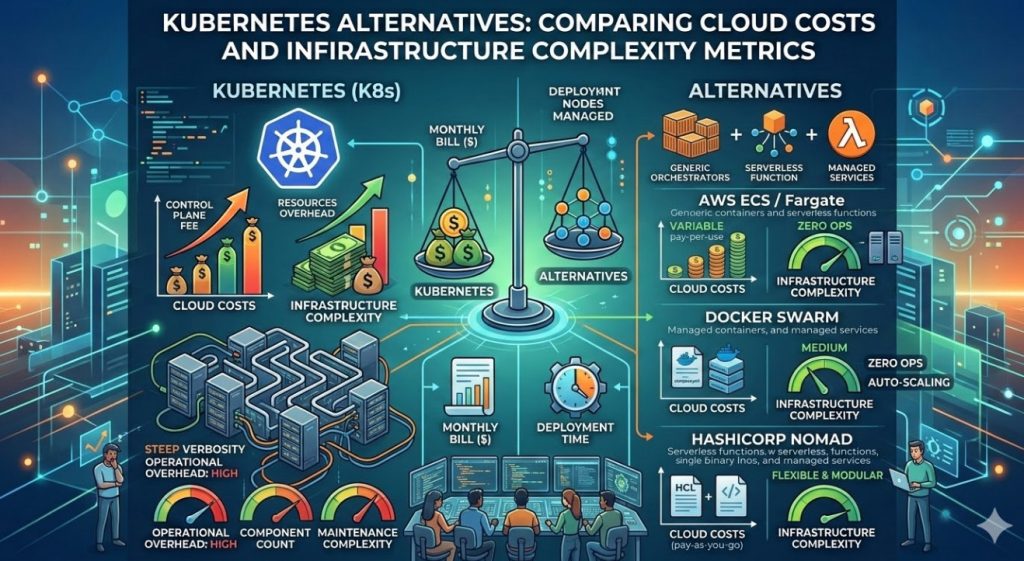
First, there is the “K8s Tax.”
Just running the control plane on AWS (EKS) costs around $70 a month.
That is before you run a single line of your own code.
Then, you have resource overhead.
K8s components (kubelet, kube-proxy) consume RAM and CPU on every worker node.
You often need larger instances just to support the orchestrator.
Compare that to Docker Swarm, which has almost zero overhead.
Finally, there is the talent cost.
A Senior Kubernetes Administrator commands a massive salary.
Finding good ones is incredibly difficult in today’s market.
If they leave, your infrastructure knowledge walks out the door with them.
Using simpler Kubernetes Alternatives democratizes your operations.
Any competent mid-level backend engineer can manage Docker Swarm.
FAQ on Kubernetes Alternatives
Are Kubernetes Alternatives secure enough for enterprise use?
Absolutely. Tools like HashiCorp Nomad are used by massive financial institutions.
Security is more about how you configure your network, secrets, and access controls.
Complexity is often the enemy of security.
A simple, well-understood Swarm cluster is more secure than a misconfigured K8s cluster.
Can I migrate from Kubernetes to a simpler alternative?
Yes, and I do it for clients frequently.
Your applications are already containerized, which is the hard part.
You simply need to translate your YAML manifests into the new format.
Moving from K8s to Amazon ECS is a very common migration path.
Will I miss out on the CNCF ecosystem?
This is a valid concern.
Many modern cloud-native tools assume you are running Kubernetes.
However, major tools like Prometheus, Grafana, and Traefik work perfectly with Swarm and Nomad.
You might have to configure them manually rather than using a Helm chart.
Conclusion:
You do not need to follow the herd off a cliff.
Container orchestration should make your life easier, not give you ulcers.
By evaluating these Kubernetes Alternatives, you can reclaim your time.
Stop wrestling with YAML and get back to shipping features your customers actually care about.
Would you like me to analyze your specific tech stack to recommend the perfect orchestration tool for your team? Thank you for reading the DevopsRoles page!