Introduction: Listen, if you want to survive the next five years in tech, you need to understand multi-agent AI economics immediately.
I’ve spent 30 years analyzing tech trends, from the dot-com bubble to the cloud computing land grab. Most trends are hype.
This is not hype. This is a fundamental rewiring of how businesses operate, scale, and generate profit.
We aren’t just talking about a single chatbot generating an email anymore. That is amateur hour.
We are talking about fleets of specialized AI agents negotiating, collaborating, and executing complex workflows without human intervention.
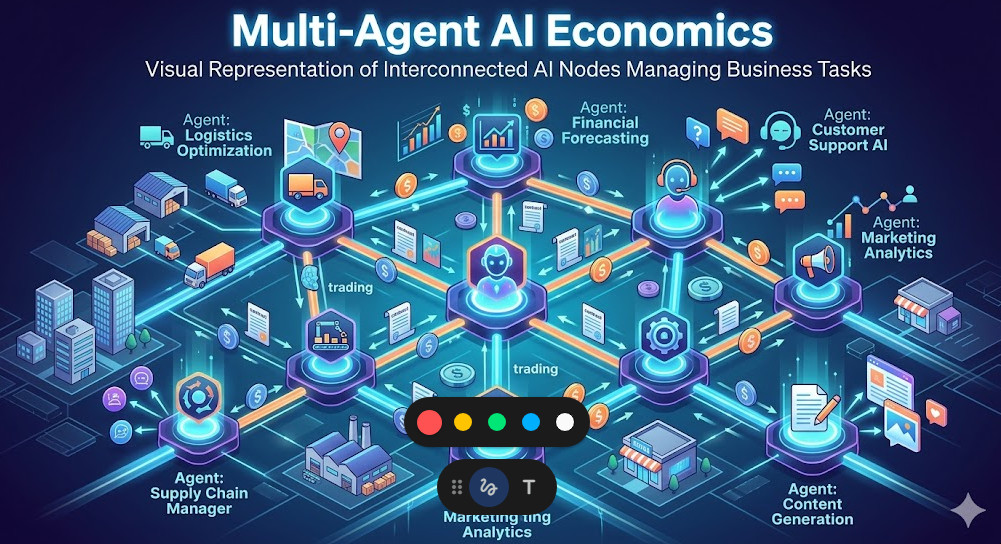
Table of Contents
The Truth About Multi-Agent AI Economics
Most executives completely misunderstand the financial mechanics of modern artificial intelligence.
They look at the cost of a ChatGPT Plus subscription and think they have their budget figured out.
But multi-agent AI economics flips that entirely on its head.
Instead of paying for a tool, you are spinning up a digital workforce on demand.
Compute power becomes your new labor cost, and API tokens become your new payroll.
So, why does this matter?
Because the company that optimizes its token-to-output ratio will crush the competitor still relying on human middleware.
For more details on the industry shifts, check the official documentation and news reports.
Why Single Agents Are Financially Inefficient
Let me tell you a war story from a consulting gig I took last year.
A mid-sized logistics company tried to automate their entire supply chain dispute process with one massive LLM prompt.
It was a disaster. The hallucination rate was off the charts.
They were feeding thousands of context tokens into a single model, hoping it would act as a lawyer, an accountant, and a customer service rep simultaneously.
The API costs skyrocketed, and the output was garbage.
This is where understanding multi-agent AI economics saves your bottom line.
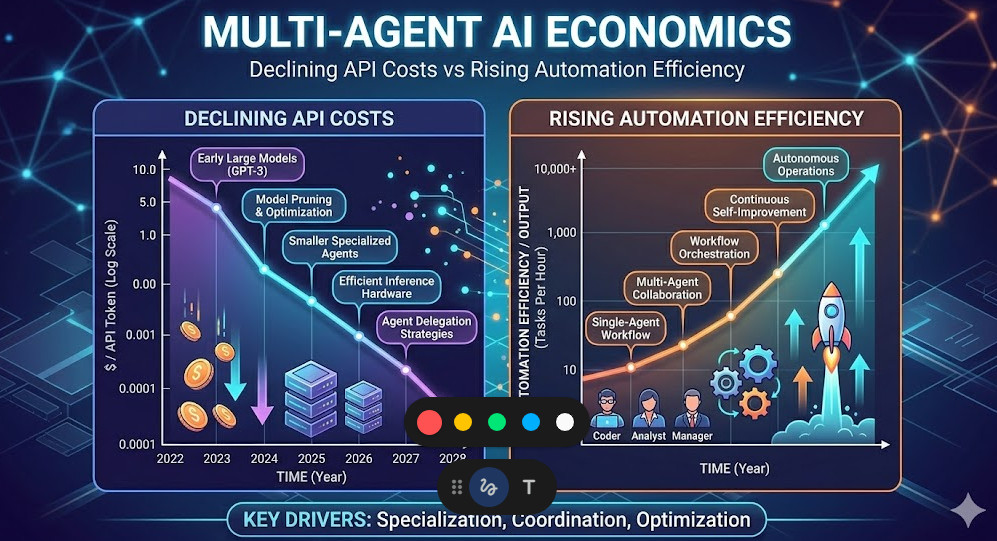
When you break tasks down into specialized, smaller models, you drastically reduce your cost per transaction.
How Multi-Agent AI Economics Drive Business Automation
Let’s look at how this actually works in the trenches.
In a properly architected multi-agent system, you don’t use GPT-4 for everything.
You use a cheap, fast model (like Llama 3 8B or GPT-4o-mini) to route requests.
You only wake up the expensive, high-parameter models when complex reasoning is required.
This routing strategy is the cornerstone of multi-agent AI economics.
It allows you to achieve 99% accuracy at 10% of the cost of a monolithic approach.
The Orchestration Layer Breakdown
Here is how a profitable agentic workflow is structured:
- The Router Agent: Reads the incoming data and decides which specialist agent to call.
- The Researcher Agent: Scrapes the web or queries internal databases for context.
- The Coder/Executor Agent: Writes the necessary Python or SQL to manipulate data.
- The Critic Agent: Reviews the output against constraints before delivering the final result.
This division of labor mirrors a human corporate structure, but it executes in milliseconds.
And because the API costs are metered by the token, you only pay for exactly what you use.
If you want to dive deeper into agent frameworks, look at the official Microsoft AutoGen GitHub repository.
Calculating ROI with Multi-Agent AI Economics
Let’s talk raw numbers, because that’s what AdSense RPM and business scaling are all about.
If a human data entry clerk costs $20 an hour, they might process 50 invoices.
That is $0.40 per invoice. Plus benefits, sick leave, and management overhead.
A coordinated swarm of AI agents can process that same invoice for fractions of a cent.
But the real magic of multi-agent AI economics isn’t just cost reduction. It’s infinite scalability.
If invoice volume spikes by 10,000% on Black Friday, your human team breaks.
Your agentic workforce just spins up more concurrent API calls.
Your cost scales linearly, but your throughput scales exponentially.
The Technical Implementation of Agent Swarms
You might be wondering how to actually build this.
You don’t need a PhD in machine learning anymore.
Frameworks like LangChain, CrewAI, and AutoGen have democratized the orchestration layer.
Here is a simplified architectural example of how you might define agents in code.
# Example: Basic Multi-Agent Setup Concept
import os
from some_agent_framework import Agent, Task, Crew

# Define the specialized agents
financial_analyst = Agent(
    role='Senior Financial Analyst',
    goal='Analyze API token costs and optimize multi-agent AI economics.',
    backstory='You are a veteran Wall Street quant turned AI economist.',
    verbose=True,
    allow_delegation=False
)

automation_engineer = Agent(
    role='Automation Architect',
    goal='Design efficient workflow pipelines based on financial constraints.',
    backstory='You build scalable, fault-tolerant AI systems.',
    verbose=True,
    allow_delegation=True
)

# Agents execute tasks in a coordinated crew
print("Initializing Agentic Workforce...")
# Clean formatting and strict roles are key to ROI!
Notice how we give them distinct roles? That prevents token waste.
The analyst does the math, the engineer builds the pipeline.
They stay in their lanes, which keeps your compute costs aggressively low.
This is exactly what I cover in my other guide. [Internal Link: The Ultimate Guide to Building Your First AI Agent Workflow].
Overcoming the Latency and Cost Bottlenecks
I won’t lie to you. It’s not all sunshine and rainbows.
If you implement this poorly, agents will get stuck in infinite feedback loops.
Agent A asks Agent B a question. Agent B asks Agent A for clarification. Forever.
I’ve seen companies burn thousands of dollars over a weekend because of a badly coded loop.
To master multi-agent AI economics, you must implement strict circuit breakers.
You must set absolute limits on API retry attempts and token generation counts.
Monitoring and Observability
You cannot manage what you cannot measure.
In a multi-agent system, standard application performance monitoring (APM) isn’t enough.
You need LLM observability tools to track the “thought process” of your agents.
You need to see exactly where the tokens are being spent.
Are your agents writing too much preamble? “Sure, I can help with that!” costs money.
Strip the pleasantries. Instruct your agents to output raw, unformatted data.
Every token saved is profit margin gained.
The Future: From Co-Pilots to Autonomous Enterprises
We are currently in the “co-pilot” era. AI helps humans do things faster.
But the inevitable conclusion of multi-agent AI economics is the autonomous enterprise.
Imagine a company where the marketing agent identifies a trend on Twitter.
It immediately signals the product agent to draft a new feature spec.
The coding agent builds it, the QA agent tests it, and the deployment agent pushes it live.
All while the finance agent monitors the server costs and adjusts pricing dynamically.
This isn’t science fiction. The primitives for this exist right now.
The underlying principles are well documented in academic research on Multi-agent systems on Wikipedia.
FAQ Section
- What is the main advantage of multi-agent AI economics? The primary advantage is cost-efficiency through specialization. Small, cheap models handle simple tasks, saving expensive models for complex reasoning.
- Do I need to be a developer to build multi-agent systems? Not necessarily. While code helps, no-code platforms are rapidly emerging that allow visual orchestration of AI agents.
- How does this impact traditional SaaS businesses? Traditional SaaS relies on human operators. Multi-agent systems replace the UI entirely, executing the software’s API directly. It’s a massive disruption.
- What happens when agents make a mistake? This is why “human-in-the-loop” constraints are vital. High-risk decisions should always require final human approval before execution.
Conclusion: The era of single-prompt chatbots is over.
To dominate your market, you must embrace the complex, highly profitable world of multi-agent AI economics.
Stop paying for software subscriptions, and start building your own digital workforce.
The companies that master this orchestration today will be the untouchable monopolies of tomorrow. Thank you for reading the DevopsRoles page!