Introduction: Let’s be honest: testing emails in a distributed system is usually an afterthought. But effective Email Flow Validation is the difference between a seamless user onboarding experience and a support ticket nightmare.
I remember the first time I deployed a microservice that was supposed to send “password reset” tokens. It worked perfectly on my local machine.
In production? Crickets. The queue was blocked, and the SMTP relay rejected the credentials.
Table of Contents
Why Traditional Email Flow Validation Fails
In the monolith days, testing emails was easy. You had one application, one database, and likely one mail server connection.
Today, with microservices, the complexity explodes.
Your “Welcome Email” might involve an Auth Service, a User Service, a Notification Service, and a Message Queue (like RabbitMQ or Kafka) sitting in between.
Standard unit tests mock these interactions. They say, “If I call the send function, assume it returns true.”
But here is the problem:
- Mocks don’t catch network latency issues.
- Mocks don’t validate that the HTML template actually renders correctly.
- Mocks don’t verify if the email subject line was dynamically populated.
True Email Flow Validation requires a real integration test. You need to see the email land in an inbox, parse it, and verify the contents.
The DevOps Approach to Email Testing
To solve this, we need to treat email as a traceable infrastructure component.
We shouldn’t just “fire and forget.” We need a feedback loop. This is where DevOps principles shine.
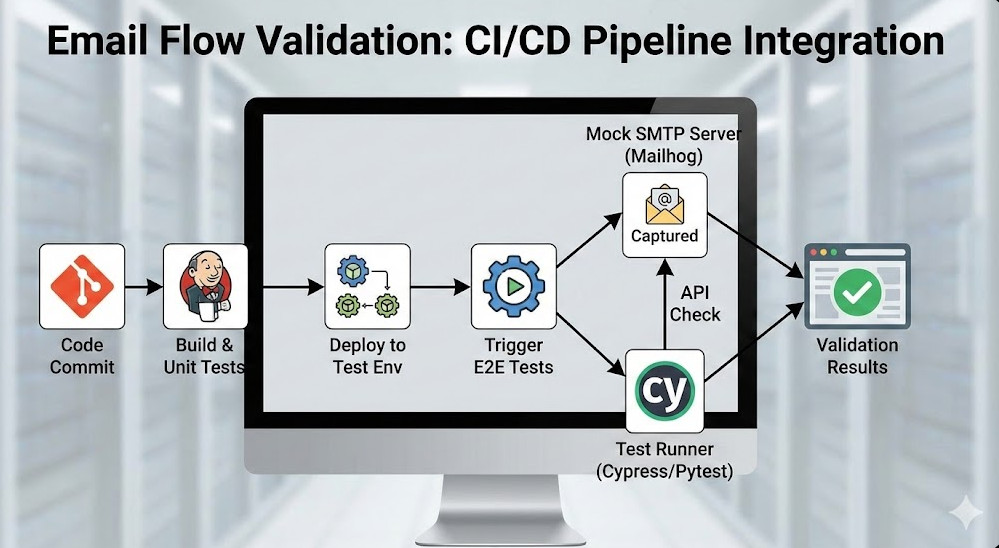
By integrating tools like Mailhog or Mailtrap into your CI/CD pipeline, you can create ephemeral SMTP servers. These catch outgoing emails during test runs, allowing your test suite to query them via API.
This transforms Email Flow Validation from a manual check into an automated gatekeeper.
Architecture Overview
Here is how a robust validation flow looks in a DevOps environment:
- Trigger: The test suite triggers an action (e.g., User Registration).
- Process: The microservice processes the request and publishes an event.
- Consumption: The Notification Service consumes the event and sends an SMTP request.
- Capture: A containerized SMTP mock (like Mailhog) captures the email.
- Validation: The test suite queries the SMTP mock API to verify the email arrived and contains the correct link.
Step-by-Step Implementation
Let’s get our hands dirty. We will set up a local environment that mimics this flow.
We will use Docker Compose to spin up our services alongside Mailhog for capturing emails.
1. Setting up the Infrastructure
First, define your services. We need our application and the mail catcher.
version: '3.8'
services:
  app:
    build: .
    environment:
      - SMTP_HOST=mailhog
      - SMTP_PORT=1025
    depends_on:
      - mailhog

  mailhog:
    image: mailhog/mailhog
    ports:
      - "1025:1025" # SMTP port
      - "8025:8025" # Web UI / API
This configuration ensures that when your app tries to send an email, it goes straight to Mailhog. No real users get spammed.
2. Writing the Validation Test
Now, let’s look at the code. This is where the magic of Email Flow Validation happens.
We need a script that triggers the email and then asks Mailhog, “Did you get it?”
Here is a Python example using `pytest` and `requests`:
import requests
import time

def test_registration_email_flow():
    # 1. Trigger the registration
    response = requests.post("http://localhost:3000/register", json={
        "email": "test@example.com",
        "password": "securepassword123"
    })
    assert response.status_code == 201

    # 2. Wait for async processing (crucial in microservices)
    time.sleep(2)

    # 3. Query Mailhog API for Email Flow Validation
    mailhog_url = "http://localhost:8025/api/v2/messages"
    messages = requests.get(mailhog_url).json()

    # 4. Filter for our specific email
    email_found = False
    for msg in messages['items']:
        if "test@example.com" in msg['Content']['Headers']['To'][0]:
            email_found = True
            body = msg['Content']['Body']
            assert "Welcome" in body
            assert "Verify your account" in body
            break

    assert email_found, "Email was not captured by Mailhog"
This script is simple but powerful. It validates the entire chain, not just the function call.
For more robust API testing strategies, check out the Cypress Documentation.
Handling Asynchronous Challenges
In microservices, things don’t happen instantly. The “eventual consistency” model means your email might send 500ms after your test checks for it.
This is the most common cause of flaky tests in Email Flow Validation.
Do not use static `sleep` timers like I did in the simple example above. In a real CI environment, 2 seconds might not be enough.
Instead, use a polling mechanism (retry logic) that checks the mailbox every 500ms for up to 10 seconds.
Advanced Polling Logic
def wait_for_email(recipient, timeout=10):
    start_time = time.time()
    while time.time() - start_time < timeout:
        messages = requests.get("http://localhost:8025/api/v2/messages").json()
        for msg in messages['items']:
            if recipient in msg['Content']['Headers']['To'][0]:
                return msg
        time.sleep(0.5)
    raise Exception(f"Timeout waiting for email to {recipient}")
Tools of the Trade
While we used Mailhog above, several tools can elevate your Email Flow Validation strategy.
- Mailhog: Great for local development. Simple, lightweight, Docker-friendly.
- Mailtrap: Excellent for staging environments. It offers persistent inboxes and team features.
- AWS SES Simulator: If you are heavy on AWS, you can use their simulator, though it is harder to query programmatically.
Choosing the right tool depends on your specific pipeline needs.
Common Pitfalls to Avoid
I have seen many teams fail at this. Here is what you need to watch out for.
1. Ignoring Rate Limits
If you run parallel tests, you might flood your mock server. Ensure your Email Flow Validation infrastructure can handle the load.
2. Hardcoding Content Checks
Marketing teams change email copy all the time. If your test fails because “Welcome!” changed to “Hi there!”, your tests are too brittle.
Validate the structure and critical data (like tokens or links), not the fluff.
3. Forgetting to Clean Up
After a test run, clear the Mailhog inbox. If you don’t, your next test run might validate an old email from a previous session.
# Example API call to delete all messages in Mailhog
curl -X DELETE http://localhost:8025/api/v1/messages
Why This Matters for SEO and User Trust
You might wonder, “Why does a journalist care about email testing?”
Because broken emails break trust. If a user can’t reset their password, they churn. If they churn, your traffic drops.
Reliable Email Flow Validation ensures that your transactional emails—the lifeblood of user retention—are always functioning.
For further reading on the original inspiration for this workflow, check out the source at Dev.to.
FAQ Section
- Can I use Gmail for testing?
Technically yes, but you will hit rate limits and spam filters immediately. Use a mock server. - How do I test email links?
Parse the email body (HTML or Text), extract the href using Regex or a DOM parser, and have your test runner visit that URL. - Is this relevant for monoliths?
Absolutely. While Email Flow Validation is critical for microservices, monoliths benefit from the same rigor.

Conclusion: Stop guessing if your emails work. By implementing a robust Email Flow Validation strategy within your DevOps pipeline, you gain confidence, reduce bugs, and sleep better at night. Start small, dockerize your mail server, and automate the loop. Thank you for reading the DevopsRoles page!