
Introduction: I have been building and breaking servers for three decades, and let me tell you, MicroVM Isolation is the exact technology we need right now.
We are currently handing autonomous AI agents the keys to our infrastructure.
That is absolutely terrifying. A hallucinating Large Language Model (LLM) with access to a standard container is just one bad prompt away from wiping your entire production database.
Standard Docker containers are great for trusted code, but they share the host kernel. That means a clever exploit can bridge the gap from the container to your bare metal.
This is where NanoClaw changes the game completely.
By bringing strict, hardware-level boundaries to standard developer workflows, NanoClaw is finally making it safe to let AI agents write, test, and execute arbitrary code on the fly.

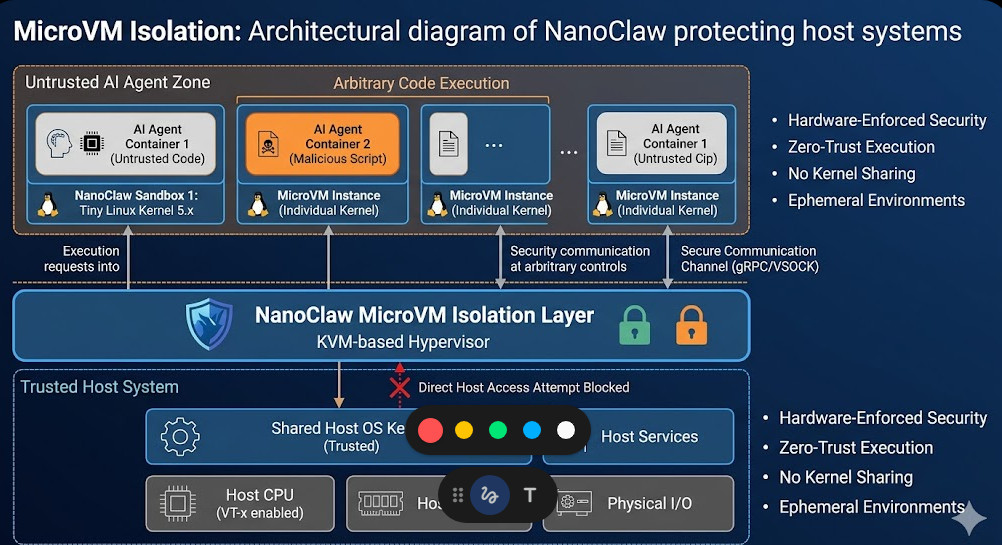
Table of Contents
The Terrifying Reality of Autonomous AI Agents
I remember the early days of cloud computing when we trusted hypervisors implicitly.
We ran untrusted code all the time because the hypervisor boundary was solid steel. Then came the container revolution. We traded that steel vault for a thin layer of drywall just to get faster boot times.
For microservices written by your own engineering team, that trade-off makes sense. You trust your team (mostly).
But AI agents? They are chaotic, unpredictable, and highly susceptible to prompt injection attacks.
If you give an AI agent a standard bash environment to run its Python scripts, you are asking for a massive security breach.
It’s not just theory. I’ve seen systems completely compromised because an agent was tricked into downloading and executing a malicious binary from a third-party server.
So, why does this matter so much today?
Because the future of tech relies entirely on autonomous agents doing the heavy lifting. If we can’t secure them, the entire ecosystem stalls.
Why MicroVM Isolation is the Ultimate Failsafe
Enter the concept of the micro-virtual machine. It is exactly what it sounds like.
Instead of sharing the operating system kernel like a standard container, a microVM runs its own tiny, stripped-down kernel.
MicroVM Isolation gives you the strict, hardware-enforced boundaries of a traditional virtual machine, but it boots in milliseconds.
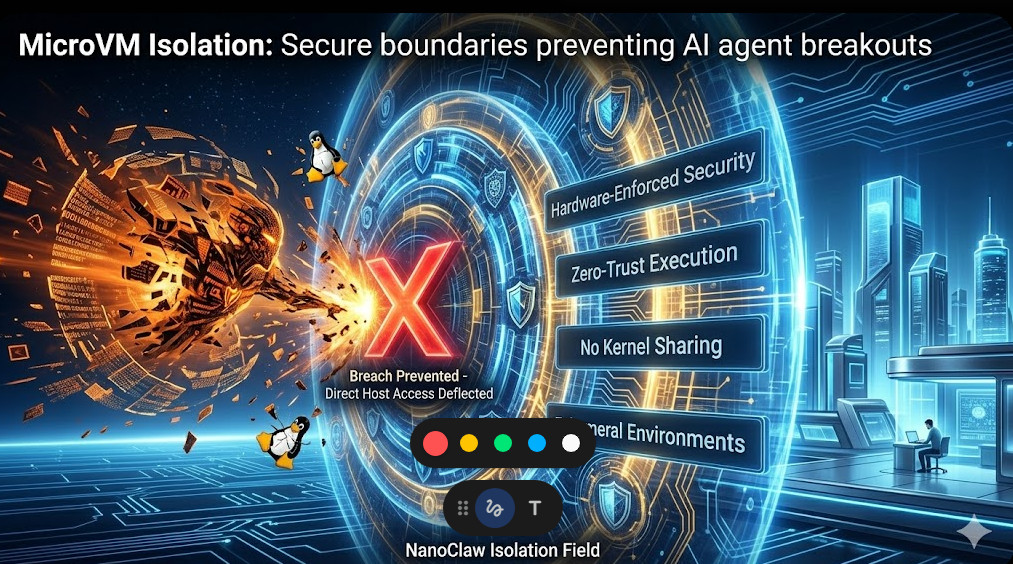
This means if an AI agent goes rogue and manages to trigger a kernel panic or execute a privilege escalation exploit, it only destroys its own tiny, isolated kernel.
Your host machine? Completely unaffected.
Your other AI agents running on the same server? Blissfully unaware that a digital bomb just went off next door.
This is the holy grail of cloud security. We’ve wanted this since 2015, but the tooling was always too complex for the average development team to adopt.
How MicroVM Isolation Beats Standard Containers
Let’s break down the technical differences, because the devil is always in the details.
- Kernel Sharing: Containers share the host’s Linux kernel. MicroVMs do not.
- Attack Surface: A container has access to hundreds of system calls. A microVM environment drastically reduces this.
- Resource Overhead: Traditional VMs take gigabytes of RAM. MicroVMs take megabytes.
- Boot Time: VMs take minutes. Containers take seconds. MicroVMs take fractions of a second.
NanoClaw essentially gives you the speed of a container with the bulletproof vest of a virtual machine.
To really understand the foundation of this tech, I highly recommend reading up on how a modern Hypervisor actually manages memory paging and CPU scheduling.
Inside NanoClaw’s Architecture
So how does NanoClaw actually pull this off without making developers learn a completely new ecosystem?
They use Docker sandboxes.
You write your standard Dockerfile. You define your dependencies exactly the same way you have for the last ten years.
But when you run the container via NanoClaw, it intercepts the execution. Instead of spinning up a standard runC process, it wraps your container in a lightweight hypervisor.
It is brilliant in its simplicity. You don’t have to rewrite your CI/CD pipelines.
You don’t have to train your junior developers on obscure virtualization concepts.
You just change the runtime flag, and suddenly, your AI agent is trapped in an inescapable box.
Setting Up NanoClaw for MicroVM Isolation
I hate articles that talk about theory without showing the code. Let’s get our hands dirty.
Here is exactly how you spin up an isolated environment for an AI agent to execute arbitrary Python code.
First, you need to configure your agent’s runtime environment. Notice how standard this looks.
import nanoclaw
from nanoclaw.config import SandboxConfig

# Initialize the NanoClaw client
client = nanoclaw.Client(api_key="your_secure_api_key")

# Define strict isolation parameters
config = SandboxConfig(
    image="python:3.11-slim",
    memory_limit="256m",
    cpu_cores=1,
    network_egress=False # Crucial for security!
)

def run_agent_code(untrusted_code: str):
    """Executes AI-generated code safely."""
    try:
        # MicroVM Isolation is enforced at the runtime level here
        sandbox = client.create_sandbox(config)
        result = sandbox.execute(untrusted_code)
        print(f"Agent Output: {result.stdout}")
    except Exception as e:
        print(f"Sandbox contained a failure: {e}")
    finally:
        sandbox.destroy() # Ephemeral by design
Look at that network egress flag. By setting it to false, you completely neuter any attempt by the AI to phone home or exfiltrate data.
Even if the AI writes a perfect script to scrape your environment variables, it has nowhere to send them.
For a deeper dive into the exact API parameters, check the official documentation provided in the recent release notes.
5 Golden Rules for Securing AI
Just because you have a shiny new tool doesn’t mean you can ignore basic security hygiene.
I’ve audited dozens of startups that claimed they were “secure by design,” only to find glaring misconfigurations.
If you are implementing this tech, you must follow these rules without exception.
- Read-Only Root Filesystems: Never let the AI modify the underlying OS. Mount a specific, temporary `/workspace` directory for it to write files.
- Drop All Capabilities: By default, drop all Linux capabilities (`–cap-drop=ALL`). The AI agent does not need to change file ownership or bind to privileged ports.
- Ephemeral Lifespans: Kill the sandbox after every single task. Never reuse a microVM for a second prompt. State is the enemy of security.
- Strict Timeouts: AI agents can accidentally write infinite loops. Hard-kill the sandbox after 30 seconds to prevent resource exhaustion.
- Audit Everything: Log every standard output and standard error stream. You need to know exactly what the agent tried to do, even if it failed.
Implementing these rules will save you from 99% of zero-day exploits.
If you want to read more about locking down your pipelines, check out my [Internal Link: Ultimate Guide to AI Agent Security].
The Hidden Costs of MicroVM Isolation
I always promise to be brutally honest with you. There is no free lunch in computer science.
While this technology is incredible, it does come with a tax.
First, there is the cold start time. Yes, it is fast, but it is not instantaneous. We are talking roughly 150 to 250 milliseconds of overhead.
If your AI application requires real-time, sub-millisecond responses, this latency will be noticeable.
Second, memory density on your host servers will decrease. A micro-kernel still requires base memory that a shared container does not.
You won’t be able to pack quite as many isolated agents onto a single EC2 instance as you could with raw Docker containers.
But ask yourself this: What is the cost of a data breach?
I will gladly pay a 20% infrastructure premium to guarantee my customer data is not accidentally leaked by an overzealous AutoGPT clone.
It is an insurance policy, plain and simple.
You can read more about standard container management and resource tuning directly on the Docker Docs.
Frequently Asked Questions
I get a ton of emails about this architecture. Let’s clear up the most common misconceptions.
- Is this just AWS Firecracker?
Under the hood, NanoClaw relies on similar KVM-based virtualization technology. However, NanoClaw provides a developer-friendly API layer specifically tuned for AI agent execution, abstracting away the brutal networking setup Firecracker usually requires. - Does MicroVM Isolation support GPU acceleration?
This is the tricky part. Passing a GPU through a strict hypervisor boundary while maintaining isolation is notoriously difficult. Currently, it’s best for CPU-bound tasks like executing Python scripts or analyzing text files. - Will this break my current Docker-compose setup?
No. You can run your databases and standard APIs in normal containers, and only spin up NanoClaw sandboxes dynamically for the specific untrusted agent execution steps. - Can an AI agent escape a microVM?
Nothing is 100% hack-proof. However, escaping a microVM requires a hypervisor zero-day exploit. These are exceptionally rare, incredibly expensive, and far beyond the capabilities of a hallucinating language model.

Conclusion: We are standing at a critical juncture in software development.
The transition from static code to autonomous agents requires a fundamental shift in how we think about infrastructure security.
By leveraging MicroVM Isolation, platforms like NanoClaw are giving us the tools to innovate rapidly without gambling our company’s reputation.
Stop trusting your AI models. Start isolating them. Implement sandboxing today, before your autonomous agent decides your production database is holding it back. Thank you for reading the DevopsRoles page!